Train Your Brain to Manage Information
Welcome to the Course 🎉
Welcome to Train Your Brain to Manage Information! Critical thinking is not just about analyzing problems—it's about cultivating habits and mental disciplines that enable clear thinking when it counts. Inspired by Srini Pillay's insights from the HBR Guide to Critical Thinking, you'll learn to manage the flood of information vying for your attention, turning insightful analysis into confident action.
In this lesson, you'll explore techniques to enhance how you process information. You'll learn to harness different mental modes, filtering tactics, and the value of strategic breaks to improve your thinking under pressure. By mastering these skills, you'll make thoughtful decisions, learn from experience, and enhance your leadership capabilities. Let's begin by addressing one of the most fundamental obstacles to clear thinking: the sheer volume of information your brain must process every day.
Select the Right Mental Mode 🧠
Our brains are sophisticated but can often function on autopilot. To think critically, it's important to choose the appropriate mental mode for each task. This is like managing a vacuum cleaner to collect only what’s necessary.
The brain operates in different modes, and selecting the right one for each task is crucial. One key distinction is between local feedback and global feedback.
Local feedback involves reflecting on immediate experiences—like a task just completed, a recent conversation, or a decision.
Global feedback, however, encompasses reflection on broader activities, integrating experiences from the entire day or week.
Practically speaking, when your day is busy with multiple demands, focusing on local feedback trains your brain to multitask more efficiently. Instead of letting your mind wander through open loops from earlier in the day, take a brief break after completing a task to evaluate it. Ask yourself, "What worked? What connects to what I'm doing next?" Resist the urge to think about the entire day.
This focused approach is about giving your brain the right task at the right moment. When integration is needed, a different mode is applied. But when executing a demanding schedule, utilizing local feedback maintains efficiency and prevents cognitive overload from disrupting your focus.
Reduce Cognitive Clutter 🧹
Your short-term memory is limited. Think of it as a cup that can only hold so many ideas at once. When irrelevant information takes up space in that cup, it crowds out what actually matters and makes it harder to think clearly. The solution is to filter information throughout the day, and there are two complementary approaches you can use: proactive filtering and reactive filtering.
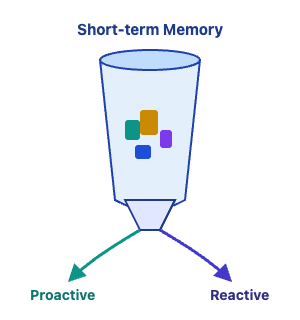
Reactive filtering is a form of in-the-moment self-talk. When you notice your mind getting cluttered with unnecessary details—random facts, stray comments, or unhelpful memories—you quickly clear them away. For everyday distractions, this might mean pausing and consciously telling yourself, "This isn’t important," then deliberately letting it go. When it comes to troublesome or lingering memories, research suggests a quick substitution strategy: as soon as an unwanted memory starts to form, immediately shift your attention to something positive, like putting on your favorite music or looking at an image you enjoy. This early redirection helps stop negative thoughts from taking hold and helps keep your cup clear for information that matters.
Proactive filtering, on the other hand, is even more effective because it prevents the clutter from arriving in the first place. Before you start your day or a new task, set up mental boundaries and routines that help your brain sort what’s useful from what’s not. For example, you might silence notifications before focused work, state clear intentions for what you’ll pay attention to in a meeting, or batch emails to only check them at set times. This way, you’re training your mind to accept only what’s valuable and automatically sort out the rest, so distractions never even take up space in your working memory.
By using both of these filtering strategies, proactively sorting before distractions arrive and reactively disposing of clutter that sneaks in, you maintain more mental space and preserve your capacity for focused, clear thinking.
Use Strategic Unfocus to Enhance Insight 🌱
Here is a counterintuitive truth: focusing harder is not always the answer. Prolonged or intense focus can sometimes make it even more difficult to break through a mental block. Strategic unfocus is not laziness or avoidance—it is a purposeful practice that ultimately improves your ability to think clearly.
When you're deeply focused, your brain is in collection mode or gathering facts, processing details, and getting things done. But it's not in connection mode, where separate ideas come together, patterns become visible, and new solutions emerge. To activate this connection mode, it’s important to intentionally include unfocus time in your day. A good method when you feel overloaded is to add a light, enjoyable activity, something that engages your mind differently and encourages creative connections. For example, taking a walk often sparks new connections and boosts mental energy, especially if you walk outside.
Consider how this might play out in a typical workplace conversation between a manager and a team member who is stuck:
- Dan: I've been staring at this resource allocation plan for two hours and I'm getting nowhere. I keep running the numbers but nothing is clicking.
- Natalie: It sounds like you're deep in collection mode. Have you stepped away at all?
- Dan: No, I figured I just needed to push through. The deadline is tomorrow.
- Natalie: Sometimes pushing harder is exactly what keeps us stuck. Why don't you take a fifteen-minute walk outside and let your mind wander?
- Dan: That feels wrong when I'm already behind. Won't that just waste more time?
- Natalie: It's actually the opposite! You're giving your brain permission to shift into connection mode. When you come back, you'll likely see options you couldn't see before.
Notice how Natalie reframes the break not as avoidance but as a deliberate thinking strategy. This mindset shift is what makes strategic unfocus effective because it treats unfocus as part of the work rather than an escape from it.
Strategic unfocus also strengthens memory through a technique called spaced learning. Rather than grinding through material continuously, building deliberate distractions into your day cements what you need to learn much faster than working nonstop. These short breaks empty your short-term memory cup and help transfer important information into long-term storage.
When you organize your day with these principles in mind, you create the conditions for sharper thinking, better memory, and deeper insight. In the upcoming practices, you will have the opportunity to diagnose the issue, reframe unfocus as a legitimate thinking strategy, and prescribe a specific approach. These skills will serve you well as a leader who helps others think at their best.
