Restoring Digital Friction
Putting the Friction Back
Here's a question worth sitting with before we go further: from the moment you feel the urge to check your phone, how many actual steps stand between you and the screen? You reach into your pocket, glance down, and it has already unlocked from your face before you've consciously decided anything. That gap between wanting and doing has been engineered down to almost nothing. This unit is about what happens when you deliberately widen it back out.
The Effort That Was Quietly Removed
Let's start with a plain-language term. Friction is simply the effort standing between you and an action: the number of steps, the seconds of delay, the small hassles you'd have to get through. Older technology had lots of it. To make a call you found a phone, dialed each digit, waited for a connection. Every step was a little chance to change your mind.
Your smartphone removes that friction on purpose, and it does so in three quiet ways. First, pocket access: it's always within arm's reach, so there's no "go get it" moment. Second, instant unlocking: your face or fingerprint opens it faster than you can form a thought. Third, fast-loading apps: whatever you want appears in about a second. Put together, this is friction removal, the deliberate design choice of making access effortless.
Now ask yourself honestly: would you check as often if your phone took two full minutes to boot up first? Almost certainly not. That's the whole point. The less effort a behavior takes, the more often you'll do it without ever deciding to.
The Cue Hiding Inside Boredom
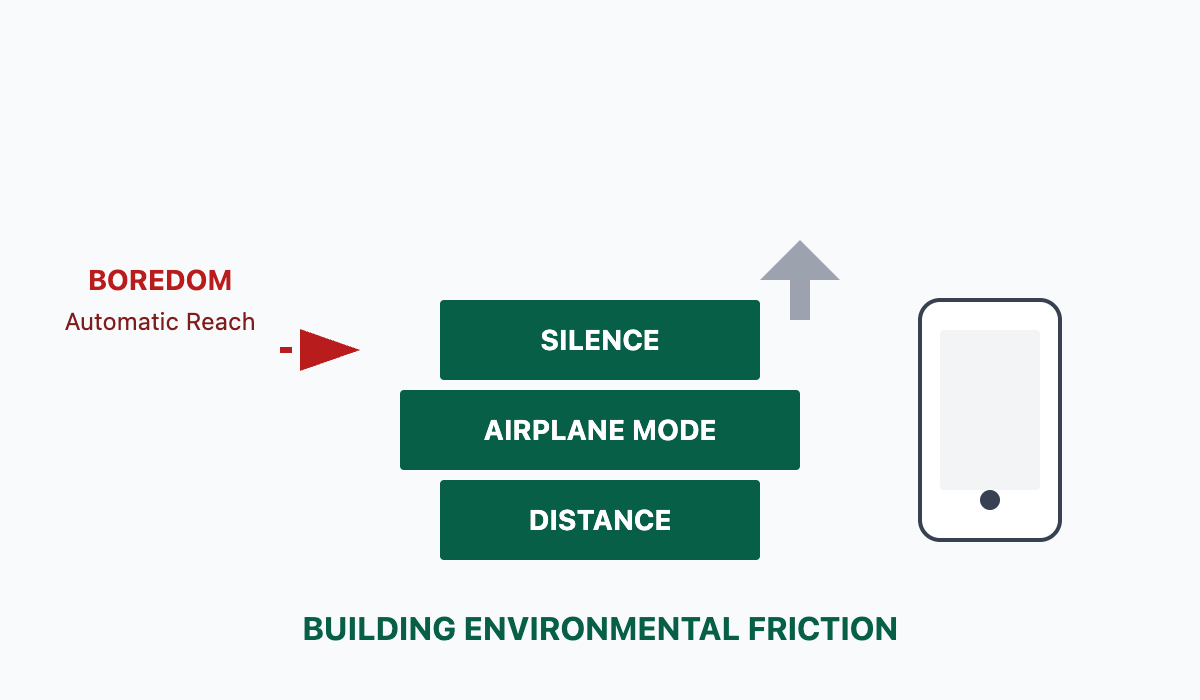
So the reach is easy. But easy isn't the same as automatic. What actually sets it off? Think back to the last few times your phone ended up in your hand before you'd chosen to check it. Odds are you were in the middle of something dull: repetitive data entry, a tedious form, a task with no spark in it. That's the pattern worth catching. Boredom is the cue. When a task turns tedious, your mind reaches for relief, and because the phone offers relief with zero effort, your hand moves before conscious thought catches up.
- Milo: I don't even decide to check my phone. Halfway through a boring spreadsheet, it's just in my hand.
- Victoria: So what happens right before your hand moves?
- Milo: Nothing, really. The task gets dull, and I guess I'm reaching before I notice.
- Victoria: That "dull" moment is the cue. Boredom hits, and because the phone is right there and opens in a second, the reach happens before you can weigh it.
- Milo: So it's not that I caved. The setup did half the work.
Notice what Milo lands on at the end. The cue (boredom) sits upstream of the reach, and naming it as the trigger is what makes the whole reflex catchable in the first place.
Rebuilding the Barrier on Purpose
Here's the uncomfortable implication. If near-zero friction is what turns boredom into an automatic check, then trying harder in the moment is aiming at the wrong target. The reflex is faster than your discipline. So the fix isn't willpower, it's putting the effort back into the environment before you start.
Consider three moves you can stack before a demanding or repetitive block. Turn on airplane mode, which kills the alerts and red badges that would otherwise pull you. Silence or block notifications so nothing pings for attention. And physically place the phone out of immediate reach: a drawer, a bag, ideally another room. Each added step reintroduces a small hassle, and each hassle is a moment where you can actually catch yourself before checking. You're not fighting the boredom cue; you're making sure it no longer opens straight onto a screen.
So the question to carry forward isn't "why can't I resist?" It's sharper than that: if your setup does half the work of distracting you, what would it look like if your setup did half the work of protecting you instead?
The single idea to hold onto: your phone's near-zero friction turns a boring moment into an automatic check, so the reliable defense is to rebuild that effort into your environment before you begin, not to summon discipline once the urge is already moving. Next you'll do a quick pattern-spotting exercise, matching those low-friction features to the environmental responses that interrupt them, before you take the skill into a live conversation and then package it into a setup someone could actually run in under a minute.
