Aligning Your Attention
The Real Price of One More Check
You've spent this course learning how your phone is engineered to win. You've named the variable rewards, the red badges, the bottomless feeds, and the near-zero friction that turns a dull moment into an automatic check. So here's the question that decides whether any of it mattered: if a single check takes only a few seconds, why bother resisting at all? That belief is the one quietly protecting every distraction you have, and in this unit you're going to put it on trial.
Two Ledgers: What Distraction Costs, What Focus Buys
Start with a sharper question than "is my phone bad for me?" Ask instead: what am I actually trading, and for what? Every distraction carries a cost, and every stretch of sustained focus carries a payoff, but they land in areas you rarely tally up.
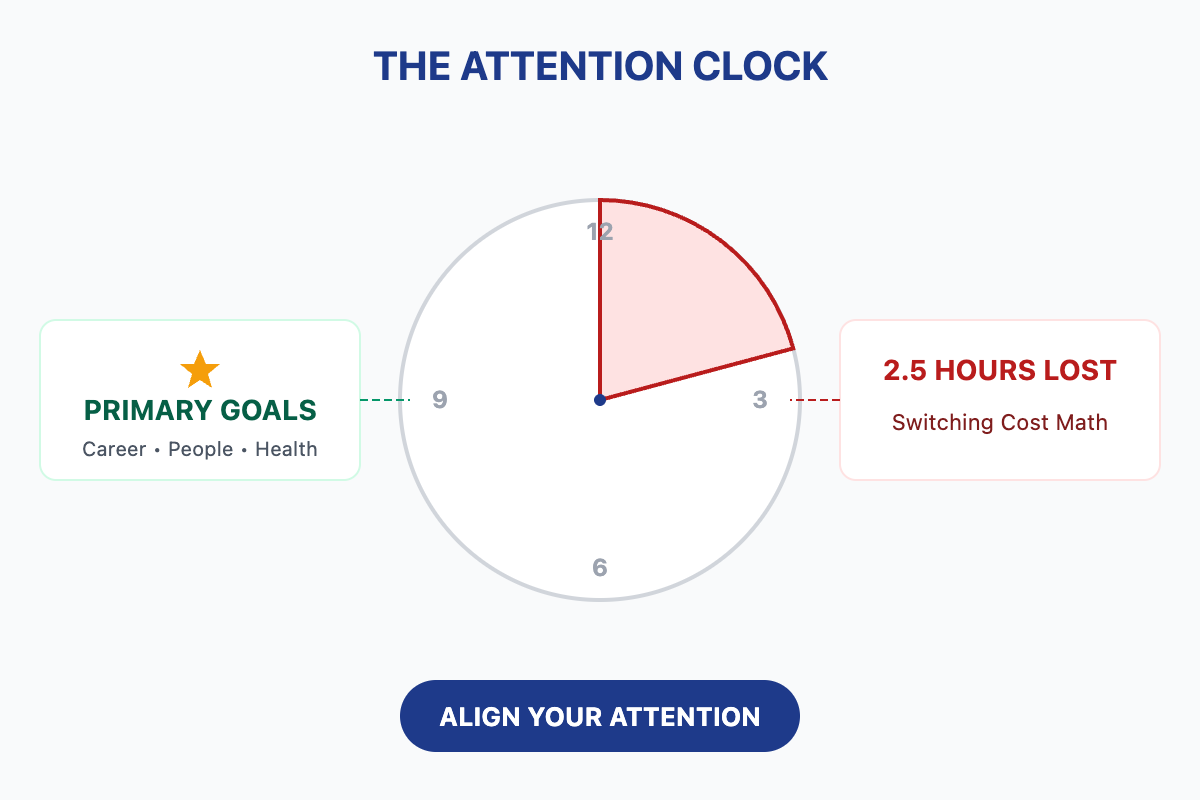
The Goal Linkage Categories give you three honest places to look. The first is your professional aspirations: the report that lands sharp or scattered, the promotion you're building toward. The second is your personal relationships: whether you're actually present at dinner or half-listening behind a screen. The third is your health routines: the workout you keep or skip, the sleep you protect or scroll away.
Now put the two ledgers side by side. Distraction quietly debits all three columns, lower work quality, strained connection, dropped routines, plus more stress and less sense of control. Sustained focus credits them, better output, real presence, kept promises to yourself, and a calmer feeling of being in charge of your own day. The provocation here is uncomfortable: a distraction isn't a neutral little break. It's an active obstacle standing between you and the person you say you want to become.
It's Just Five Seconds: Let's Do the Math
Let the belief stand first, because it deserves a fair hearing. "One more check never hurt anyone." In pure isolation, that's almost true. A five-second glance costs five seconds. So where's the harm?
The harm was never in the check. It's in the return. And this is where everything from earlier in the course collides: switching costs and attention residue mean that after you look up, your mind takes minutes, not seconds, to fully re-engage with what you were doing.
- Dan: Honestly, glancing at my phone for five seconds between tasks isn't the thing sinking my report.
- Natalie: Maybe not the five seconds. But what happens in the five minutes after you look back up?
- Dan: I guess I re-read the last paragraph, hunt for where I was. A minute or two, maybe.
- Natalie: Now do that every fifteen minutes. Thirty-something times a day, a few minutes each. Where does that land?
- Dan: That's most of an afternoon gone. So the check was never the expensive part.
Notice the exact moment the defense collapses: not when Dan is scolded, but when he does the arithmetic himself. That's the Interruption-Cost Example in action. Checking a phone every fifteen minutes creates roughly 32 interruptions across an eight-hour day. At three to five minutes of switching time and lingering residue each, the potential loss approaches 2.5 hours daily. The single check is cheap. The reentry, multiplied by 32, is what quietly eats your best work.
Building Your Goal-Aligned Attention Plan
So if one check is harmless but 32 are devastating, the answer isn't to feel guilty. It's to build a plan before the day starts, aimed at the goal that actually matters to you. This is where everything you've audited across this learning path comes together into a single page.
Pick one real goal first, ideally one drawn from those three linkage categories, then work down the same fields you've practiced. Name your primary distraction. Mark whether it's internal (a worried thought, boredom) or external (a buzzing phone, office chatter). Flag whether it's obvious or sneaky, since the sneaky ones do the most damage precisely because you don't see them coming. Identify your vulnerability window, the time of day your defenses dip, and the emotional trigger that tends to set the reach in motion. Finally, and this is the part people skip, attach a countermeasure that matches the type: an environmental fix for external cues, a gentle mental redirection for internal ones. A plan that mismatches the fix to the source is just a wish.
Here's the single idea to carry out of this whole course: the cost of distraction was never one check, it was the compounding return trip, multiplied across a day and charged against the goals you care about most. So the question worth sitting with is this: which goal are you willing to protect on purpose, and what will you change tonight so tomorrow's version of you doesn't have to rely on willpower at all? You'll first sort real effects into costs and benefits to sharpen the distinction, then defend the "one check won't hurt" belief in a live conversation until the math dismantles it, and finally design the one-page plan you could actually run against a goal that matters to you.
