Compare and Explain Equivalent Expressions
🎉 Introduction
Welcome to Compare and Explain Equivalent Expressions! Over the previous three lessons, you translated everyday phrases into expressions, combined multiple operations into a single statement, and used parentheses to group quantities that belong together. Each of those skills gave you a new way to build a mathematical model from a real situation.
This lesson shifts the focus from writing expressions to comparing them. Consider a familiar idea: a friend asks how many eggs are in three full cartons. One person might think, "Each carton has 12 eggs, so that is ." Another might say, "Each carton has two rows of 6, so there are ." The reasoning is different, but the answer is the same because both descriptions capture the same real-world quantity. Expressions work the same way — two expressions can be structured differently yet still represent the exact same amount, as long as each one faithfully models the situation. In this lesson, you will learn to:
- Recognize equivalent expressions by checking whether both forms describe the same real-world quantity from different angles.
- Explain equivalence in plain language by connecting each expression back to what it counts or measures in the situation.
- Test and spot non-equivalence by substituting values and watching for traps like one-time versus repeated quantities.
What Does "Equivalent" Mean in Context? 🟰
Two expressions are called equivalent when they produce the same value no matter what number we substitute for the variable. In a real-world setting, this means both expressions describe the same quantity; they just organize the calculation from a different angle.
You may recall from the previous lesson that we wrote to model the total cost of 8 gift bags, each containing a toy at dollars and a $3 card. But someone else might think about the same purchase differently: "I am buying 8 toys and 8 cards, so the total is ." These two expressions look different, yet they model the identical situation and will always give the same result. That makes them equivalent.
The takeaway is that equivalence is not about appearance. It is about meaning. If two expressions faithfully describe the same situation, they must be equivalent, even when their structures look nothing alike.
Seeing Equivalence Through Two Perspectives 🔀
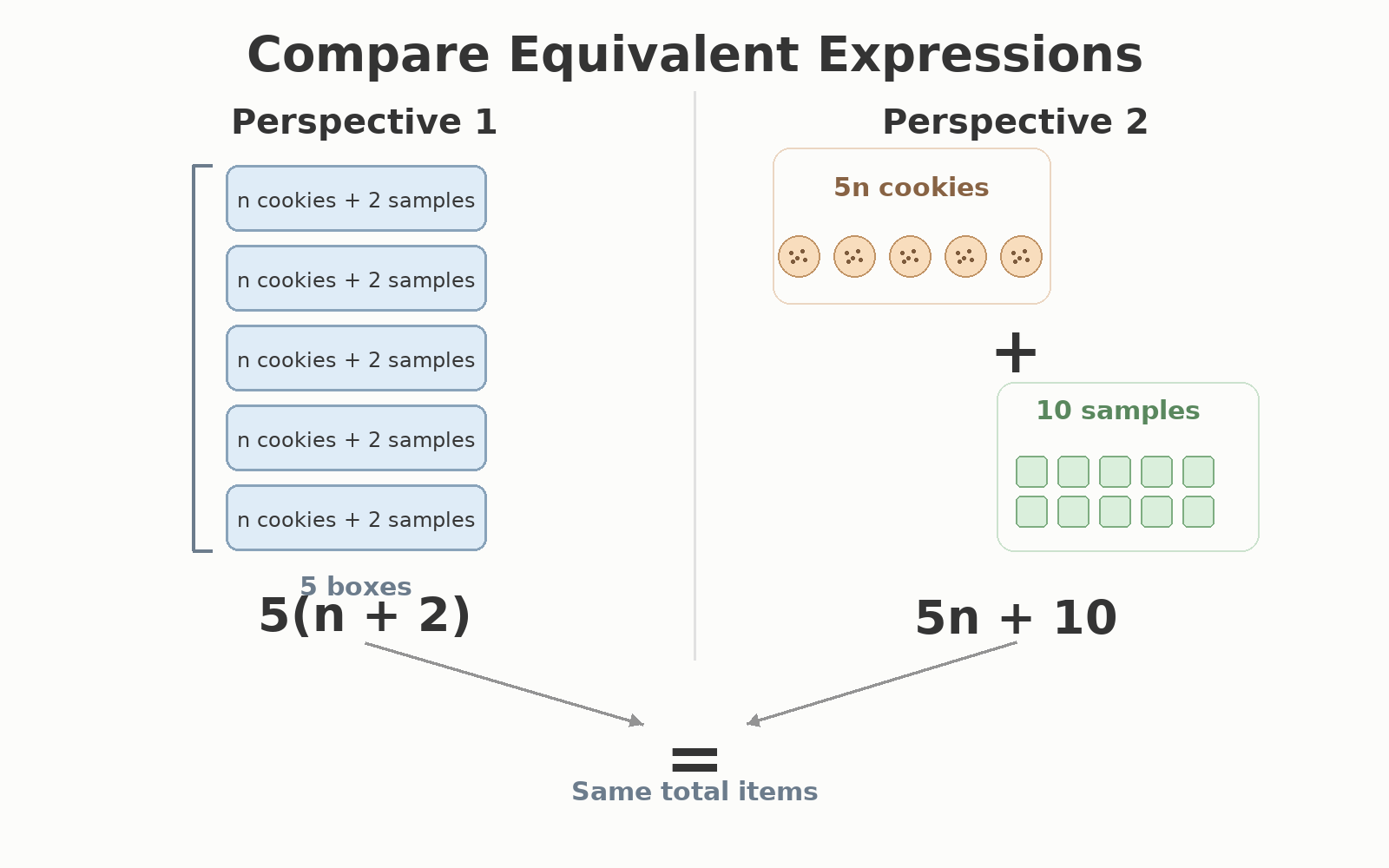
Let's walk through a fresh example step by step. Imagine a small bakery packages cookie boxes for a holiday sale. Each box contains cookies and 2 bonus samples. A customer orders 5 boxes.
Perspective 1 — group first, then multiply. Each box holds items. Five boxes means:
Perspective 2 — count each type across all boxes. The 5 boxes contain cookies total and samples total:
Both expressions describe the same total number of items in the order. The first groups the contents of one box and then multiplies; the second counts cookies and samples separately across all boxes. Neither perspective is "more correct" — they are simply two ways of looking at the same purchase.
| Perspective | Thinking | Expression |
|---|---|---|
| Per-box total, then multiply | per box, times 5 boxes | |
| Each type across all boxes | cookies plus samples |
Checking Equivalence with a Quick Substitution 🔢
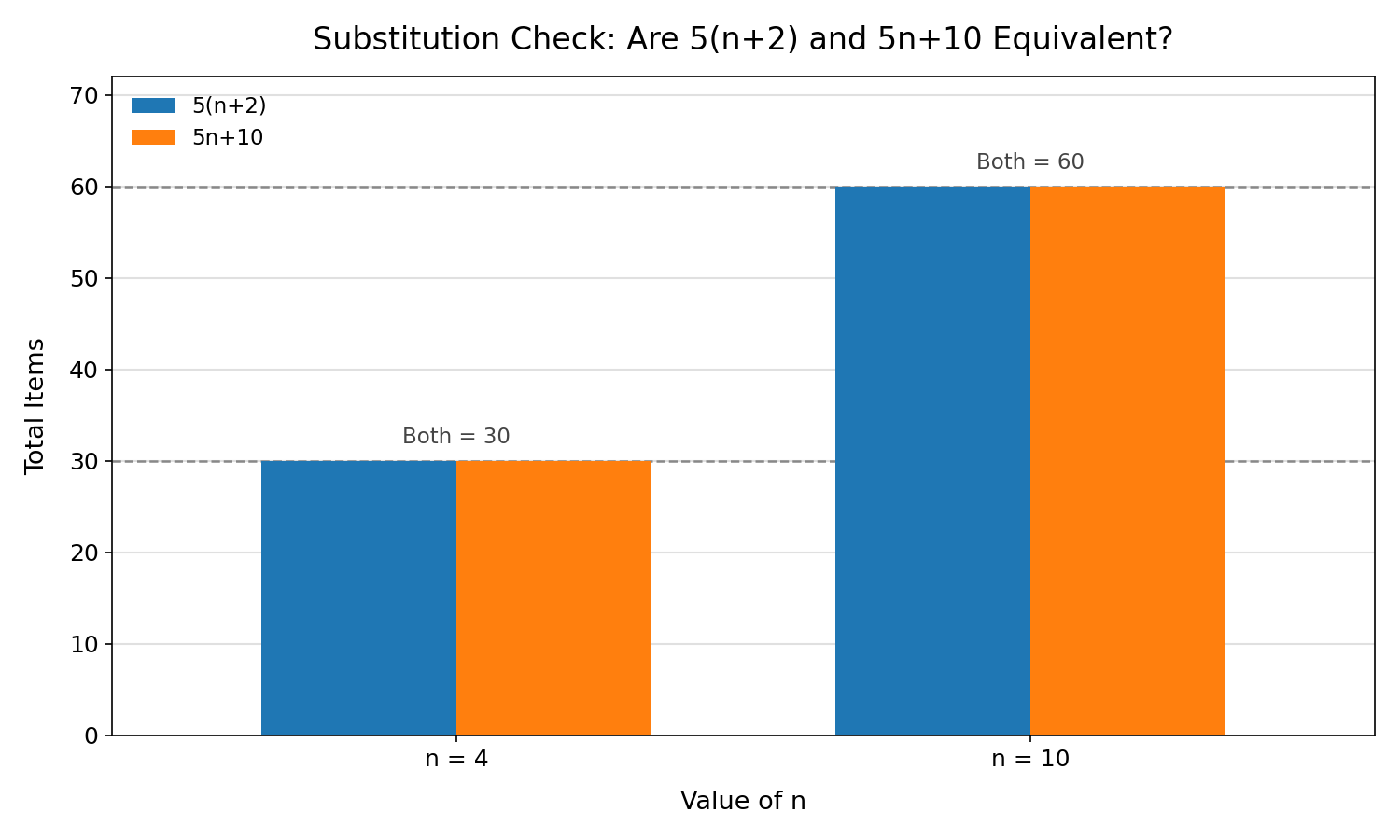
A practical way to build confidence that two expressions are equivalent is to substitute a specific value for the variable and verify that both produce the same result. Let's test the bakery example with :
Both give 30. We can try another value, say :
Again, the same result. Testing with numbers does not prove equivalence in a formal mathematical sense, but it is a quick and reliable sanity check. If the results ever differ, we know the expressions are not equivalent and something in our model needs a second look.
Explaining Equivalence in Plain Language 💬
Recognizing equivalence is important, but being able to explain it in everyday words is just as valuable — especially when a teammate or classmate looks at two different expressions and wonders why both are correct. A clear explanation usually has three parts:
| Step | What to Do |
|---|---|
| 1 | Describe what the first expression calculates in terms of the situation. |
| 2 | Describe what the second expression calculates in terms of the situation. |
| 3 | State why both totals must be the same. |
Here is an example using the bakery scenario:
- First expression: finds the number of items in one box and then multiplies by 5.
- Second expression: adds up all the cookies from every box and all the samples from every box separately.
- Why they match: Both must give the same total because every item is counted exactly once either way.
Notice that we never needed to mention a formal algebra rule. We simply talked about what each expression means in the real world and why the two ways of counting cover the same items.
Spotting Expressions That Are Not Equivalent 🚫
Not every pair of similar-looking expressions is equivalent, and part of mastering this skill is knowing when two forms do not match the same situation. Consider this scenario: a gym charges a one-time signup fee of $25 plus $m per month. A member signs up for 6 months.
- Expression A:
- Expression B:
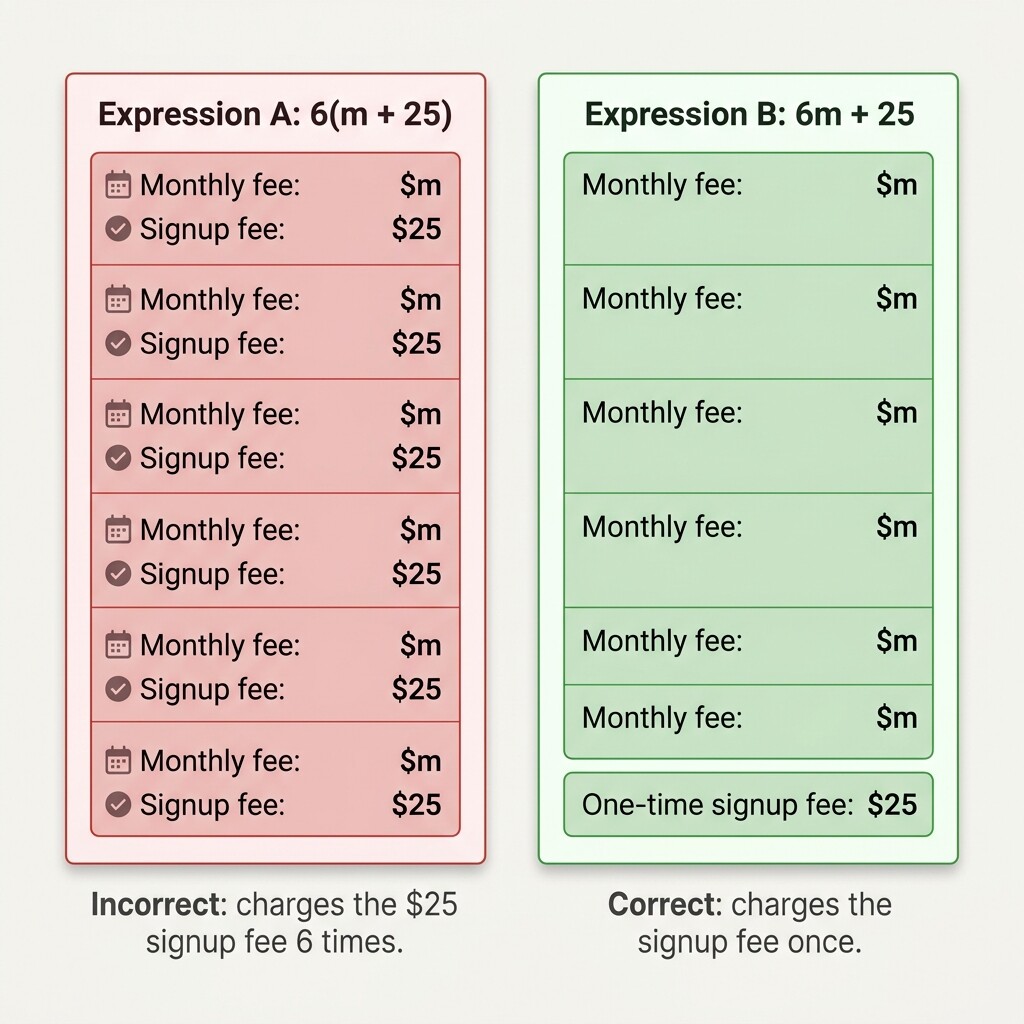
At first glance these look close, but let's think about the situation. Expression A says the member pays every month, meaning the signup fee is charged 6 times. Expression B says the member pays for the monthly fees and adds a single $25 signup fee. If the signup fee really is a one-time charge, only Expression B is correct, and the two expressions are not equivalent.
We can confirm with :
The results are different, which proves the expressions model different situations. The takeaway: always go back to the context before deciding whether two expressions are equivalent. The structure of the real-world situation is the ultimate guide.
With that warning in mind, here are a few pointers:
- Same situation, different angle is the hallmark of equivalence. If both expressions faithfully describe the scenario, they are equivalent.
- Plug in a number to quickly test whether two expressions could be equivalent — one mismatch is enough to show they are not.
- Explain in context, not in rules. Describe what each expression counts or measures in the real world, then point out why the totals must agree.
- Watch for one-time vs. repeated quantities, a common source of non-equivalence where a single charge gets treated as if it applies to every unit, or vice versa.
Conclusion and Next Steps
In this lesson, you learned that two expressions can look quite different yet still represent the same real-world quantity. The best way to understand why is to describe each expression's meaning in plain language, connect it back to the situation, and plug in a number to test when in doubt.
You now have the complete toolkit from this course: translating phrases, combining operations, grouping with parentheses, and comparing equivalent forms. Up next are exercises where you will match equivalent expressions, judge whether two forms truly model the same quantity, fill in plain-language explanations, write your own expression pairs, and even convince a skeptical colleague that two different-looking expressions can tell the same story. Let's finish strong!
