Regulating Body Responses
Regulating the Body Under Pressure 💓
Anchoring attention handles where your mind is pointed, but under real pressure, a racing heart and a braced jaw feed the loop, and neither responds to being reasoned with. That’s why this lesson focuses on the other half: measured, physical interventions you can check. You are not chasing calm as a feeling; you are checking whether a specific technique was followed by a measurable change, so you can build a practical routine for the ninety seconds before a decision.
After this lesson, you will have learned how to:
- Conduct a before-and-after pulse check while keeping measurement conditions consistent
- Apply the 4-4-4-4 box breathing cycle and compare your pulse readings without treating the difference as proof of an effect
- Run a one-minute head-to-toe body scan to pinpoint the specific physical mechanics of hidden tension
🩺 Conduct a Before-and-After Pulse Check
Your body holds stress you might not even notice, and this tension drains mental energy needed for clear decisions. Take your pulse before you do anything else, and write down the method along with the number. Note whether you checked your wrist or neck, how long you counted, and whether you were seated or standing. The number has limited meaning on its own — what makes it a useful baseline is recording the conditions so you can match them afterward.
That consistency is easy to overlook. If you take the baseline standing at your desk and the second reading sitting down, a posture change could contribute to the difference. The same concern applies to switching from wrist to neck, changing the counting window, or taking a sip of coffee in between. Keep those conditions consistent to make the readings more comparable.
For a more reliable manual estimate, count for a full sixty seconds when time allows. A fifteen-second count multiplied by four is quicker, but a one-beat counting error becomes a four-beat-per-minute error. Even with matched conditions, one before-and-after pair cannot isolate box breathing as the cause of a change: natural pulse variation, time spent resting, and counting error can also contribute. If you can't reliably find a pulse, substitute a self-rated 1 to 10 activation score and use it both times. Treat either measure as a practical check, not proof that the technique worked.
Apply Box Breathing Basics 😮💨
Box breathing is four counts in, four holding, four out, four holding, repeated four times through. It's the technique first responders train on because it works without equipment, without privacy, and while your heart is already going. Picture drawing a square with your breath — each side takes exactly 4 seconds. Count deliberately rather than fast, and treat the two holds as real. The exhale is where the parasympathetic shift shows up, and the exhale plus the following hold are the two parts you will instinctively shorten.
Then re-check your pulse, with the identical method, and state the observed difference in beats per minute out loud. Honesty here is the whole discipline. Sometimes the number barely moves, and a small difference may reflect measurement error rather than a meaningful change.
Let’s see how this plays out in a real conversation. Natalie is testing her baseline and applying the technique. Chris helps her confirm the method and interpret the readings cautiously.
- Chris: Okay, what is your baseline?
- Natalie: Ninety-two. Left wrist, a full sixty seconds, sitting.
- Chris: Good. Four cycles, I'll count. In, two, three, four. Hold, two, three, four. Out, two...
- Natalie: That exhale got away from me, about two counts.
- Chris: Then it wasn't a cycle. Run it again, four out, four hold, then re-check your pulse exactly the same way.
- Natalie: Same wrist, same window, still sitting: eighty-six. Six beats lower.
- Chris: That's the observed difference. It doesn't tell us how much, if any, was caused by the breathing.
Notice that Chris cares more about the method than the result. He doesn't let a shortened exhale slide; he resets the cycle. A six-beat difference under matched conditions is an observation worth recording, not an exact physiological effect attributable to box breathing. Look for patterns across repeated sessions rather than drawing a conclusion from one pair of readings.
🧘 Conduct a One-Minute Head-to-Toe Body Scan
Your pulse is one channel, and it's a narrow one. The one-minute body scan opens the rest. A quick body scan identifies these tension spots so you can release them, freeing up mental bandwidth for better focus. Think of it as clearing your mind by clearing your body. Let's start at the top and move your attention in this fixed order:
- Head
- Jaw
- Shoulders
- Chest
- Hands
- Gut
- Legs
- Feet
Now here's the powerful part: choose a personal release cue — a single word that signals your body to let go of tension. Something like 'soften,' 'release,' or 'melt.' When you find tension during future scans, silently say your release cue and imagine that area relaxing. In the next lesson, you’ll refine this into a specific Word–Region–Phrase structure.
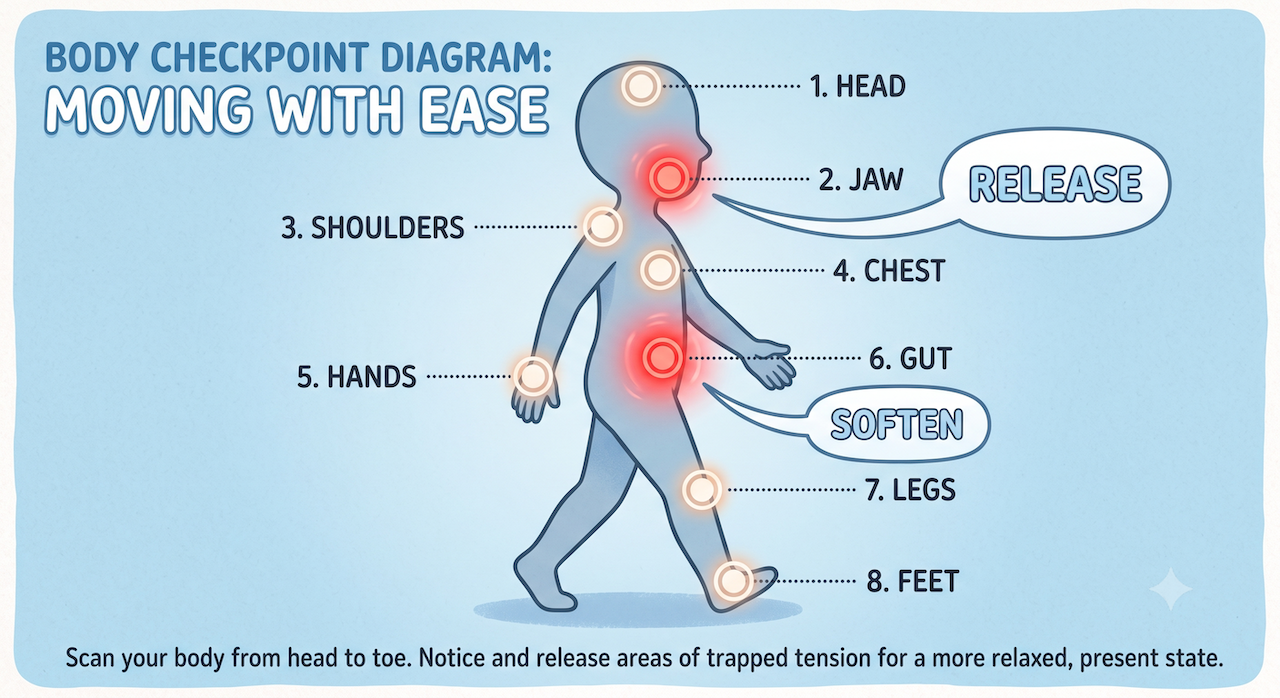
Run the full sequence even when a region seems boring. The unglamorous ones (gut, feet) are frequently where the tension has gone to hide, and skipping them is how people conclude they're fine while their jaw is locked. It's also normal to find a region you genuinely cannot read. Say so, rather than filling in a guess. Over a few scans you'll notice one region reports first every time, and that region becomes your early warning system: the thing you feel before you notice you're spiraling.
The takeaway is simple and slightly humbling: your pulse and your jaw are two different instruments measuring different responses. One can change while the other stays steady; neither reading invalidates the other.
The whole lesson comes down to checking your physical responses consistently and learning from patterns without overstating what one measurement can tell you. Next, you'll sort a pile of actions into what maintains comparable measurement conditions and what weakens the comparison. Then you'll coach a colleague through four live box-breathing cycles, holding them to consistent measurement conditions, before running a real-time body scan on yourself to document the tension a pulse check misses.
