Detaching from Intrusive Thoughts
Detaching from Intrusive Thoughts 🫧
The body scan showed you where tension lands. Now you’ll work with the other half of the loop: the thoughts themselves. The goal isn’t to stop, fix, or replace them. It’s to create enough distance that they can run in the background while you make the call anyway.
By the end of this lesson, you’ll be able to:
- Create a personal cue word that helps release tension in a specific area
- Label intrusive thoughts without answering, debating, or acting on them
- Choose an everyday object as a calm anchor you can use in seconds
🔑 Script a Personal Cue Word That Releases Tight Areas
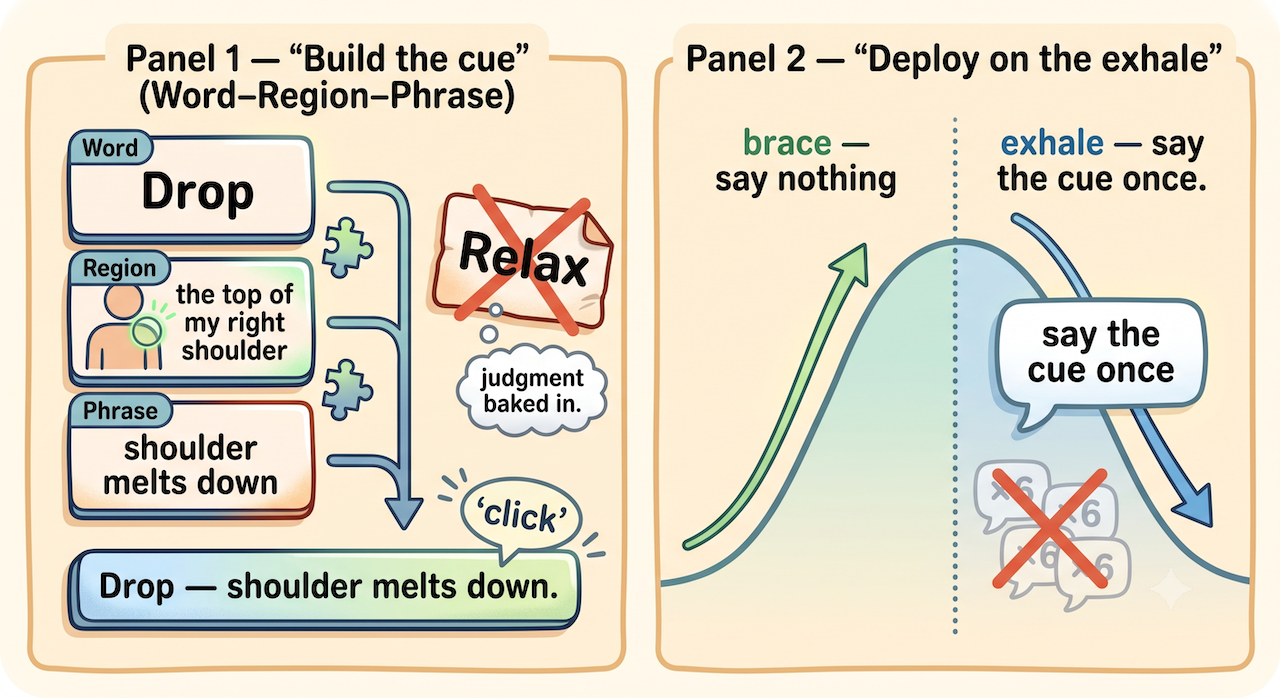
In the last lesson, you chose a word to help your body relax during the scan. Now, you’ll upgrade that into a formalized release cue. This isn't just a general wish; it is a Word–Region–Phrase structure used to target the specific region that reports tension first on you — like the jaw, the shoulders, or the gut. You say this cue (out loud or silently) on the exhale, paired with one specific region and one short phrase that tells the region what to do.
Here's the key thing: all three parts are mandatory. A word alone is a wish. Use the Word–Region–Phrase structure to build yours:
- Word: Short, neutral, and not already doing another job in your vocabulary. Try soften, drop, loose, melt. Skip words with judgment baked in, like "relax" said through gritted teeth, because you'll hear it as an instruction you're failing.
- Region: Name it precisely. Not "my upper body" but "the hinge of my jaw" or "the top of my right shoulder."
- Phrase: Attach the words you say together: Drop, shoulder melts down.
The good news? The timing is simple. Deploy the cue on the exhale only. The inhale is where you brace; the exhale is where tissue actually lets go. Say the word once, let the exhale finish, and move on. Repeating it six times turns it into effort, which is the opposite of the point.
Apply "Name It to Tame It" to a Live Thought Stream 🏷️
Thought labeling, sometimes called "name it to tame it," means you label a thought as a thought rather than treating it as fact or as an instruction. This creates psychological distance, like watching clouds pass instead of being inside the storm. When you label a thought, you create psychological distance. You shift from participating in the thought to observing it. You say what type it is and move on:
- "That's a planning thought."
- "That's a fear thought."
- "That's a comparison thought."
The categories are deliberately coarse. Planning, fear, memory, comparison, and self-criticism will cover almost everything you generate. You aren't diagnosing, you're sorting mail. What matters is the second half: you do not answer the thought, rank it, argue with it, or act on it. Say it, label it, next.
This is where overthinkers slip, and predictably. The instant a thought looks solvable, you'll start solving it, and solving feels productive enough that you won't notice you stopped labeling three thoughts ago. The other failure is subtler: labeling a thought as fact. "That's true though" is not a label. It's a fear thought wearing a suit.
Let's see how this works in a conversation:
- Dan: Whenever you're ready, just say them out loud as they land. I'll help you catch the ones that slip past.
- Victoria: Okay. If I turn this down, I'll be stuck in the same role for another two years. That's a fear thought. And the money is only about eight percent up, which after tax is barely worth the -
- Dan: Hold on, you just started doing arithmetic. That's solving, and it's the easiest one to miss. Can you label it instead and let it go by?
- Victoria: Fair enough. That's a planning thought. And the next one: everyone else my age has figured this out already. That's a comparison thought.
Notice that Victoria never finishes the salary calculation, and nothing bad happens. The thought still gets named, it just doesn't get answered. Notice too how quickly the next thought arrives once she stops engaging with the last one, which is exactly what labeling is for: keeping the stream moving instead of getting pulled into any single item.
⚓ Designate an Everyday Object as an Instant Calm Anchor
Labeling takes a few minutes. Sometimes you have seconds, which is where an anchor earns its place. A calm anchor is an ordinary object (a ring, a specific key, a pen, a watch strap, a coin) that you deliberately use as a physical reminder to run your reset. When you repeatedly pair an object with an intentional pause, the object becomes a reliable prompt to start the sequence instead of spiraling.
Before you pick one, run it through two strict tests:
- Carry test: Do you have it on you every single day, without thinking about it? A mug on your desk fails, because it isn't with you in the stairwell.
- Clean test: Does it already carry a stress association? Your phone fails hard here, because your phone is frequently the trigger. Anything work-issued is suspect for the same reason.
Now you'll create your three-breath reset ritual. When you touch your anchor object, take three intentional breaths — each one a slow nasal inhale, a brief pause, then a full exhale. This simple pattern enforces a physical pause when your mind wants to race. To strengthen the anchor connection, practice this three-breath reset 5-10 times daily for the next week, always using the same object.
Using your calm anchor before important decisions or difficult conversations helps interrupt automatic stress loops. Over time, this physical trigger can become a reliable prompt to choose a mindful pause instead of an immediate reaction.
You're not managing the content of your thoughts, you're changing your relationship to them. A release cue gives your tightest region one word on the exhale, labeling strips a thought of its authority by naming it instead of answering it, and a calm anchor makes both available in two seconds when that's all the time you have. Next you'll check your understanding of release cues and anchors, then run a live three-minute labeling stream for a friend, catching them the moment they start solving instead of observing. Finally, you'll put their chosen calm anchors through the carry and clean tests to argue them down to exactly one reliable object.
