Welcome to Measuring Space at Home, the course where we learn to work confidently with the dimensions of rooms, furniture, and materials found in everyday household projects. This is the first lesson of five in the course, so we are starting right at the foundation: reading and converting lengths measured in feet and inches.
Whether we are buying curtains online, checking if a bookshelf fits against a wall, or measuring a window for a replacement blind, feet and inches are the units we will encounter most often in U.S. homes. By the end of this lesson, we will be comfortable reading these measurements from tape measures and product labels, and converting between inches, feet-and-inches, and decimal feet.
Feet and Inches in Daily Life
Reading the Notation
Reading a Tape Measure
Converting Inches to Feet and Inches
Converting Feet and Inches to Total Inches
Working with Decimal Feet
Choosing the Right Curtain Rod
Conclusion and Next Steps
In this lesson we covered the essentials of household length measurement: the foot-and-inch system, how to read the marks on a tape measure down to fractional inches, and how to convert freely among inches, feet-and-inches, and decimal feet. These skills form the foundation for every remaining lesson in this course, from computing room area to checking whether furniture fits through a doorway.
Up next, you will put all of this into practice with hands-on exercises that include reading tape-measure positions, interpreting product labels, performing conversions, and making a real shopping decision. Let's see how sharp those new measuring skills are!
Be a part of our community of 1M+ users who develop and demonstrate their skills on CodeSignal
In the previous courses we worked with kitchen units like cups, ounces, and grams. Household lengths follow a similar pattern: there is one large unit (feet) and one smaller unit (inches) that combine to describe the same distance. The key relationship is simple:
1 foot=12 inches
Almost every tape measure, furniture listing, and building material in the U.S. uses this pair. Lengths shorter than a foot are stated in inches alone, while longer lengths are usually given as a combination of feet and inches, such as "5 feet 4 inches."
Product packaging and online listings use a shorthand that can look confusing at first glance. Here are the two symbols to remember:
A single tick mark (′) or a foot mark stands for feet: 5′ means 5 feet.
A double tick mark (″) or an inch mark stands for inches: 8" means 8 inches.
When both units appear together, the feet value comes first, followed by the inches value. For example, 7′6" means 7 feet and 6 inches. Some labels write it with a dash or a space (7′-6" or 7′6"), but the meaning is the same. Occasionally we also see the word forms written out, like "7 ft 6 in," which is just another way of expressing the identical measurement.
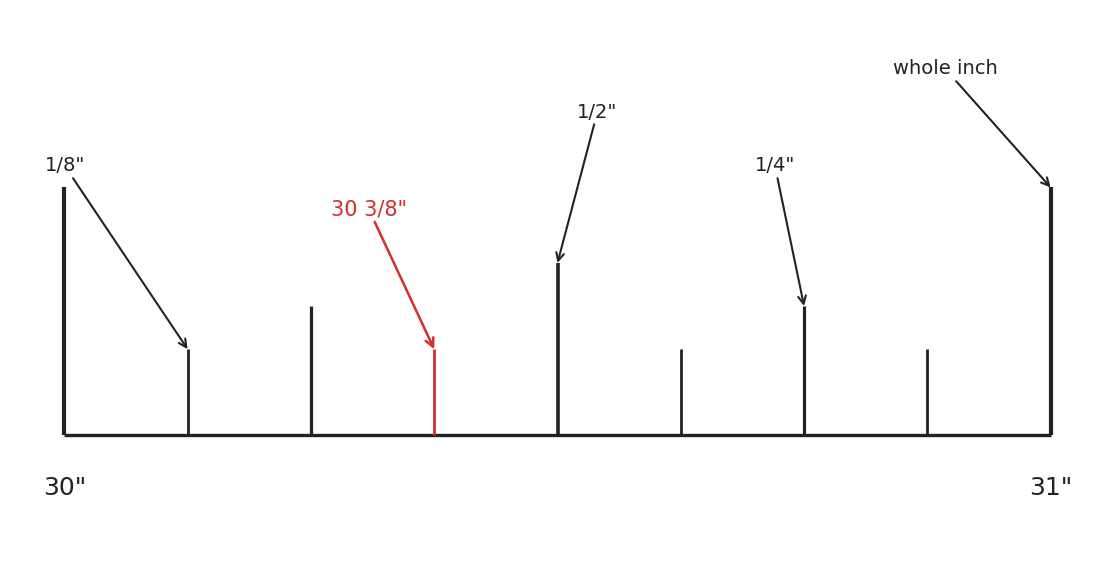
Now that we know the notation, let's look at where these numbers come from in the first place — the tape measure. A standard tape measure is marked in feet and inches. Every 12-inch interval is labeled with the next foot number, and between those labels we see inch lines of varying heights. Here is how the marks typically break down:
Mark height
What it represents
Example at the 2-foot zone
Tallest
Whole inch
24", 25", 26"…
Medium
Half inch (21")
Midway between 24" and 25"
Shorter
Quarter inch (41")
Between each half-inch pair
Shortest
Eighth inch (81")
Between each quarter-inch pair
To read a tape measure, we first identify the nearest whole-inch line to the left of the point we are measuring. Then we count how many smaller divisions past that line our measurement falls. For instance, if the edge lands three small eighth-inch marks past the 30" line, the reading is 3083".
This close-up shows the pattern within a single inch:
Tape measures and product specs do not always use the same format. A tape might show 45" while a furniture listing says 3′9". To compare them, we need to convert, and the process uses simple division by 12.
Divide the total inches by 12.
The whole-number quotient is the feet.
The remainder is the leftover inches.
For example, suppose a shelf is 45" long:
45÷12=3 remainder 9
So 45"=3′9". This is the same operation we use when converting minutes to hours and minutes — just with 12 instead of 60.
Going the other direction is even simpler: multiply the feet by 12 and add the inches.
total inches=(feet×12)+inches
If a door frame is 6′8", the total inches are:
(6×12)+8=72+8=80"
This conversion is especially handy when we need to compare two measurements that are written in different formats — for example, a room opening listed in feet-and-inches and a product listed in inches only.
Beyond feet-and-inches, some floor plans and product specs express lengths as decimal feet. To convert feet-and-inches to decimal feet, we divide the inches portion by 12 and add it to the feet.
decimal feet=feet+12inches
For 5′3":
5+123=5+0.25=5.25 ft
A few inch values produce clean decimals that are worth memorizing:
3"=0.25 ft, 6"=0.5 ft, 9"=0.75 ft
For other values, rounding to two decimal places is usually precise enough for home projects. For example, 5′7" becomes 5+127≈5.58 ft.
Let's put all of these conversions to work in a real shopping scenario. Imagine we are ordering a curtain rod online. The window opening measures 3′4" and the rods are sold in inch lengths: 36", 40", 48", and 52". First, we convert the opening to total inches:
(3×12)+4=40"
Now the comparison is straightforward. A 36" rod would be too short. The 40" rod matches the opening exactly, but curtain rods typically need a few extra inches on each side for the brackets. So the 48" rod is the practical choice. Converting everything to the same unit made the decision easy.