Understand the Impact of Body Language
Welcome to the Course
Welcome to Mastering Presence and Connection, where you move beyond what you say and start mastering how you show up. As a people manager, research shows that non-verbal cues carry as much weight as your words when building trust and rapport.
Throughout this course, you will develop a toolkit of physical and interpersonal skills to transform everyday interactions into moments of genuine connection. You will start by learning how your body communicates authority and openness. From there, you will explore eye contact and authentic facial expressions. You will then build active listening habits that create psychological safety. Finally, you will learn to adapt your tone to different personality types so you can connect with anyone on your team. Once you master these skills, your physical presence will reinforce the confident, approachable leader you already are. Let's begin with your foundation—how you stand.
Mastering Open-Palm Gestures vs. Defensive Postures
Your gestures are powerful because they operate in peripheral vision. Your team may not consciously register what your hands are doing, but their brains are processing every movement and assigning it meaning.
Open-palm gestures are your greatest ally. When you speak with your palms visible, you signal honesty and inclusion. For example, extending one hand outward with the palm up while asking for a perspective reinforces the invitation at a visceral level. Using both hands with palms open to indicate the scope of a project communicates transparency and invites your team into the conversation.
Contrast this with defensive or aggressive postures. Crossed arms, hands in pockets, or a pointed finger send very different signals. A pointed finger—even if your words are reasonable—can feel like an accusation. These postures are often unconscious habits, which is why they deserve your attention.
Imagine your gestures on a spectrum. On one end sit closed gestures: arms crossed, hands hidden. On the other end sit open gestures: palms visible, arms unfolded. Your goal is to spend the majority of your time on the open end of that spectrum. You do not need to gesticulate dramatically; even small, calm movements with visible palms communicate that you are approachable and in control.
To see how this plays out in a real management scenario, consider the following exchange between two people managers reflecting after a team meeting:
- Natalie: Did you notice anything different about this morning's retro? The team was way more vocal than usual.
- Ryan: Honestly, I made one small change. Last week I realized I was standing at the whiteboard with my arms crossed the entire time. No wonder people weren't jumping in.
- Natalie: So what did you do differently today?
- Ryan: I kept my hands open on the table when I was sitting, and when I stood up to summarize, I used open palms instead of pointing at the board. I even caught myself about to cross my arms and just let them drop to my sides.
- Natalie: That's it? Just the hands?
- Ryan: That's it. Same agenda, same questions. But two people who never speak up actually volunteered ideas today. I think they just felt safer.
Notice how Ryan did not change his words or his meeting agenda—he only shifted from closed to open gestures. That single adjustment created enough psychological safety for quieter team members to contribute. This is the practical power of conscious gesture management: your body can either invite participation or silently discourage it, and the choice is often as simple as uncrossing your arms and showing your palms.
Mirroring and Matching for Rapport Building
You have likely noticed that in great conversations, people often lean forward at the same angle or nod at the same rhythm. This is mirroring, and it is one of the most effective ways to build rapport. For a manager, intentional mirroring during one-on-ones can deepen trust significantly.
Mirroring means subtly reflecting another person's body language, gestures, or speaking pace. This creates a subconscious feeling of alignment. Begin by observing the other person's energy. If they are sitting forward and animated, match that general level. This approach—often called matching—aligns your tempo to theirs and creates a sense of being on the same wavelength.
A few boundaries keep mirroring authentic:
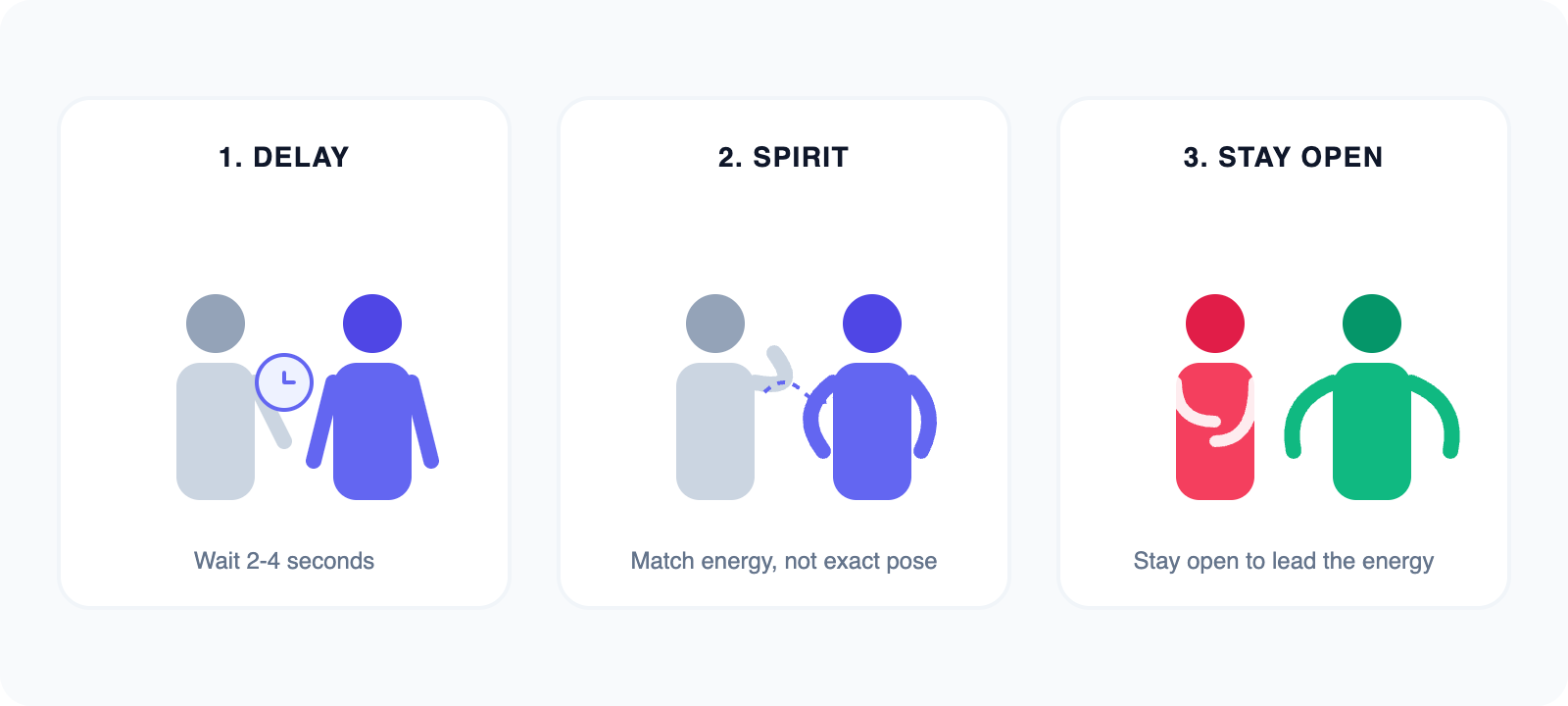
- Delay: Introduce a slight delay of two to four seconds before reflecting a posture shift so it doesn't feel robotic.
- Spirit: Mirror the spirit of the gesture—if someone tilts their head, you might nod gently instead of copying the exact angle.
- Avoid Negativity: Never mirror negative body language. If a team member crosses their arms in frustration, stay open. Your calm posture can help them relax through leading, where they eventually mirror your openness.
Now that you understand stance, gestures, and mirroring, it is time to put these concepts into action.In the upcoming role-play session, you will practice delivering a brief introduction while describing your body positioning out loud. This is your chance to feel these techniques in motion and get comfortable making intentional choices about your physical presence.
