Linking Active Listening and Psychological Safety
Linking Active Listening and Psychological Safety
In the previous unit, you built a physical foundation—stance, gestures, eye contact, and camera alignment—to project confidence and warmth before you even speak. Now, we bridge the gap between how you look and how you listen. Presence is not just about how you show up; it is about how you make others feel when they show up. Active listening transforms your polished physical presence into genuine psychological safety. This unit provides a repeatable system for doing it: a three-step listening loop, verbal "micro-affirmations," and a framework for responding to sensitive disclosures. These skills prove to your team that you aren’t just performing presence—you are truly engaged.
The "Hear-Paraphrase-Confirm" Loop
Most managers default to two habits: silently waiting for their turn to speak, or jumping straight into problem-solving. Both signal that the speaker’s words are being filtered rather than received. The Hear-Paraphrase-Confirm loop is a structured alternative that makes comprehension visible.
- Hear: Give the speaker your full, uninterrupted attention. Absorb the words and the emotion behind them. Your physical presence—open stance and eye contact—tells the speaker that hearing them is your only job.
- Paraphrase: Reflect the message back in your own words. A weak paraphrase parrots the speaker; a strong one captures meaning and feeling:
"It sounds like the constant interruptions are making it hard to build momentum, and that's frustrating." - Confirm: A brief check that invites the speaker to correct or expand, such as
"Am I getting that right?"This hands control back to the speaker. If you nailed it, they know with certainty they were heard.
Resist merging the Confirm step with a solution. Separate the two. Confirm first, pause, and then ask if they would like to brainstorm solutions. This pause is one of the most respectful things you can offer.
To see what the full loop looks like in practice, consider this exchange between a people manager and her direct report during a one-on-one check-in:
- Natalie: Hey Ryan, how's the onboarding project going?
- Ryan: Honestly, it's been rough. The vendor keeps changing the timeline on us, and I feel like I'm constantly re-planning instead of making actual progress.
- Natalie: That makes sense. So the vendor's shifting timelines are forcing you to redo your plans over and over, and it feels like you're spinning your wheels instead of moving forward. Am I getting that right?
- Ryan: Yeah, exactly. And I think what's really getting to me is that I promised the team we'd have this wrapped up by end of quarter, and now I'm not sure that's realistic.
- Natalie: I hear you—so on top of the constant replanning, there's pressure from the commitment you made to the team about the timeline. Is there more to it?
- Ryan: No, I think that's the core of it. I just needed to say it out loud, honestly.
Notice how Natalie cycles through the loop twice without once jumping to a fix. Her paraphrases capture both the facts (vendor delays, replanning) and the feelings (spinning wheels, pressure from a promise), and her confirm questions—"Am I getting that right?" and "Is there more to it?"—give Ryan space to go deeper. By the end, Ryan feels fully heard and even arrives at his own small insight, all because Natalie resisted the impulse to solve and chose to listen instead.
Using Micro-Affirmations to Encourage Dialogue
Micro-affirmations are the small verbal and non-verbal signals that say "Keep going, I'm with you" without interrupting the speaker's flow.
- Non-verbal: A slight nod, sustained eye contact, and leaning forward. These cues operate below conscious awareness but powerfully signal safety.
- Verbal: Short, low-disruption phrases like
"Mm-hmm,""I see,"or"Tell me more.""Tell me more"is especially valuable because it communicates curiosity and gives the speaker explicit permission to go deeper.
Virtual settings make these even more important. Make your nods slightly more pronounced on camera so they read clearly, and use brief verbal cues more frequently since the speaker cannot rely on peripheral vision to pick up your body language. Micro-affirmations are the connective tissue that holds a safe conversation together.
Creating Safety Through "Thanks for Sharing" Frameworks
How you respond in the first five seconds of a risky disclosure—like a mistake or a disagreement—determines if that person will ever take that risk again. The "Thanks for sharing" framework ensures your reaction builds trust:
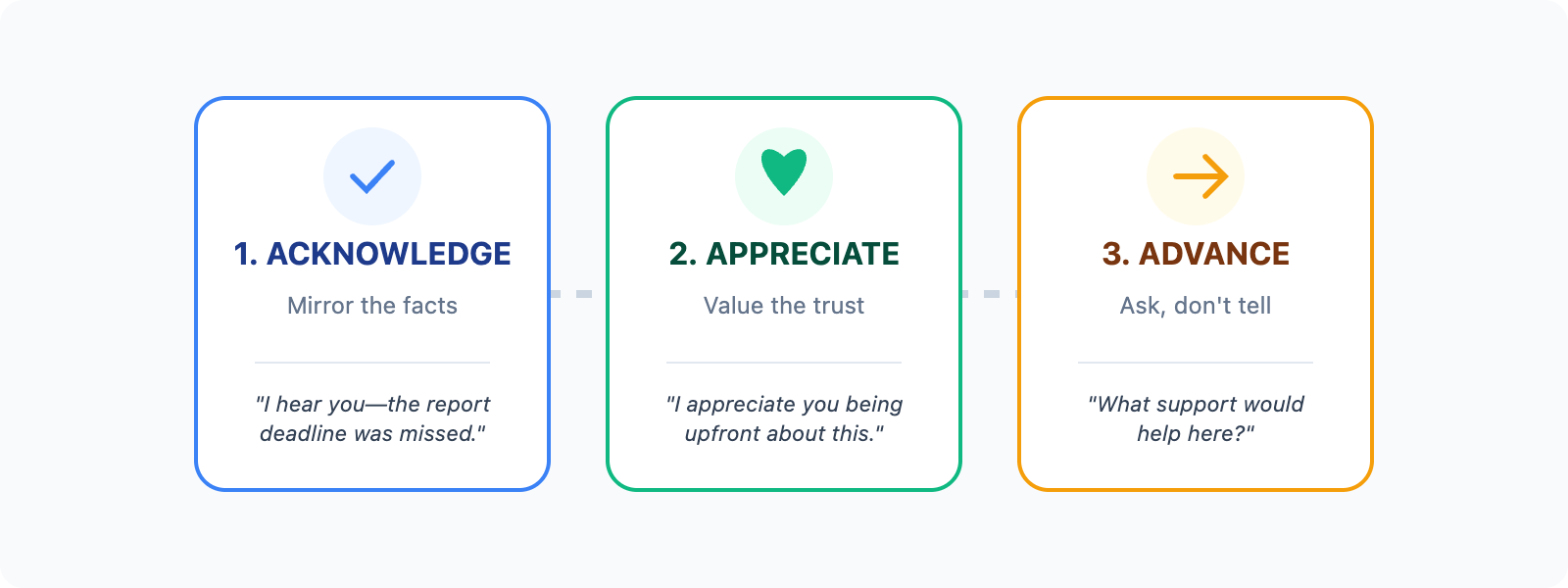
- Acknowledge: Name what the person just did without judgment:
"I hear you—the report deadline was missed." - Appreciate: Explicitly thank them for the act of sharing:
"I appreciate you being upfront about this."This separates the behavior of honesty from the problem being discussed. - Advance: Pivot to next steps with a question:
"What support would help here?"By asking rather than telling, you preserve the person's agency.
This framework is a first response, not the entire conversation. It ensures that your initial reaction reinforces a partnership rather than a tribunal. Practice this in low-stakes moments so the muscle memory carries you through the hard ones.
Together, these tools form a complete system. In the upcoming exercises, you will practice the listening loop to move from simply looking like you’re listening to proving that you are.
