Personality Traits and Cognitive Bias
Personality Traits and Cognitive Bias
In the previous lesson, you explored how the neurobiology of stress can hijack your thinking. Now, we shift from the reactive brain to the habitual mind. Personality traits and cognitive biases operate continuously in the background, shaping how you hire, evaluate, and lead. Because these patterns feel like "clear thinking," they are dangerous when left unexamined. This lesson provides tools to see your mental defaults and audit your reasoning before it leads you astray.
Understanding the Big Five (OCEAN)
The Big Five (OCEAN) model is the most validated framework for understanding personality. Your position on these five spectrums predicts your natural leadership tendencies and blind spots.
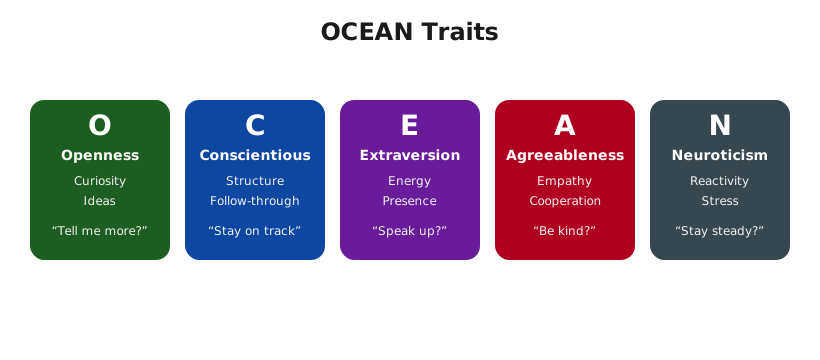
- Openness: Measures appetite for novelty. High openness managers push for experimentation but may chase new ideas prematurely. Low openness managers provide stability but may reflexively dismiss unconventional suggestions.
- Conscientiousness: Reflects discipline and organization. High scorers excel at execution but risk micromanaging. Lower scorers are adaptive but may struggle with consistent follow-through.
- Extraversion: Describes energy source. Extraverts thrive in collaboration but may dominate conversations. Introverts excel at deep coaching but may find high organizational visibility draining.
- Agreeableness: Your tendency toward harmony. High agreeableness builds trust but can lead to conflict avoidance. Low agreeableness ensures clarity but may require more effort in relational repair.
- Neuroticism: Reflects emotional sensitivity to stress. Higher scorers may be more reactive under pressure; lower scorers are stable but might underestimate the stress levels of their team.
The goal is trait-aware leadership: recognizing that your "reasonable" approach is often just your personality talking. Naming these traits allows you to reclaim choice rather than acting on autopilot.
Identifying Common Biases
While traits shape your style, cognitive biases—systematic shortcuts in thinking—distort specific decisions. Three are particularly critical for managers:
- Confirmation Bias: The tendency to favor information that confirms existing beliefs. If you label a hire as "low potential" early on, you will unconsciously catalog their mistakes while ignoring their wins. Antidote: Actively seek disconfirming evidence.
- The Halo (and Horn) Effect: When one trait colors your entire perception. A team member who is articulate (Halo) may be rated high on technical skills they don’t actually possess. Conversely, one awkward interaction (Horn) can unfairly darken a performance review. Antidote: Evaluate competencies independently.
- Sunk Cost Fallacy: Continuing to invest in a failing direction because of past costs. This keeps managers "coaching" an ill-fitting employee long after the evidence suggests they should move on. Antidote: Ask, "If I were making this decision fresh today, would I make the same choice?"
Techniques for Decision Auditing
A decision audit is a repeatable process to pressure-test your judgment before finalizing high-stakes people decisions.
- State the Inclination: Write down your current "gut" choice to make it easier to interrogate.
- Search for Disconfirming Evidence: List three reasons why your preferred choice might be wrong.
- De-cluster the Evaluation: Review criteria (technical skill, collaboration, etc.) separately to ensure a "Halo" isn't inflating every score.
- Apply the Sunk Cost Test: Imagine you have no history with this person. Would you still commit to this path?
- Invite a Challenge: Ask a peer, "Where might I be wrong?" rather than "Do you agree?"
To see this in practice, consider this exchange between two managers reviewing quarterly performance ratings:
- Jessica: I'm finalizing the quarterly ratings, and I keep landing on "exceeds expectations" for Leah. She's been incredible in client meetings.
- Ryan: She’s great there, but have you audited for the Halo effect? What does her actual project delivery look like when you isolate it?
- Jessica: Honestly, I think I’ve been letting the client work overshadow the data. Her delivery has actually been late on two of the last three milestones.
- Ryan: That’s the audit working. It forces you to look at what your gut was unconsciously filtering out.
Decision auditing acts as a "bias immune system." It doesn't stop the initial bias from occurring, but it prevents the bias from becoming the final decision. In the next session, you will apply these steps to a past decision to uncover the hidden reasoning that shaped it.
