Energy Management and Resilience
Energy Management and Resilience
In the previous lesson, you defined your core values and moral compass. However, even the most principled manager cannot lead effectively when running on empty. Knowing your values does not help when you are too exhausted to act on them or too mentally scattered to think clearly. This lesson explores the final dimension of self-awareness: understanding and managing your personal energy. You will learn to shift from managing time to managing energy, identify specific workday patterns that deplete you, and build a sustainability toolkit.
Moving from Time Management to Energy Management (Physical, Emotional, Mental)
Most people managers have been trained to think about productivity in terms of time. The problem is that time is a fixed resource, while energy is a renewable one that determines the quality of your attention. You can have two free hours and still be useless if you are physically or mentally frayed. The shift to energy management recognizes that the capacity you bring to a block of time matters more than the block itself.
Energy operates across three interdependent dimensions: physical, emotional, and mental:
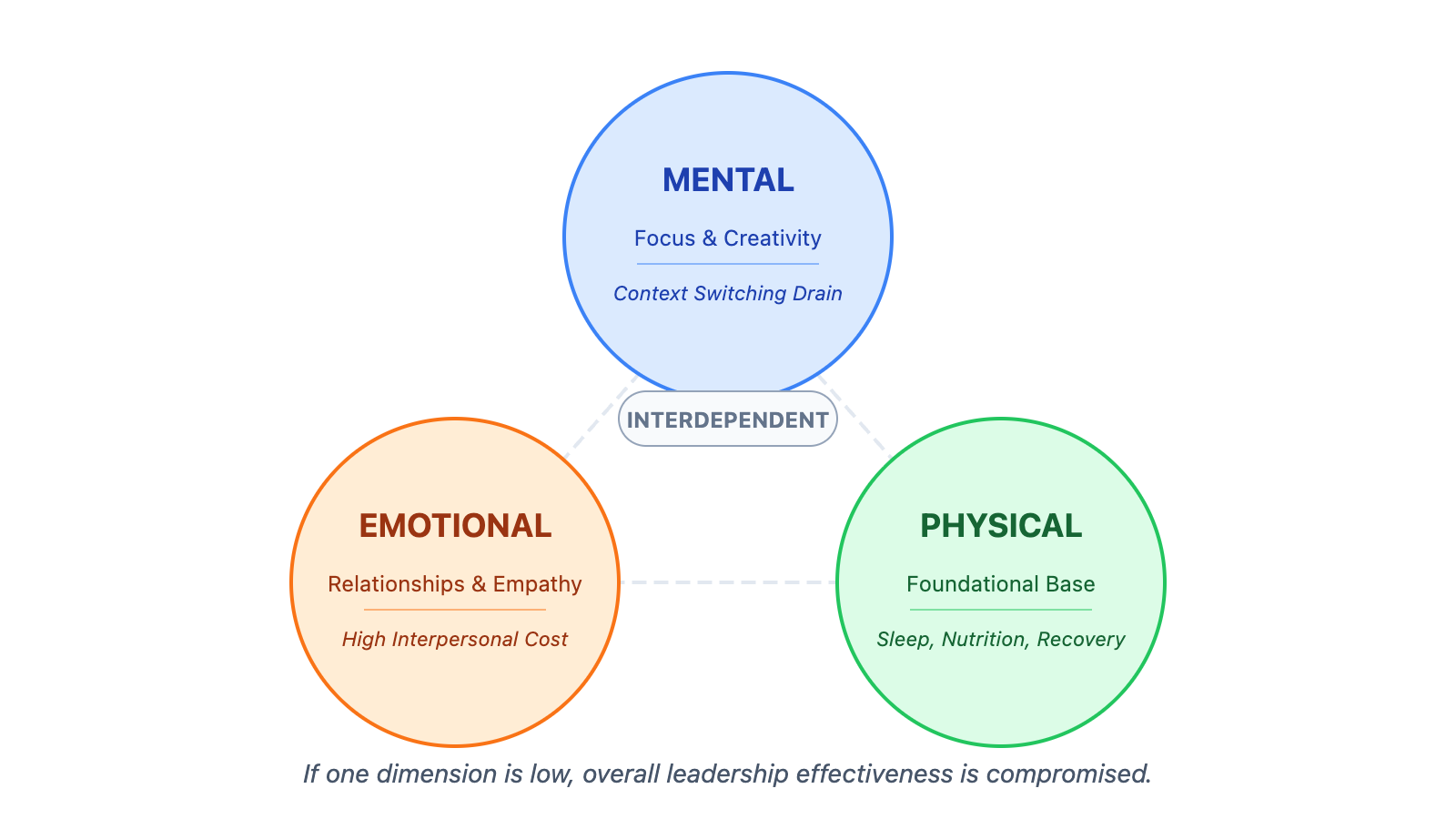
Physical energy is foundational, governed by sleep, nutrition, and recovery. Emotional energy fuels relationships and empathy, depleting quickly during difficult conversations or office politics. Mental energy powers focus and creativity, yet it is easily fragmented by constant context-switching and information overload. When any one dimension is low, your ability to lead effectively is compromised.
To manage these resources, you must audit your energy patterns just as you audit your calendar. Notice when your physical energy peaks and which interactions leave you feeling emotionally spent. Tracking mental clarity allows you to schedule demanding cognitive work during your highest-energy windows. This intentionality ensures you are not just busy, but truly capable of performing your most critical tasks. Smart energy choices directly determine how well you lead your team through challenges.
Identifying "Drainers" and "Givers" in the Managerial Workday
The next step is to distinguish between energy drainers and energy givers in your typical workday. Drainers are activities that deplete your capacity, while givers are those that restore or sustain you. Some drainers are obvious, like pointless meetings, while others are subtle, like the mental load of carrying unresolved decisions. These background items consume cognitive power much like hidden apps draining a phone battery.
To see how this plays out in practice, consider this conversation between two managers reflecting on their weeks:
- Milo: I'm completely wiped out and I can't figure out why. I only had five meetings today — that's light for me.
- Jessica: Forget the count. What were the meetings? Walk me through them.
- Milo: Two back-to-back one-on-ones where people were venting about the reorg, then a budget review I hadn't had time to prep for, then a skip-level with my director, and then a coaching session with Priya on her development plan.
- Jessica: So four of those five drained your emotional or mental energy — absorbing frustration, being underprepared, performing for leadership. And the one with Priya?
- Milo: That one actually felt great. I left it energized.
- Jessica: There's your answer. It's not about how many meetings you had — it's the ratio. Four drainers to one giver is a recipe for exactly how you feel right now. What if you moved the Priya session to right after those venting conversations so you have something that refuels you before the budget review?
Notice that Milo's exhaustion had nothing to do with the quantity of work on his calendar and everything to do with the energy profile of that work. Jessica helped him see that by naming each activity as a drainer or a giver, he could redesign the sequence of his day to protect his capacity — not by doing less, but by balancing the ratio more deliberately. Energy givers are equally important to identify, as they are moments that restore or amplify your capacity. For many people managers, these givers are specific types of work, like coaching a team member or solving a complex problem. The key insight is that energy management is about balancing the ratio deliberately to maintain your capacity over time.
Building a Personal Resilience Toolkit for Long-Term Sustainability
Sustainability requires a personal resilience toolkit comprised of recovery rituals, boundaries, and support structures. Recovery rituals are consistent, non-negotiable practices that restore your energy, such as a walk or a specific end-of-day routine. These small, repeated deposits into your energy reserves compound over time to prevent burnout. The most common mistake is treating recovery as something you will "get to when things calm down." Consistent rituals ensure you have the capacity to lead even during high-pressure periods.
Clear boundaries are equally essential, as they prevent you from becoming a resource that everyone draws from but no one replenishes. These boundaries involve being explicit about when you are available for deep work versus interpersonal support. Beyond boundaries, you must build a support network of peers and mentors who understand the unique pressures of management. These relationships provide the external perspective and processing space needed to maintain long-term effectiveness. Sustainable leaders rarely work in isolation; they leverage support to stay grounded.
Resilience also requires honest self-monitoring to catch the subtle shifts that signal approaching burnout. You must regularly assess whether you are still leading with integrity or if you are beginning to cut corners on critical practices. This check-in connects back to your core values, ensuring your daily actions remain aligned with your leadership standards. In the upcoming role-play session, you will put this into practice by navigating a scenario where your boundaries are tested in real time — learning to protect your energy while remaining collaborative and responsive to a request from above. The goal is to practice the discipline of saying "not right now" without saying "not at all," because sustainable leadership depends on your ability to hold that line.
