Locking in Learning and Progress
Locking in Learning and Progress
Even the most elegant systems suffer from a universal challenge: they decay without deliberate maintenance and refinement. Research shows that 87% of new productivity practices fail within 30 days, not because they don't work, but because practitioners never build the reflective loops that transform initial enthusiasm into lasting habit. This final lesson introduces the 10-minute diary method, a simple practice that locks in your learning, surfaces improvement patterns, and creates accountability structures that turn temporary changes into permanent capabilities.
The power of daily reflection lies not in lengthy journaling or complex analysis, but in consistent micro-captures that compound over time. When you spend just 10 minutes each evening documenting what moved forward, what blocked progress, and what you'll adjust tomorrow, you create a feedback loop that accelerates improvement. Think of it as installing a learning algorithm into your daily practice where each iteration makes the system smarter and better adapted to your unique context. When you extend this practice to your team, you create a culture of continuous improvement where everyone's productivity gains reinforce each other, multiplying the impact beyond individual efforts.
Capturing Progress and Blockers Using the 10-Minute Diary Method
The 10-minute diary method turns the vague intention of "I should reflect more" into a concrete, sustainable practice. At the conclusion of your workday, try to spend about 10 minutes answering these four prompts:
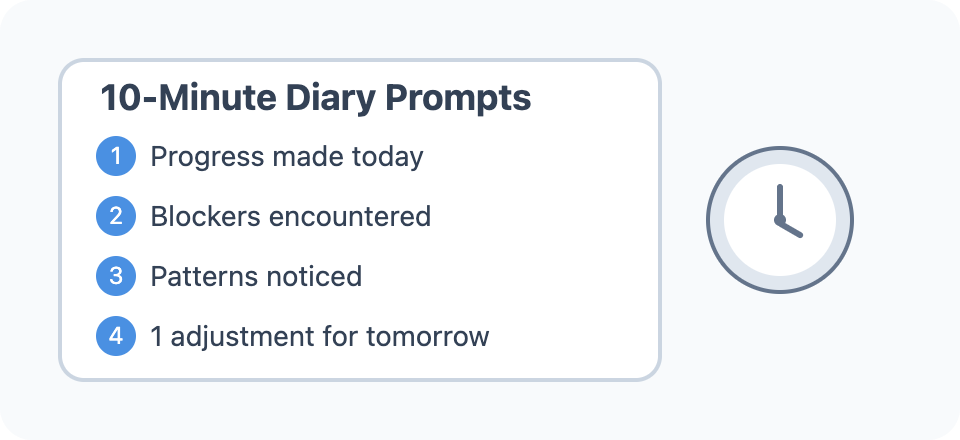
The time constraint prevents overthinking, while the prompts ensure you capture information that drives improvement.
To make the practice automatic, choose a consistent trigger and location, such as shutting down your laptop. Create a simple template in your daily tool to capture the first three prompts: progress made today, blockers encountered, and patterns noticed. Be sure to answer each with specificity and actionable detail. Instead of "Meetings interrupted my flow", note "Lost 45 minutes to context-switching when impromptu sync broke my 10:30 AM focus block". This precision turns vague feelings into data you can act on.
The final prompt—one adjustment for tomorrow—bridges reflection and action. Adjustments should be small, specific, and testable, like "Tomorrow I'll batch all Slack checks to top of each hour" instead of "I'll be less distracted". One engineer's micro-adjustments over two weeks—trying headphones, then adding a 'deep work' status, then sharing with the team—compounded into a major productivity boost.
The diary also acts as an early warning system. If the same blocker appears three days in a row, it signals a problem needing attention. One manager saw "waiting for approval" as a blocker seven times in two weeks and proposed a new approval matrix, eliminating 60% of escalations. Tracking energy and mood alongside progress and blockers can reveal when you're most effective, helping you restructure your week for better results.
Detecting Patterns for Ritual Tweaks
After a week of consistent diary entries, patterns begin emerging that reveal which of your productivity rituals are serving you and which need adjustment. The key is looking across multiple days for recurring themes rather than reacting to single-day anomalies. You're searching for three types of patterns: friction patterns where the same obstacles keep appearing, success patterns where certain conditions consistently produce great outcomes, and energy patterns where your mood and effectiveness correlate with specific practices or times. These patterns become your roadmap for systematic improvement.
Start your pattern detection by reviewing your week's entries with a highlighter or digital marker, coding similar items with the same color or tag. You might mark all mentions of interruptions in red, successful focus sessions in green, and energy dips in yellow. This visual clustering immediately reveals predominant themes.
Success patterns often hide in plain sight because we focus more on problems than on what's working well. When you identify conditions that consistently produce progress, you can intentionally recreate them. Look for correlations between your highest-progress days and specific factors. Perhaps you started with a particular morning routine, worked from a certain location, tackled specific task types, or followed a particular sequence.
Energy patterns reveal the hidden metabolic costs of different activities and help you optimize your ritual timing. Track not just what you accomplish but how you feel during and after different types of work. You might discover that back-to-back video calls create an energy crater that torpedoes your entire afternoon, while alternating calls with solo work maintains steady energy.
The pattern detection process should lead to specific, testable ritual adjustments rather than wholesale system changes. Use the "change one variable" principle from scientific experimentation—adjust a single element of your routine, test it for at least three days, and measure the impact before making another change. Consider, for example, this progression from a software developer's diary synthesis: "Week 1 pattern: afternoon energy crashes killing code quality. Week 2 test: added 15-minute walk at 2 PM. Result: 30% improvement but still sluggish by 4 PM. Week 3 test: kept walk, added protein snack at 3 PM. Result: sustained energy until 5:30 PM. Week 4: standardized both practices." This methodical approach ensures you understand what's actually driving improvements.
Coaching Adoption Across the Team
Extending the 10-minute diary practice to your team multiplies its impact, though it requires thoughtful coaching that addresses natural skepticism about "another documentation requirement". The secret to successful adoption lies in positioning the practice as a performance enhancement tool rather than a compliance exercise, demonstrating personal results before requesting participation, and providing scaffolding that makes the practice nearly effortless to begin. Remember that you're not asking people to journal their feelings—you're offering them a scientific method for systematically improving their own productivity.
Start by sharing your own concrete results from the diary practice, focusing on specific improvements rather than vague benefits. Instead of saying "The diary method really helped my productivity", present data: "After two weeks of diary tracking, I identified that email processing was fragmenting my mornings. I consolidated it into two 20-minute blocks, which freed up 90 minutes of morning focus time and increased my project completion rate by 35%." When team members see tangible outcomes, they become curious about what patterns they might discover in their own work.
The most common objection you'll encounter is "I don't have time for this"—address it by proposing a micro-trial that feels achievable even for skeptics. A seven-day experiment with a three-question simplified version takes only five minutes nightly and provides enough data to demonstrate value. Here's how this coaching conversation might unfold in practice:
- Jessica: Hey Ryan, I wanted to share something that's really improved my productivity. Have you heard about the 10-minute diary method?
- Ryan: Yeah, you mentioned it in the team meeting. Honestly, it sounds like another time sink. I'm already working until 7 PM most nights.
- Jessica: I totally get that—I felt the same way. That's actually why I'm suggesting we start super small. What if you tried just three questions for one week?
- Ryan: Three questions? That's still more documentation at the end of an already long day.
- Jessica: It takes literally five minutes. Here's what I discovered—I was losing two hours daily to email interruptions I wasn't even aware of. Finding that pattern saved me ten hours the following week.
- Ryan: Ten hours from five minutes of writing? That seems unlikely.
- Jessica: I know it sounds too good to be true. Look, try this: What went well today? What got in your way? What's one tiny thing to try tomorrow? Five minutes for seven days. If you don't find at least one useful pattern, we never talk about it again.
- Ryan: And you really think I'll discover something worthwhile in just a week?
- Jessica: In my first week, I realized all my afternoon code had three times more bugs than morning work. One insight, massive impact. Worst case, you lose 35 minutes total. Best case, you find hours of hidden time.
- Ryan: Alright, seven days. But if this is just busy work, I'm done.
- Jessica: Fair deal. I'll send you a simple template. Start tonight, and let's check in on Friday to see what patterns emerge.
Notice how Jessica doesn't push the full diary method but instead offers a minimal viable version that addresses Ryan's time concerns while maintaining the core value of pattern discovery. She uses her own concrete results as evidence and frames the experiment with clear boundaries and an exit clause.
Providing templates and tools removes the startup friction that often derails good intentions. Create a team template with your standard prompts, but allow customization once people understand the basics. You might set up a shared document with private sections for each team member, a simple form that emails responses to individuals, or a chat bot that sends evening prompts. By eliminating all setup decisions, you increase the likelihood that people will actually try the practice rather than intending to start "when they have time to set it up properly".
Supporting continued adoption requires regular lightweight check-ins that maintain momentum without becoming burdensome oversight. Schedule a brief weekly pattern share where team members voluntarily share one insight or improvement from their diary practice, keeping it casual and celebratory rather than mandatory and formal. This creates positive peer influence and idea cross-pollination without feeling like surveillance. Furthermore, share your own ongoing discoveries and adjustments to model that this is a continuous practice, not a one-time exercise.
With the 10-minute diary method, pattern detection skills, and team coaching approaches you've mastered in this lesson, you're equipped to create sustainable improvement cycles that compound over time. The upcoming roleplay session will challenge you to coach a skeptical peer through diary adoption, while practical exercises will guide you in creating templates and running your own pattern analysis to surface high-impact ritual adjustments.
