Applying Levels of Delegation
Applying Levels of Delegation
Many people operate with only two delegation modes. They either dump tasks with minimal context, saying things like "Just handle it," or they hover anxiously over every decision with instructions like "Check with me before you do anything." This binary approach fails because delegation isn't actually binary—it exists on a spectrum with at least five distinct levels, each appropriate for different combinations of task complexity, individual capability, and risk tolerance. By mastering this spectrum and learning to explicitly communicate which level you're using, you'll transform delegation from a source of frustration into a powerful development tool that simultaneously frees your time and grows your team's capabilities.
Note: The five levels of delegation were originally developed for people management, but the same principles apply to anyone who needs to share responsibility, assign tasks, or clarify ownership—whether or not you have formal authority. If you’re a project lead, a senior team member, or simply collaborating with others, you can use these levels to clarify expectations, support others’ growth, and ensure work gets done effectively. Throughout this lesson, when you see examples involving managers or direct reports, feel free to substitute your own context—these levels work for any situation where you’re handing off work or decisions to someone else.
The foundation of effective delegation begins with understanding that not all tasks deserve the same treatment. Consider the five levels of delegation as a ladder of increasing autonomy:
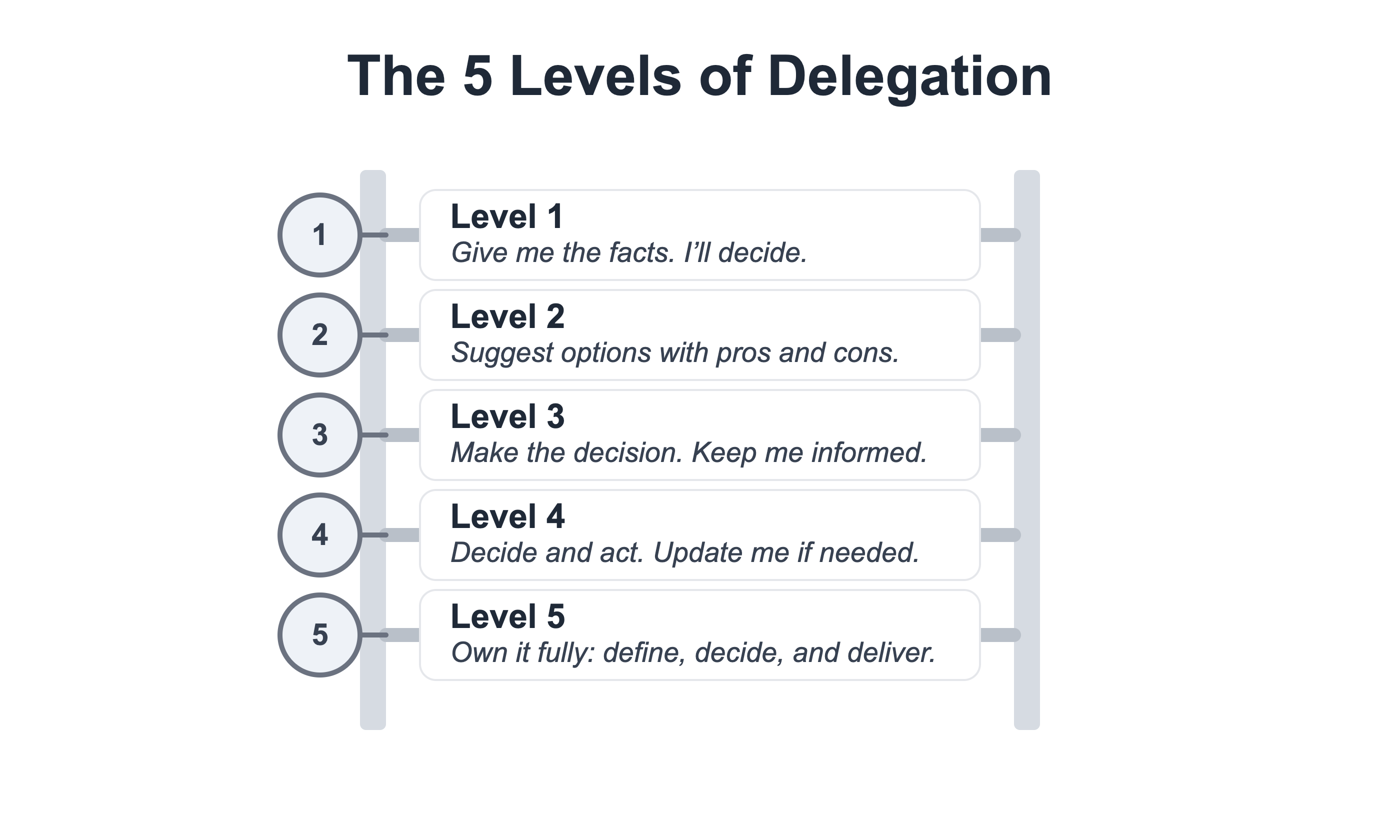
To match the right level to each situation, you need to evaluate three critical dimensions:
- Task priority
- Readiness of the person taking on the task
- Reversibility of decisions.
For instance, a high-stakes customer presentation with someone new to the task might warrant Level 2 delegation, where they research and recommend while you make the final call. Meanwhile, updating routine documentation with someone experienced could easily be Level 4, where they handle it independently and only escalate true exceptions. The key insight here is that the same person might operate at different levels for different types of work. Your star analyst might function at Level 5 on data modeling but only at Level 2 on stakeholder communications if that remains a growth area for them.
Specifying Outcomes, Guardrails, and Check-ins
Once you've selected the appropriate delegation level, success depends on crystal-clear communication of three essential elements: the outcome you're seeking, the guardrails that define acceptable approaches, and the check-in rhythm that keeps things on track without micromanaging. Many delegation failures stem not from choosing the wrong person or level, but from fuzzy expectations that leave people guessing about what success looks like or what boundaries they must respect.
Let's watch how someone sets up a delegation with all three elements clearly defined. (Note that these roles could be anyone sharing or assigning responsibility.)
- Jessica: Dan, I need you to own the quarterly customer satisfaction report. Let me walk you through exactly what I'm looking for.
- Dan: Sure, I'm ready to take notes.
- Jessica: The outcome I need is a 10-page report by April 7th that includes satisfaction scores by segment, top three pain points with supporting data, and specific recommendations for each. Success means the executive team can make decisions directly from your report without needing clarification.
- Dan: Got it. What about the approach—any specific requirements?
- Jessica: Good question. Here are your guardrails: use only validated survey data from the last 90 days, budget up to $2,000 for any additional analysis tools you need, and don't contact customers directly—work through the customer success team. Beyond that, you have complete freedom on methodology and presentation style.
- Dan: That's really helpful. How often should I check in with you?
- Jessica: Let's do a quick 10-minute sync every Thursday at 2pm, plus send me a one-line status in our team channel every Monday—just green, yellow, or red. If you hit any blockers that could delay the April 7th deadline by more than two days, text me immediately.
- Dan: Perfect. I feel really clear on this. I'll have my initial data analysis ready for our Thursday sync.
Notice how Jessica covered all three critical elements in a natural conversation that took less than two minutes. Dan walked away knowing exactly what success looks like, what boundaries he must respect, and when to communicate updates or escalations.
Starting with outcomes, you must define them in concrete, observable terms that leave no room for misinterpretation. Rather than saying something vague like "Improve our documentation," you would specify "By March 15, create a searchable wiki with troubleshooting guides for our top 10 customer issues, each with screenshots and resolution times under 5 minutes." This precision eliminates those endless cycles of "This isn't quite what I had in mind" that drain energy and destroy confidence. Your outcome definition should answer three fundamental questions: What does "done" look like? By when? How will we measure success?
Guardrails represent the boundaries within which the person has full autonomy to operate creatively. These aren't step-by-step instructions but rather the non-negotiables that protect against unacceptable risks or approaches. You might specify something like "Stay within the approved $15K budget, don't commit to any timeline changes without checking with me, and ensure all solutions comply with our data privacy standards. Beyond that, you have full freedom to approach this however you think best." This approach gives the person complete ownership over the how while you retain control over critical constraints that could cause broader problems if violated.
The check-in cadence provides the safety net that allows both parties to proceed with confidence. Instead of random "How's it going?" interruptions that disrupt flow, establish a predictable rhythm such as "Send me a one-paragraph status every Tuesday at 4pm, and we'll do a 15-minute deep dive every other Friday." For higher-risk or higher-complexity work, you might add trigger-based check-ins like "Also ping me immediately if you hit any blockers lasting more than 4 hours or if the vendor pushes back on our requirements." This structured approach ensures everyone stays informed without becoming a bottleneck, while the person taking on the task knows exactly when and how to engage for support.
Creating Lightweight Decision Logs
Lightweight decision logs serve multiple critical purposes. They protect everyone if questions arise later, accelerate onboarding of new team members who can learn from past decisions, and create a valuable knowledge base that prevents repeatedly solving the same problems. Most importantly, they provide a clear trail of accountability that reduces anxiety for people worried about making mistakes.
A functional decision log doesn't require complex tools or lengthy documentation. A simple shared document or spreadsheet works perfectly when it includes columns for Date, Decision, Rationale, Delegation Level, and Outcome. An entry might read:
- Tuesday, April 1st: Switched from Vendor A to Vendor B | 20% cost savings with comparable SLA; validated with technical team | Level 3 | Smooth transition, no service disruptions.
This brief capture takes less than two minutes but provides invaluable context months later when someone asks "Why did we choose this vendor?" or when you're evaluating decision-making patterns during reviews.
The key to adoption lies in making these logs natural extensions of existing work rather than additional burdens. Integrate log updates into your check-in cadence with instructions like "As part of your Tuesday status update, add one line to the decision log for any Level 3+ decisions you made this week." You might also create simple templates that prompt the right information without requiring lengthy narratives. A delegation kickoff template could include fields such as Task, Owner, Level, Outcome Needed, Key Constraints, First Check-in, and Decision Log Location. This standardization ensures nothing falls through the cracks while keeping documentation time to an absolute minimum.
With your understanding of delegation levels, clear communication frameworks, and lightweight documentation systems now in place, you're ready to put these concepts into practice. In the upcoming roleplay session, you'll work with someone who's been over-checking decisions, helping them understand their delegation level while building their confidence to act independently. You'll also complete practical exercises to assess appropriate delegation levels for your current tasks and craft crystal-clear delegation kickoff messages that set your team up for success.
