Evaluate Evidence Across Different Domains
Introduction 🎉
Welcome to Evaluating Evidence Across Different Domains! In the previous lesson, you assembled a powerful tool: the five-step evaluation routine. That routine tells you how to evaluate a claim. This lesson turns to the equally important question of where those evaluations happen, showing you how the same routine applies whether a claim comes from a doctor's office, an investment brochure, a casino floor, or a product advertisement. In this lesson, you will learn to:
- Recognize recurring misconceptions beneath the surface story by seeing how base rate neglect, survivorship bias, regression to the mean, and small-sample overconfidence reappear in domain after domain wearing different costumes.
- Match errors to the questions that expose them by connecting each misconception to the specific step of your routine that catches it, so a misleading health statistic feels just as familiar as a misleading gambling pitch.
- Evaluate claims in unfamiliar territory with confidence by mapping any new claim onto a shared grid of misconceptions and domains, letting you know exactly what to ask even when the subject is brand-new to you.
The Same Errors in Different Clothing 👕
Probability misconceptions are like a small troupe of actors who keep changing costumes. The characters are always the same — base rate neglect, small-sample overconfidence, survivorship bias, regression to the mean — but the stage set changes from a hospital to a trading desk to a poker table to a shopping cart.
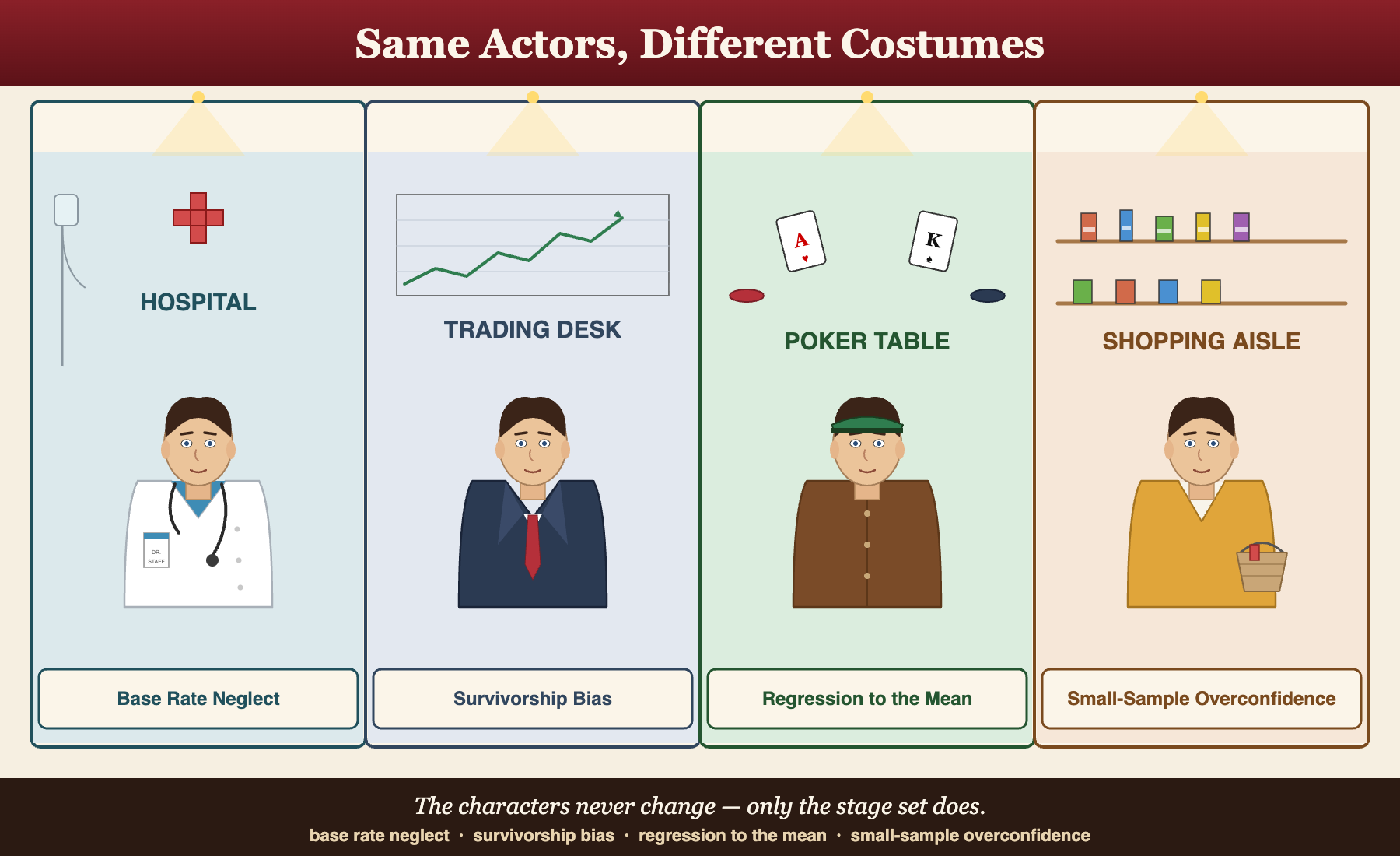
Why does this matter? Because most people learn to spot an error in one context but fail to notice the identical error in another. Someone who laughs at the gambler's fallacy at a roulette wheel may still believe that a stock is "due for a bounce" after three bad quarters. Recognizing the underlying structure, rather than the surface story, is what makes your reasoning truly transferable.
This lesson walks through four major domains (health, finance, gambling, and consumer products) and highlights which actors tend to take center stage in each one. Along the way, you will see that the evaluation questions you already know apply in every setting; only the vocabulary changes.
Health Claims: Where Stakes Feel Personal 🏥
Health is one of the most emotionally charged domains for probability claims, which makes it one of the easiest places for errors to slip past us. Two patterns appear especially often.
Base rate neglect is widespread in medical screening. Even a highly sensitive test produces mostly false alarms when the condition is rare. What changes in the health domain is the emotional weight. A patient who receives a positive screening result rarely pauses to ask, "What is the base rate of this disease?" Fear takes over, and the base rate gets ignored. Keeping that question at the front of your mind is the single most valuable habit you can bring to a medical conversation.
Relative risk without a baseline is another frequent guest. A headline stating "This food increases cancer risk by 50%" sounds frightening, but if the baseline risk is 2 in 1,000, a 50% relative increase brings it to 3 in 1,000, an absolute increase of just 0.1 percentage points. Restating in absolute terms almost always lowers the emotional temperature and reveals whether the effect is genuinely worth worrying about.
Finance Claims: Where Patterns Tempt Us 💵
Financial markets generate enormous amounts of data, which ironically makes them fertile ground for false pattern detection.
Survivorship bias is perhaps the signature error of the investing world. When a fund family advertises that its funds have "beaten the market for 10 years," it often quietly excludes funds that performed poorly and were merged or closed. If 100 funds started and 30 were shut down for underperformance, the remaining 70 will naturally have better track records — not because of skill, but because failure was removed from the picture. By naming what's missing, step 5 from the evaluation routine, you can catch this misconception.
Regression to the mean also misleads investors regularly. A fund manager who delivers exceptional returns one year often has much more ordinary results the next. That does not necessarily mean the manager suddenly became less skilled. Exceptional years are usually a combination of skill and favorable circumstances. Those favorable circumstances are unlikely to repeat year after year, so performance often moves back toward a more typical level. Investors who chase last year's top-performing fund may mistake a short-lived exceptional result for evidence of consistently superior performance.
Gambling Claims: Where Fallacies Are Built In 🎲
Gambling contexts are where many of these misconceptions were first identified and named, so they serve as a useful reference point for all other domains.
The gambler's fallacy is the belief that past outcomes influence future independent events. After seeing red appear six times in a row on a roulette wheel, many players feel that black is "due." But each spin is independent, and the probability of black remains the same probability regardless of history. The wheel has no memory.
Hot-hand thinking is essentially the flip side. A poker player on a winning streak may feel they "can't lose" and increase their bets. While poker does involve skill, the portion of success attributable to a lucky run of cards will naturally fade. Confusing a temporary streak with lasting momentum leads to overconfidence and, often, larger losses.
Notice that the gambler's fallacy and hot-hand thinking are the same two errors you may see in finance, just on a faster timescale: one predicts a reversal that is not justified, and the other predicts continuation that is not justified. Recognizing this parallel is exactly the kind of cross-domain transfer we are building toward.
Consumer Claims: Where Framing Does the Selling 🛒
Product marketing is designed to persuade, and probability-related framing is one of its sharpest tools. Two patterns come up over and over.
Small-sample testimonials are a staple of advertising. "4 out of 5 users saw results!" may be technically true, but if the sample was only 10 people, that fraction is highly unreliable. The result could easily change if just a few more people were surveyed then. Small samples naturally produce more variable results, making dramatic percentages appear more convincing than the underlying evidence deserves. Before trusting a testimonial or survey result, ask how many people was this based on?
Cherry-picked comparisons are equally common. A product might claim to be "3× more effective than the leading brand" — but effective at what? Measured how? Over what time period? And what counts as the "leading brand"? These are exactly the kinds of questions your evaluation routine is designed to uncover. When important details are missing, the comparison may sound impressive without providing enough evidence to judge it fairly.
Mapping Errors Across Domains 🗺️
Now let's put everything side by side. The table below shows how the same underlying misconceptions take different surface forms depending on the setting. Recognizing these parallels is the key skill of this lesson.
| Misconception | Health | Finance | Gambling | Consumer |
|---|---|---|---|---|
| Base rate neglect | Overreacting to a positive screening test | Ignoring how rare market-beating skill is | Overestimating odds of a jackpot | Believing a rare defect report means a product is dangerous |
| Survivorship bias | Citing miracle recoveries while ignoring typical outcomes | Showcasing only funds that survived | Remembering big wins, forgetting losses | Displaying only glowing reviews |
| Regression to the mean | Crediting a remedy when symptoms naturally improve | Expecting a star fund to repeat | Expecting a winning streak to continue | Trusting a product because it "worked last time" |
| Small-sample overconfidence | Trusting a case study of 5 patients | Drawing conclusions from one quarter of returns | Judging a strategy after 20 hands | Relying on 3 online reviews |
| Relative change without a baseline | "Doubles your risk" from a tiny baseline | "Cuts your chance of losing money by 50%" without stating the original loss rate | "Doubles your chance of winning" when the odds move from 1 in 10,000 to 2 in 10,000 | "3× more effective" without saying what the original success rate was |
When you encounter a new claim, try placing it in this grid. If you can identify the row (the misconception) quickly, you already know what questions to ask regardless of the column (the domain).
Conclusion and Next Steps
The core takeaway from this lesson is that probability errors are not domain-specific; they are reasoning-specific. Whether someone is selling you a supplement, a mutual fund, a betting strategy, or a kitchen gadget, the underlying tricks are drawn from the same small playbook. By learning to see through the surface story to the structural error beneath, you can evaluate claims in unfamiliar territory with the same confidence you bring to familiar ones.
Now it is time to put this cross-domain thinking into action. In the upcoming practice exercises, you will identify reasoning errors across multiple fields, pinpoint the evidence that matters most for evaluating each claim, match claims that share hidden similarities, and write your own evaluation of a real-sounding claim. Let's see how quickly you can spot the actors beneath the costumes!
