Balance Likelihood and Consequence
Introduction 🎉
Welcome to Balance Likelihood and Consequence! Over the previous lessons, you built a five-step evaluation routine, learned to spot reasoning errors across health, finance, gambling, and consumer domains, and practiced critiquing framing tricks and selective evidence in media and advertising. All of those skills answer one question: what does the evidence actually say? This lesson takes the next step — turning what the evidence says into decisions you can act on. In this lesson, you will learn to:
- Weigh probability and consequence together by asking not just how likely an outcome is, but how serious it would be, so your attention flows toward the risks that actually matter most.
- Diagnose the two classic decision traps by recognizing when a vivid, rare danger is pulling you into overreaction and when a familiar, probable one is lulling you into complacency.
- Calculate and apply expected impact by multiplying probability and consequence to compare options side by side — while knowing when a catastrophic or deeply personal outcome calls for looking beyond the math.
Weigh Both Sides of a Risk ⚖️
Think about how people typically react to risk. Many travelers worry about plane crashes but think nothing of texting while driving. The fear flows toward the rare, dramatic event and away from the common, undramatic one. This mismatch is not a sign of ignorance; it is a deeply human tendency. Our brains respond strongly to vivid, catastrophic images and weakly to familiar, low-key hazards.
The problem is that basing decisions on vividness alone leads to poor choices. A well-reasoned decision asks two questions:
- How likely is this outcome?
- How serious would it be?
When you ignore either dimension, you can fall into one of two predictable traps.
Overreacting to rare risks happens when a consequence is so dramatic that it dominates your thinking regardless of how unlikely it is. Consider spending hundreds of dollars on exotic travel insurance for a disease that affects 1 in a million travelers. The consequence (serious illness) is genuinely severe, but the probability is so small that the expected harm is tiny. Fear, not evidence, is driving the decision.
Underweighting likely risks is the opposite trap. Skipping a flu shot because "it's just the flu" ignores the fact that influenza is both common and potentially costly, causing missed work, medical bills, and real discomfort. The consequence per episode may seem modest, but the relatively high probability means the overall expected impact is much larger than it first appears.
Recognizing which trap is at play is the first step toward a more balanced judgment.
The Likelihood-Consequence Grid 🔲
A simple framework for organizing your thinking is a two-by-two grid that plots probability against consequence. Before doing any math, just placing a scenario into the right cell can sharpen your intuition.
| Low Consequence | High Consequence | |
|---|---|---|
| High Probability | Routine nuisance (e.g., a minor traffic delay) | Urgent priority (e.g., repeatedly driving without a seatbelt over many trips) |
| Low Probability | Easy to accept (e.g., losing a cheap pen) | Worth preparing for (e.g., a house fire) |
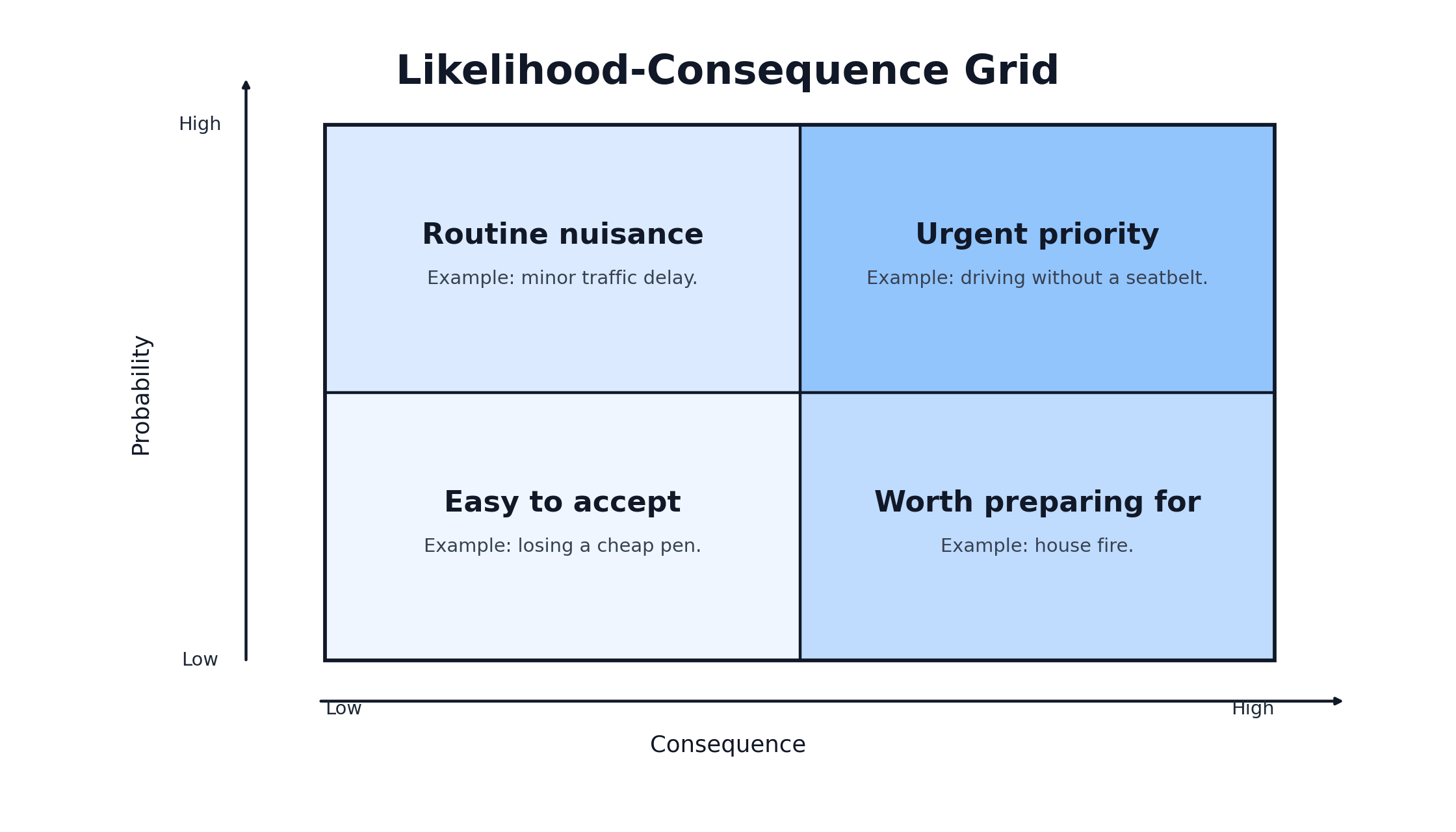
Note: For repeated behaviors like driving without a seatbelt, "high probability" refers to cumulative risk over many trips, not the chance of a serious crash on any single drive.
Notice that the two off-diagonal cells cause the most confusion. A high-probability, low-consequence event may not feel worth worrying about, yet its cumulative effect can be large. A low-probability, high-consequence event may feel terrifying, yet it might not justify an expensive response. The grid reminds you to check both axes before you react.
Expected Impact: Combining Probability and Consequence 🎯
When Expected Impact Is Not Enough 🚧
Expected impact is a powerful tool, but it has limits worth respecting.
Catastrophic, one-time losses deserve extra weight. If a single bad outcome could ruin you financially, such as an uninsured house fire, the expected-impact number alone may understate how much protection matters. A 0.3% chance of losing a $300,000 home gives an expected loss of $900 per year, yet most people rightly pay more than $900 for homeowner's insurance because the unrecoverable nature of the loss matters beyond the average.
Non-monetary consequences resist simple multiplication. Health, safety, and emotional well-being do not reduce neatly to dollar figures. In these cases, the expected-impact formula still helps structure your thinking, but the final decision may reasonably weigh personal values and risk tolerance alongside the math.
Expected impact helps you compare options logically, but it does not replace judgment. Some risks are so severe that even a very small chance justifies preparation. Others involve values, such as health, safety, or peace of mind, that cannot be captured fully by a dollar amount. Use expected impact as a tool to organize your thinking, then decide whether the situation calls for additional caution.
Conclusion and Next Steps
