Writing Effective Prompts
Writing Effective Prompts ✍️
Now that you’ve picked a task for AI, the next move is harder and more useful: asking for the output in a way the model can actually deliver. A vague prompt produces a vague draft, which will then waste twenty minutes editing—the exact time you were trying to save. A strong prompt brings the important details upfront so the first output is much closer to usable. This unit gives you a framework for writing strong prompts, a method for turning fuzzy marketing requests into specific deliverables, and a habit for improving prompts after a weak first try.
By the end, you’ll be able to:
- Use the RACE framework to structure clear, complete prompts.
- Translate vague marketing requests into specific AI-ready deliverables.
- Refine weak outputs by tightening the prompt instead of simply asking the model to “try again.”
The RACE Framework 🏁
Treat every prompt like a brief you'd hand to a sharp freelancer who's never met your brand. To ensure consistency and high-quality responses, use the RACE framework—a four-step model designed to eliminate guesswork.
- R - Role (Who is the AI?): Assign a persona or expertise level. By telling the AI it is an "expert brand copywriter" or a "senior lifecycle-marketing strategist," you set the tone and the knowledge base it should pull from.
- A - Action (What do you want?): State the exact task using clear, directive verbs. Instead of "look at this," use "draft," "summarize," "critique," or "rewrite."
- C - Context (Why does it matter?): Provide the background, the exact audience, and the constraints. This is where you name the campaign, who will read it (which segment and funnel stage — a cold prospect and a loyal customer need different copy), and any "guardrails" (what to avoid: unverified claims, invented stats, off-brand tone, pricing you can't promise).
- E - Execute (How should it look?): Specify the format, length, and style — and make it channel-specific, because every channel has its own rules. An Instagram caption that front-loads the hook before the ~125-character fold, three variants; an email subject line under ~50 characters plus preview text; a Google ad headline that fits 30 characters; an SEO blog section built around one search intent. Providing an example of the desired style here is the most effective way to get a perfect match.
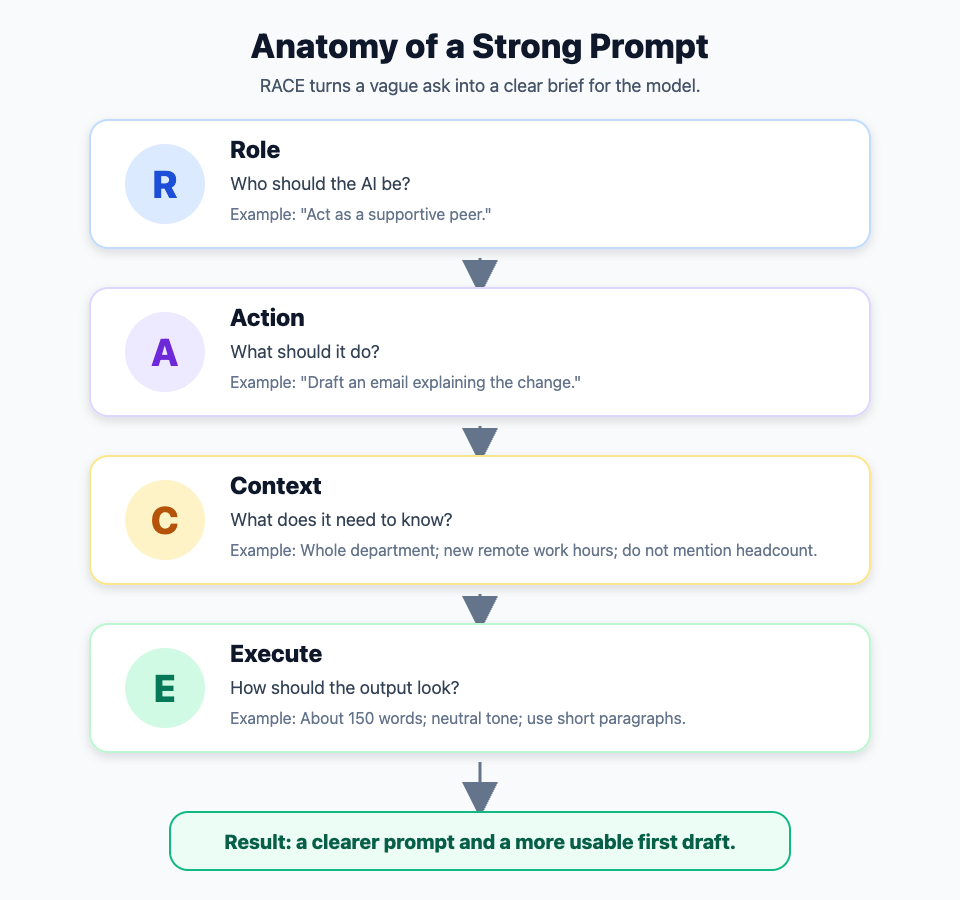
The reason this works ties back to how language models operate: they predict based on the context you give them. Sparse context leads to generic, off-brand predictions. A structured RACE prompt leads to sharper, on-brand results.
The Two RACE Slots Marketers Can't Skip 🛟
RACE works for any prompt, but two of its slots are where marketing prompts live or die. Skip them and you get fast, confident, unusable copy.
- Brand voice belongs in Role (and Context). "Write a caption" gets you the model's generic, upbeat voice. "You are our brand copywriter — our voice is warm, plain-spoken, and lightly witty; we never use exclamation points or the word 'revolutionary'" gets you something that sounds like you. Pasting two or three lines of real, on-brand copy as a reference improves the match more than any pile of adjectives.
- Claim guardrails belong in Context. Because the model will happily invent stats, awards, and superlatives, spell out the fence every time: "Use only the benefits and numbers I provide. Do not invent statistics, testimonials, awards, or comparative claims, and do not promise pricing or availability beyond what's stated." That single sentence is often the difference between a draft you can ship and a claim Legal has to unwind.
Turning Vague Requests Into Specific Deliverables 🎯
Most marketing requests show up vague. Your manager forwards a one-liner, or a stakeholder drops "can you draft something for the launch" in Slack. The instinct is to type that vague phrase straight into the AI.
Don't.
Translate the vague request into the RACE components before you write the prompt. Let's look at an example:
- Natalie: Can you draft something for our customers about the loyalty program change?
- Chris: Happy to. Quick check so I get it right the first time: what’s the goal here (Action), and who exactly is reading it (Context)?
- Natalie: It’s an email to existing members, about 150 words (Execute). We need to explain the new points tiers without promising any rewards that aren't locked yet (Context/Constraints).
- Chris: Got it. Should I sound like a warm peer or a formal brand voice (Role)?
- Natalie: Warm peer, keep it on-brand and upbeat.
Notice Chris didn't open the AI tool yet. He pulled the missing Role, Context, and Execution details out of Natalie in thirty seconds. Because he has the RACE elements ready, his first draft will be significantly more accurate and on-brand.
Refining The Prompt After The First Output 🔧
Even a strong RACE prompt rarely lands perfectly. The first output is diagnostic data, not a verdict. Read it and ask which part of the framework was thin:
- If the tone is too robotic or off-brand: Your Role was too broad.
- If the model missed the point: Your Action wasn't specific enough.
- If it included a claim it shouldn't have: Your Context lacked constraints.
- If the structure is messy, or it's the wrong length or format for the channel: Your Execute instructions were too loose or weren't channel-specific.
Don't argue with the model in chat or ask it to "try again, better." Rewrite the prompt itself, tightening the RACE elements that failed, and re-run. This gives you a reusable prompt for the future. Save the strong version in a team prompt library. Future-you (and the rest of the team) will thank present-you.
The takeaway: prompts are briefs, not questions. Structure your request using RACE, then refine based on what the first output reveals. Next, you'll move into a live practice session where you'll apply RACE to a sensitive marketing scenario.
