Cloud Deployment Models
Public, Private, and Hybrid Cloud ☁️
Deployment choices determine who owns infrastructure and how workloads are placed. In this lesson, you will learn to:
- Distinguish public, private, hybrid, and multicloud models
- Match deployment models to common business constraints
- Explain how hybrid cloud can separate sensitive and public workloads
So far you've treated "the cloud" as a single thing. It isn't. Once an organisation decides it wants cloud-style computing, a second question arrives immediately: whose hardware does it run on, and who else is allowed to use that hardware? The answers to those two questions produce four labels you'll hear constantly, and getting them straight is what lets you sit in a room with an IT lead and a finance director and have all three of you mean the same thing.
Four Models, Sorted by Ownership and Access 🔐
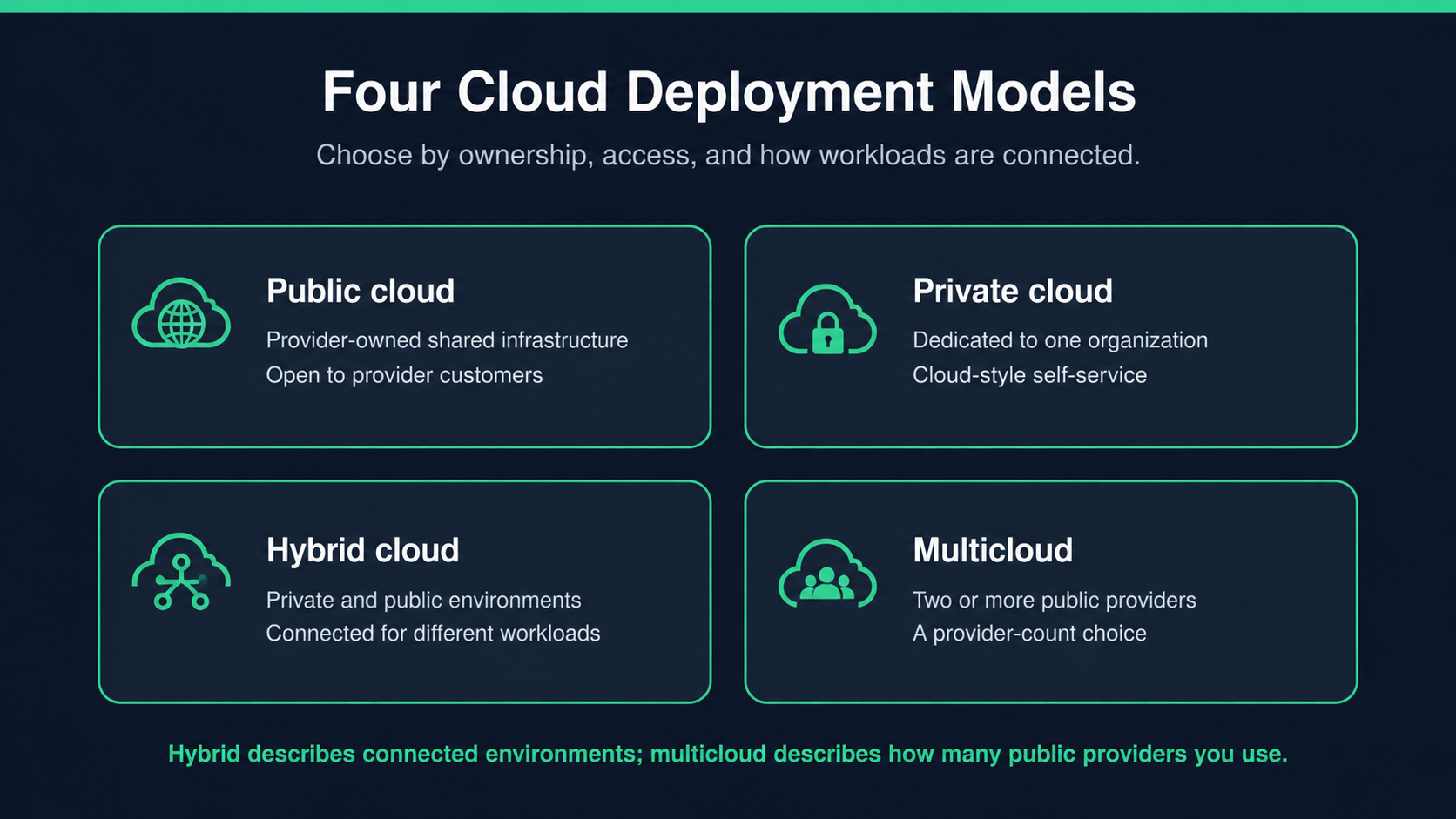
Start with public cloud. The provider owns the hardware, and anyone who signs up can use it. Your virtual machines run on physical servers that also carry other customers' workloads, kept apart by software. It's the model behind almost everything people mean when they say "we moved to the cloud," and it's why capacity feels endless: the provider bought far more than you'll ever need.
Next is private cloud. Here the hardware is dedicated to a single organisation, and only that organisation may use it. Importantly, private cloud isn't just an old server room with a new name. It behaves like a cloud, with self-service provisioning, pooled resources, and usage measured per team, but the pool is exclusive. It might live in your own data centre or be dedicated hardware a provider rents to you alone. What defines it is exclusivity of use, not physical location.
Then comes hybrid cloud: some workloads on hardware the organisation controls, some on a public provider, with a network connection linking the two so they operate as one environment. And multicloud is different again. It means using two or more public providers at once, perhaps Amazon Web Services for one application and Microsoft Azure for another. Multicloud is about how many providers you use; hybrid is about whether any of your own hardware is still in the picture. Plenty of people blur these two, and being the person who doesn't is quietly valuable.
- Natalie: The supplier keeps saying "private cloud" and I keep hearing "the servers we already own." Same thing?
- Ryan: Not quite. Our current servers have fixed capacity and someone files a ticket to get anything. A private cloud lets teams provision for themselves from a shared pool, it's just that the pool is ours alone.
- Natalie: So the difference is how it behaves, not where the box sits.
- Ryan: Exactly. And if we also ran the public website with a provider and connected the two, that combination is what "hybrid" means.
- Natalie: Right. And if we used two providers instead of one?
- Ryan: That's multicloud. Different question entirely.
Notice that Ryan never answers with a definition alone; he answers with who owns the hardware and who's allowed on it. That test resolves nearly every case you'll meet.
