Cloud Adoption Drivers
Why Organisations Move to the Cloud 🎯
Organisations move to the cloud to solve specific business constraints. In this lesson, you will learn to:
- Explain the main drivers of cloud adoption
- Distinguish capital expenditure from operating expenditure
- Summarise the trade-offs of a cloud move honestly
Knowing what cloud computing is doesn't yet tell you why anyone bothers. Organisations don't move because renting sounds appealing; they move because something specific hurts. In this unit you'll look at the five reasons that come up most often, the money language that surrounds the decision, and the trade-offs an honest engineer names out loud.
The Five Main Drivers of Adoption ⚡
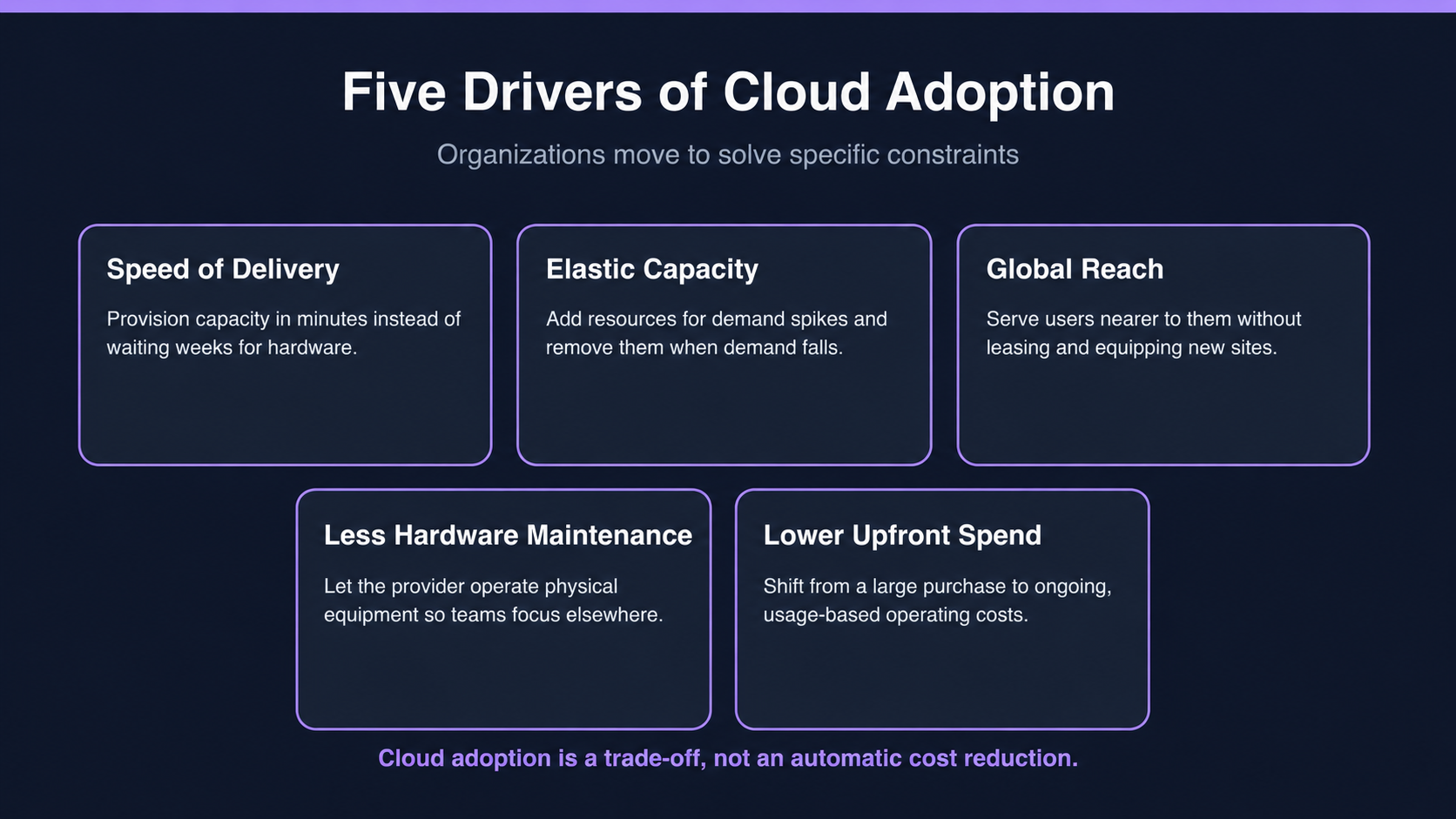
The first driver is speed of delivery. Buying a server means a quote, an approval, a delivery window, and a rack visit, often six weeks end to end. In the cloud, that same capacity exists in minutes, so a project that would have waited a month and a half starts on Monday.
The second is elastic capacity. Plenty of systems have demand that isn't flat. A public booking service might be overwhelmed every September and nearly idle every February. Bought hardware must be sized for September, which means paying all year for capacity used for eight weeks. Elastic capacity lets you add machines for the rush and remove them afterwards.
The third is global reach. Providers already operate data centres on most continents, so serving users in another country means choosing a location in a console rather than negotiating a lease and shipping equipment.
The fourth is less hardware maintenance. Someone currently spends their Friday afternoons swapping failed disks, applying firmware updates, and worrying about the air conditioning. That work is real, unglamorous, and doesn't move the business forward. When the provider owns the hardware, that work leaves your team.
The fifth is lower upfront spend. Instead of one large purchase before anything runs, you pay as you go. That distinction deserves its own section, because it's usually the part where the conversation shifts from engineering to finance.
Capital Expenditure Versus Operating Expenditure 💰
