Two Minute Interrupt Routine
The Two-Minute Interrupt Routine ⏱️
You already have three separate tools: the four-step reframe, the sensory countdown, and physical interrupts. Under real pressure, choosing between them becomes one more decision your overloaded brain has to make. That’s why this lesson combines them into one fixed sequence you can run automatically. When overthinking strikes, you need a go-to script that works automatically under stress.
By the end of this lesson, you will have learned how to:
- Script a personalized Two-Minute Interrupt Routine with the correct block order and time allocation
- Rehearse the full routine from memory against simulated high-risk triggers until you can execute it cleanly
- Coach someone through their first run by adapting each block to their thoughts, environment, and intensity
🛟 Script Your Personalized Two-Minute Rescue Routine
The Two-Minute Interrupt Routine runs in one fixed order: Physical Reset, Mental Reframe, Grounding Anchor. Under stress, this sequence acts as a mental emergency kit you can use without choosing between tools.
In the previous lesson, you learned a diagnostic approach to match specific tools to your intensity level. Think of this fixed sequence as your default emergency response when a spiral hits too fast for decision-making. The diagnostic model still matters: use it to determine the best action for your Physical Reset phase — like escalating to a location change if the intensity is high — or to deploy a single tool when a full two-minute routine isn't necessary.
- Physical Reset (30 seconds): Take ten steps while counting aloud, then change your posture or location. This interrupts the body-mind loop and signals that something different is happening.
- Mental Reframe (60 seconds): After the Physical Reset, check whether you can form a full sentence in your head. If you can, use the four-step method: notice the thought, name the distortion, neutralize it with balanced language, and identify the next step. If you cannot, you do not need to force the reframe. Use the intensity guide to strengthen your Physical Reset, such as moving to a quieter location if it is safe and practical, then check again. If a full sentence still feels out of reach, move to the Grounding Anchor and return to the reframe when you are ready. The two-minute timing is a practice target, not a reason to push through a step you cannot yet use.
- Grounding Anchor (30 seconds): Complete the 5-4-3-2-1 sensory countdown. This returns your attention to the present and helps prevent the spiral from restarting.
Personalize each phase: choose where you can take ten steps, which posture or location change is practical, the distortions you encounter most often, and familiar objects you can use for grounding. Keep the script simple enough to remember when your working memory shrinks under stress. You can even write it on a note card: 10 steps + posture change → 4-step reframe → 5-4-3-2-1 grounding.
Let’s see how this routine plays out in a real conversation. Victoria is preparing a version she can remember and use when she notices herself beginning to spiral. Chris helps her confirm the sequence, timing, and actions without making the routine overly complicated.
- Chris: Victoria, could you walk me through the three phases of your routine in order?
- Victoria: I’ll begin with the Physical Reset, move into the Mental Reframe, and finish with the Grounding Anchor.
- Chris: Exactly. How much time will you give each phase?
- Victoria: I’ll spend thirty seconds on the Physical Reset, sixty seconds on the Mental Reframe, and thirty seconds on the Grounding Anchor.
- Chris: That gives you the full two minutes. What will you do first during the Physical Reset?
- Victoria: I’ll take ten steps while counting aloud, then change my posture or move to a different location.
Notice what Chris does here. He doesn't lecture — he asks Victoria to recite the sequence, the timing, and the first concrete action. That's the test that matters. If you can name the three phases in order, allocate 30-60-30 seconds, and describe the exact first move of the Physical Reset without hesitation, your script is ready to survive real stress. If you stumble on any of those, rehearse until you don't.
Rehearse Against a Simulated High-Risk Trigger 🎯
A script you can read becomes a routine you can rely on through consistent rehearsal. Practice it twice a day for one week — once in the morning and once before bed — using imagined scenarios that reflect the situations most likely to trigger your overthinking. This gives your brain a chance to learn the sequence in a calm setting, so it feels more familiar and accessible when real stress appears.
Your first few attempts may feel awkward, and that is completely normal. You might shorten the Physical Reset, forget part of the Mental Reframe, or move through the Grounding Anchor too quickly. Rather than treating these moments as failures, use them as helpful clues about which parts need more practice. Each time you notice and correct a missed step, you strengthen your ability to recall the full routine.
If a practice run goes off track, gently reset and begin again while the sequence is still fresh in your mind. Once you can complete two or three clean runs with the same imagined trigger, try a different scenario so the skill becomes flexible enough to use in a variety of situations. With every repetition, the Physical Reset → Mental Reframe → Grounding Anchor sequence will become smoother, more natural, and easier to access when you need it most.
🤝 Coach Someone Through Their First Run
Teaching the routine exposes whether you understand it or have simply memorized your own version. The trap is reciting yourself: your distortion, your objects, your ten steps. A first-timer will tell you it doesn't apply to them, and they'll be right.
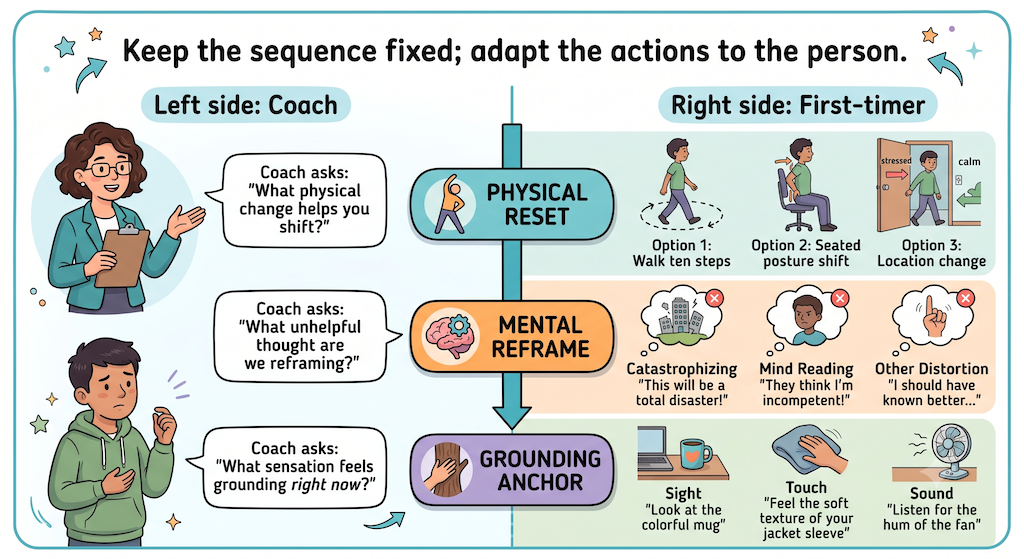
Coach by adapting each block to their situation. Their loudest thought may be catastrophizing where yours is mind reading. Their room has different objects. Their intensity may call for leaving the room rather than a desk-side posture shift, and if they're in an open-plan office they'll want to skip the physical interrupt entirely, so surface that and offer a seated equivalent instead of letting them drop the block. Give one instruction at a time, make them do rather than nod, and correct the two errors that always show up: skipping "name the loop," and ending on an intention rather than an action.
The whole lesson comes down to using one fixed sequence so you never have to choose a tool in the middle of a spiral. With regular rehearsal, the routine will become easier to recall and use when you need it most. Next, you'll build your own routine in a guided conversation with an AI coach that checks your phase order and timing, then run it live under a stopwatch, and finally coach a first-timer through theirs. Before that, write your three phases from memory and see which one you're least sure about.
