Sensory Physical Interrupts
Deploying Sensory and Physical Interrupts 🧊
The reframe script works when you can still get a full sentence into your own head. Sometimes you can't — the loop is spinning too fast, and "I'm having the thought that..." never makes it out. That's not the script failing. It means the spiral has dropped from your head into your body: tight jaw, shallow breath, restless hands. When that happens, talking to yourself won't reach it. You need to do something physical instead.
By the end of this lesson, you will have learned how to:
- Execute the 5-4-3-2-1 sensory countdown with real objects in under sixty seconds
- Apply the 10-step rule and a posture shift, then verify with specifics instead of vibes
- Diagnose which interrupt fits the intensity, and when to escalate to a location change
🖐️ Execute the 5-4-3-2-1 Sensory Countdown With Real Objects
5-4-3-2-1 Grounding works by giving your attention concrete things to focus on. You name five things you can see, four you can touch, three you can hear, two you can smell, and one you can taste. Engaging your senses redirects attention toward the present moment and away from rumination. Thoughts may still show up during the countdown; the goal is to loosen the loop's grip, not make every thought disappear.
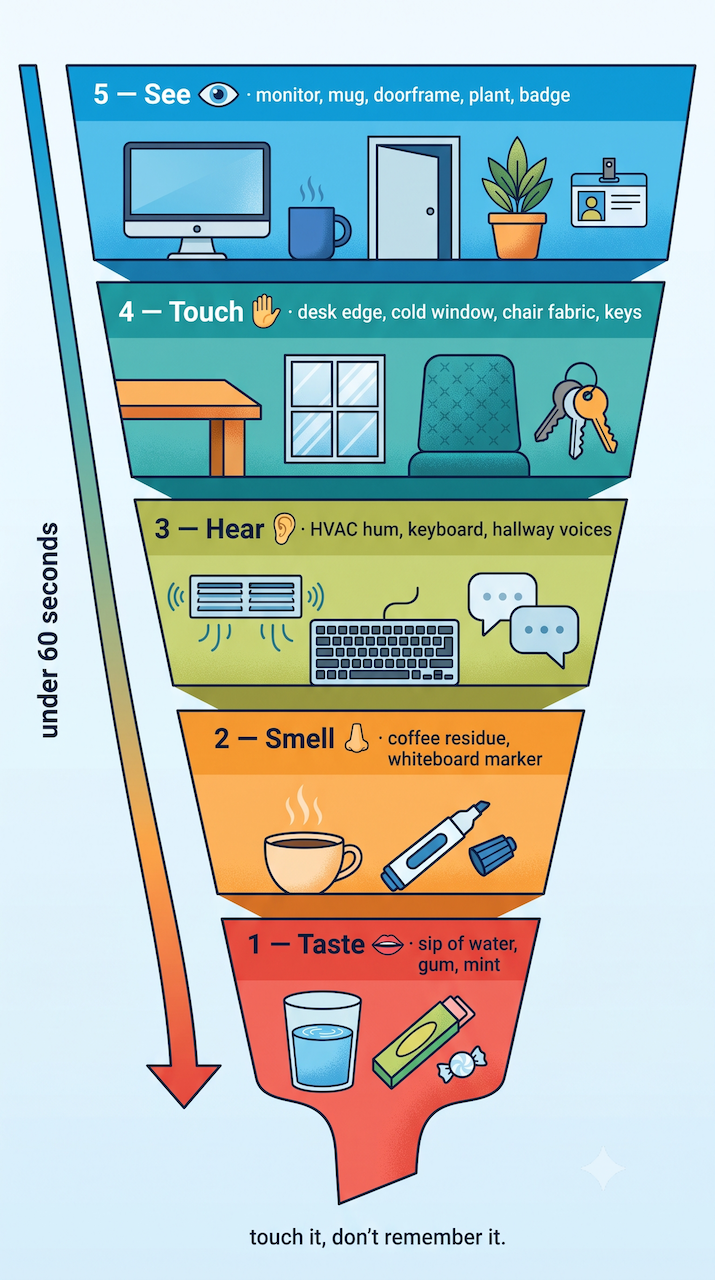
Two rules make it work:
- Use real objects, not remembered ones. Touch the four things. Reach out and put your hand on the desk edge, the cold window, the fabric of your chair arm, your own keys. Naming from memory keeps you inside your head, which is where the loop lives.
- Keep the whole pass under sixty seconds. If you're spending three minutes hunting for a smell, you've turned a reset into a project.
The last two steps — two things you can smell and one thing you can taste — trip people up, because offices smell of nothing and what can you taste while at work? Take what you have. For smell: coffee residue in the mug, whiteboard marker, the paper of a notebook, hand lotion, your own sleeve. For taste: a sip of water, gum, mint, the coffee still on your tongue. Approximate rather than skip, because this countdown forces your mind to scan your environment instead of spinning internally.
Apply the 10-Step Rule and a Posture Shift 🚶
When grounding doesn't land, escalate to a physical pattern interrupt. The 10-step rule is exactly what it sounds like: stand up and walk ten steps, counting them out loud or under your breath. This forces your brain to coordinate movement, pulling attention away from rumination toward physical coordination. The counting is what makes it work — it occupies the same verbal channel the loop is using to talk at you.
Then run a posture shift: stand, unclench the jaw, unclench the hands, open the chest, drop the shoulders. Rumination has a physical posture (hunched, braced, gripping) and holding that posture keeps feeding the loop signals that something is wrong. These shifts send "reset" signals to your nervous system within seconds.
Watch here how Emily helps Jake, who has been stuck at his desk for ten minutes replaying a comment his manager made in standup.
- Emily: You've read that same line four times. Stand up and take ten steps, count them out loud.
- Jake: Out loud? People are right there.
- Emily: Under your breath is fine. It just has to be counted, not walked absent-mindedly.
- Jake: ...eight, nine, ten. Okay.
- Emily: Good. Now shift your posture to reset your nervous system. Then check in — what's your breath doing? Where's your jaw?
- Jake: Breathing into my belly now instead of my chest. My jaw is loose. And my thoughts are slowing down. Thanks, I really needed that reminder!
Notice that Jake doesn't answer in vibes. He names his breath, his jaw, and his thought speed, which is what a real verification sounds like and what tells you whether the interrupt you chose was strong enough.
🎚️ Diagnose Which Interrupt Fits the Intensity
Don't pick your tool based on how bad the spiral feels, because feelings inflate. Pick it based on what you can actually observe.
If you've replayed something once or twice and noticed your jaw is tight, that's low intensity, and grounding will handle it. If the loop keeps restarting no matter how many times you drop it, and you're braced over your desk, you might be in mid territory. Walk your ten steps and reset your posture to help lower this intensity. And if you're rehearsing a conversation that hasn't happened, re-reading the same sentence for the third time, and twenty minutes have quietly disappeared, none of that will touch it. That's when you need a location change: physically leave the room where the spiral started. By that point the environment itself has become part of the cue, so staying in it means staying in the loop.
Micro-movements work when you can't leave your current location. Try: rolling your shoulders, stretching your arms overhead, or changing how you're sitting. Even small movements can interrupt the physical holding pattern that keeps mental loops alive. Or you could even try opening a window, turning on a different light, or playing upbeat music. These changes signal to your brain that this is a different moment. Your environment shapes your mental state more than you realize.
Successfully interrupting a spiral requires matching your physical response to the observable intensity of the moment and verifying the results through specific cues like jaw tension or thought speed. You can handle a low-intensity loop with simple grounding, but a mid-level or high-level spiral will force you to walk ten steps or completely change your location, escalating whenever thoughts restart within a minute. To lock in these reflexes, the upcoming practices will have you troubleshoot the countdown, run a live interrupt under time pressure, and consolidate everything into a one-page triage guide. Before jumping in, take a moment to reflect on your last spiral and consider whether the action you took truly matched the intensity of the loop.
