Welcome to How Events Influence Each Other, the third course in your probability learning path! You have already built a solid foundation: you can calculate single-event probabilities, apply the complement rule, count outcomes in multi-step processes, and combine events using the addition rules. That is a lot of progress, and it all comes together here as we start exploring how events relate to one another.
In this first lesson, we focus on one of the most important ideas in probability: event independence. By the end, you will be able to explain what it means for two events to be independent, and you will confidently identify independent event pairs in everyday situations.
Before we define anything formally, let's think about a simple question: does knowing the outcome of one event ever help us predict another?
Imagine you flip a coin and get heads. Does that tell you anything about whether it will rain tomorrow? Of course not. Those two events live in completely separate worlds. Now imagine you pull one red marble out of a bag that contains red and blue marbles, and you do not put it back. Has anything changed for the next draw? Absolutely — there are fewer marbles now, and the mix of colors has shifted.
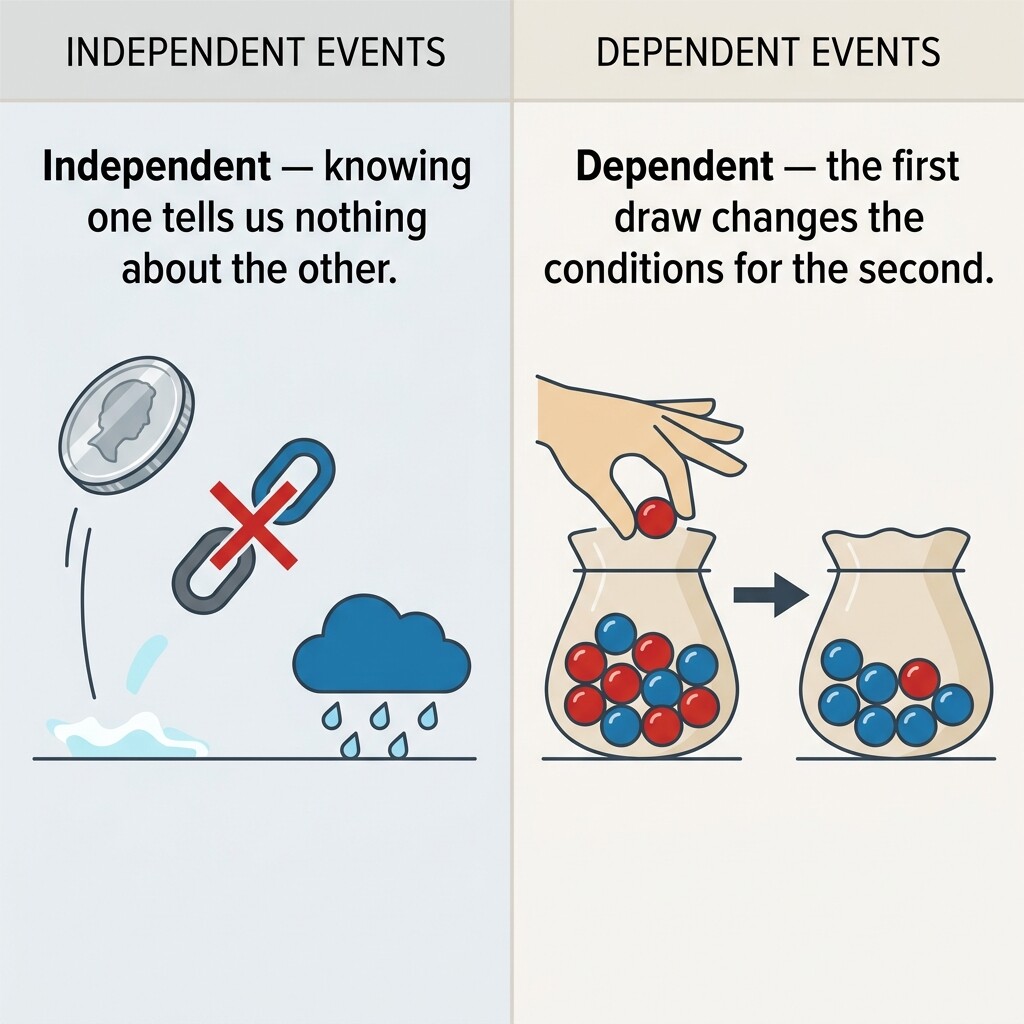
This intuition is exactly what separates independent events from dependent events, and it is the central theme of this entire course.
A practical way to test for independence is to ask one question: "Does the first outcome change the setup or conditions for the second?" If the answer is no, the events are independent. The table below walks through several familiar situations.
| Event Pair | Does one affect the other? | Independent? |
|---|---|---|
| You flip two separate coins | No — each coin has its own outcome | ✅ Yes |
| Two coworkers in different cities each decide to bike to work | No — their choices are unrelated | ✅ Yes |
| You draw a card from a deck, keep it, then draw another | Yes — the deck now has fewer cards | ❌ No |
| It rains heavily in the morning, and the playground is wet at recess | Yes — rain makes the playground much more likely to be wet | ❌ No |
Notice the pattern: when two events involve separate, unconnected processes, they tend to be independent. When they share a common pool of outcomes or one physically influences the other, they tend to be dependent.
Even with a clear definition, a few situations can trip you up. Keep these two pitfalls in mind:
- "Happened at the same time" does not mean dependent. Flipping a coin and rolling a die happen simultaneously, yet they are independent. Timing is not the deciding factor; what matters is whether one outcome influences the other's probability.
- "Happened one after the other" does not mean dependent. Suppose you flip a coin, note the result, and then flip it again. The second flip is still independent of the first because the coin has no memory. Sequence alone does not create dependence.
In both cases, the real question is the same: after we learn the result of one event, has the probability of the other event changed?
Let's recap what we covered. Two events are independent when the outcome of one has absolutely no effect on the probability of the other. The simplest test is to ask whether knowing the result of the first event changes anything about how likely the second event is — if nothing changes, you have independence. We also saw that separate, unconnected processes like distinct coin flips or unrelated personal choices are classic examples of independence, while events that share a common pool or physical connection are typically dependent.
Up next, you will put this understanding into action with a set of hands-on practice tasks. You will classify real-world event pairs as independent or not — in both everyday and workplace contexts — and explain your reasoning in your own words. Let's see how sharp your independence radar has become!
