Welcome back to How Events Influence Each Other! In the previous lesson, you learned how to recognize independent events — situations where one outcome has no effect on the probability of another. With that skill in your toolkit, a natural follow-up question emerges: once we know two events are independent, how do we find the probability that both happen at the same time?
That is exactly what this second lesson tackles. We will build a simple yet powerful formula from the ground up, see why multiplication is the correct operation for "and" questions, and apply the rule across everyday and business scenarios. By the end, you will be able to compute P(A and B) for any pair of independent events and explain the reasoning behind every step.
From Recognition to Calculation
In Lesson 1, you practiced deciding whether two events are independent. That was the qualitative side of the story. Now we move to the quantitative side: calculating the combined probability when both independent events need to occur.
Think of it as a two-stage process. Stage one is the independence check — does knowing the outcome of A change P(B)? If not, the events are independent. Stage two is the calculation — and that is where the multiplication rule comes in. Let's see where this rule comes from before we state it formally.
Why Multiplication Is the Right Operation
Join the 1M+ learners on CodeSignal
Be a part of our community of 1M+ users who develop and demonstrate their skills on CodeSignal
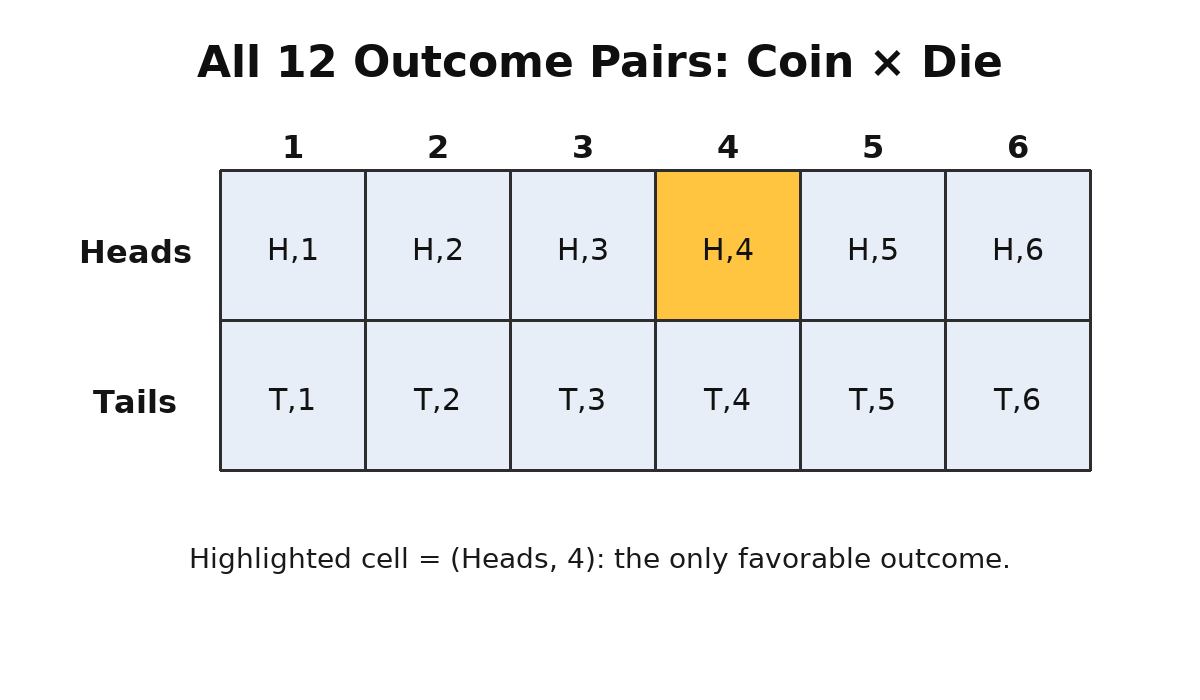
Let's start with a concrete picture. Suppose we flip a fair coin and roll a fair six-sided die at the same time. The coin has 2 equally likely outcomes and the die has 6. Every coin outcome can pair with every die outcome, so the total number of combined outcomes is:
2×6=12
We can list a few pairs to see the pattern: (Heads, 1), (Heads, 2), … (Heads, 6), (Tails, 1), … (Tails, 6). That is 12 pairs in all.
Now, how many of those pairs give us Heads and a 4? Exactly one: the pair (Heads, 4). So the probability is:
P(Heads and 4)=121
Notice that 121 is exactly 21×61. This is not a coincidence. Because the two processes are independent, every outcome of the first combines freely with every outcome of the second. Multiplying the individual probabilities accounts for that combination, just as the multiplication principle counts combined outcomes in multi-step processes (a concept you practiced back in Course 1).
We can now state the rule in general terms. If events A and B are independent, the probability that both occur is:
P(A and B)=P(A)×P(B)
Two independent probabilities joined by "and" means we multiply. The key requirement is independence: we must first confirm that knowing the outcome of A does not change P(B), and vice versa.
This rule also extends naturally to more than two events. For three independent events A, B, and C:
P(A and B and C)=P(A)×P(B)×P(C)
Each additional independent event simply adds another factor to the product.
Let's walk through two examples so the process becomes second nature.
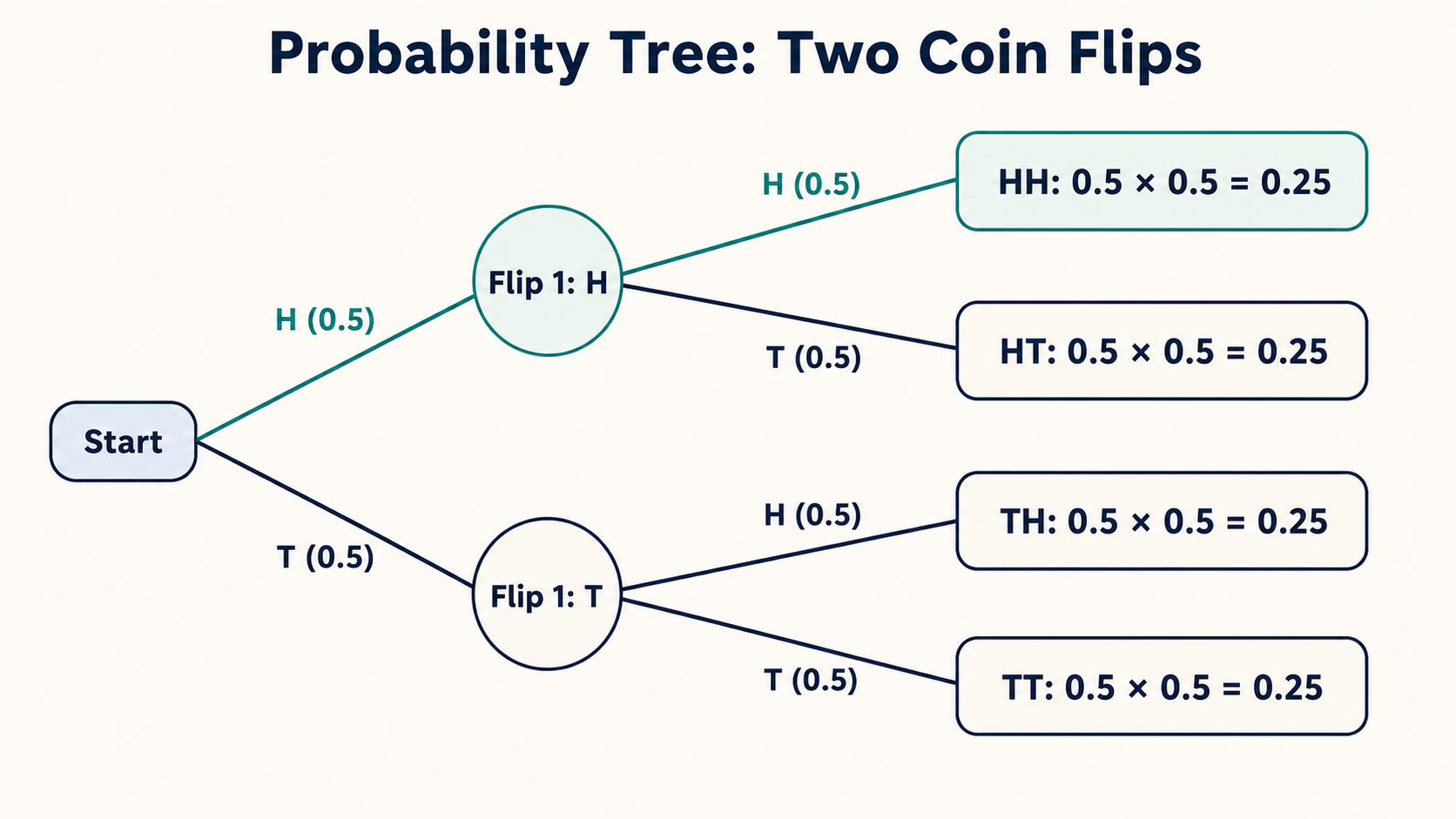
Example 1 — Two coin flips. Suppose we flip a fair coin twice and want P(Heads on flip 1 and Heads on flip 2). The second flip is not affected by the first — a coin has no memory — so the events are independent. Each flip has P(Heads)=0.5, and multiplying gives us P(both Heads)=0.5×0.5=0.25. There is a 25% chance of getting heads on both flips.
Example 2 — Green lights on a commute. Imagine two traffic intersections on your drive to work, each operating on an independent timer. The probability of catching a green light at intersection 1 is 0.6, and at intersection 2 it is 0.7.
Confirm independence: the lights run on separate, unconnected timers, so neither outcome affects the other.
Identify individual probabilities:P(G1)=0.6 and P(G2)=0.7.
Multiply:P(G1 and G2)=0.6×0.7=0.42.
You have a 42% chance of sailing through both intersections on green.
The multiplication rule appears frequently in professional settings where systems depend on independent components.
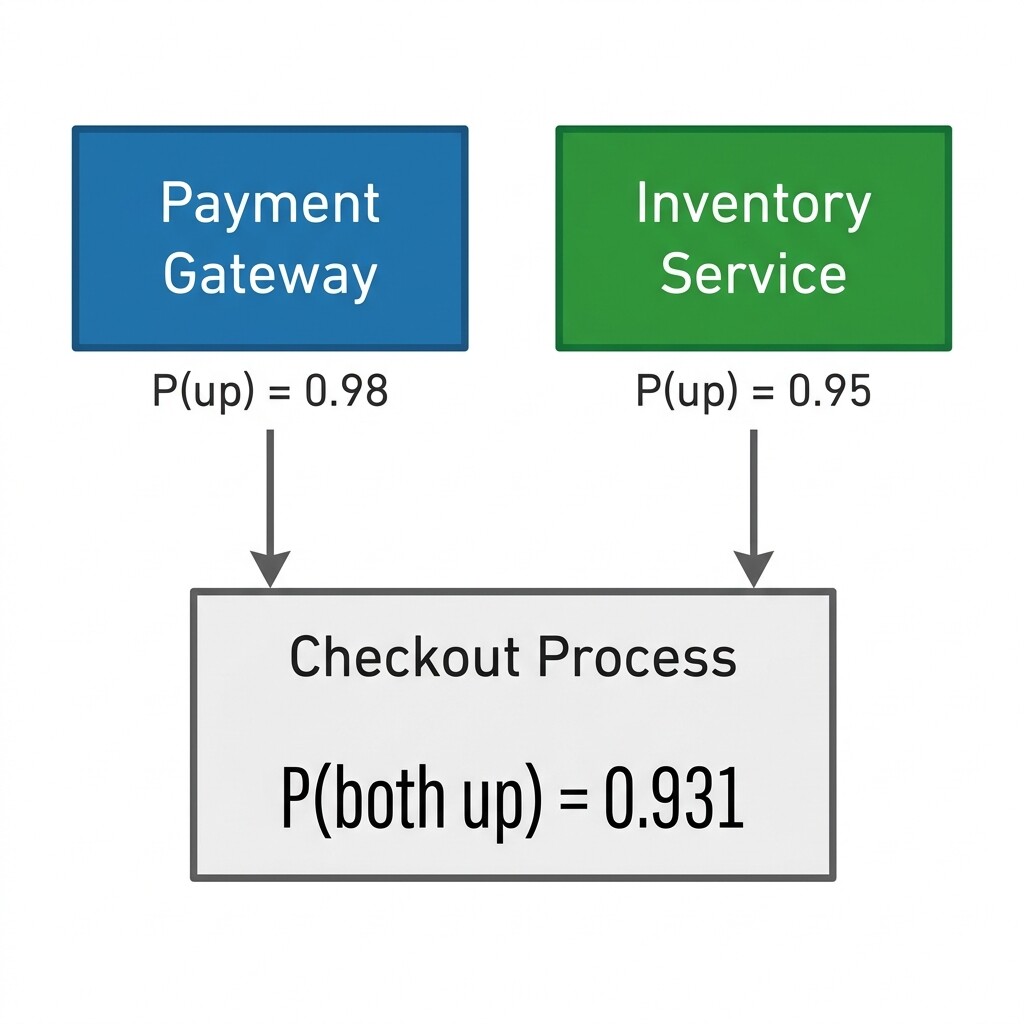
Consider an online store whose checkout process relies on two separate services: a payment gateway with an uptime probability of 0.98 and an inventory service with an uptime probability of 0.95. Because the two services run on independent infrastructure, the probability that both are running when a customer checks out is:
P(both up)=0.98×0.95=0.931
That is about a 93.1% chance that a customer experiences a fully working checkout. Notice how even two individually high probabilities combine into a noticeably lower joint probability — a critical insight for anyone designing reliable systems.
The same logic applies to logistics. If two independent shipping carriers each have a 90% on-time delivery rate, the probability that both packages arrive on time is 0.9×0.9=0.81, or 81%. Multiplication reveals the real cost of depending on multiple independent processes at once.
Before we wrap up, here are three frequent errors to watch for:
Using addition instead of multiplication. The word "and" means both events must occur, which calls for multiplication. Addition is for "or" situations, as you learned in Course 2.
Forgetting to verify independence first. The formula P(A and B)=P(A)×P(B) only works when A and B are independent. If they are dependent, a different approach is needed — and that is exactly what the next lesson covers.
Expecting the combined probability to be larger. Multiplying two numbers between 0 and 1 always produces a smaller result. Both events happening is harder than either one happening alone, so a lower probability makes perfect sense.
Here is the big takeaway: when two events are independent, the probability that both occur is P(A and B)=P(A)×P(B). Multiplication works because each outcome of the first event pairs freely with each outcome of the second, and independence guarantees that neither event's probability is altered by the other. We saw this rule in action across coin flips, traffic lights, shipping logistics, and system reliability.
Now it is time to put the multiplication rule to the test. Up next, you will work through practice tasks that range from guided, fill-in-the-blank calculations to writing your own full solution with a clear explanation of why multiplication is the right move. Let's see you turn this formula into a tool you can use without hesitation!