Welcome back to How Events Influence Each Other! You have reached the fifth and final lesson of this course — congratulations on making it this far. Over the previous four lessons, we defined independent events, applied the multiplication rule for them, explored how dependent events differ, and practiced computing joint probabilities when the pool of outcomes changes. Each lesson added one piece of the puzzle.
In this lesson, we bring all those pieces together. We will practice classifying multi-event situations as independent or dependent, choose the correct multiplication rule for each case, and carry out the full calculation with a clear justification. By the end, we will have a complete, repeatable workflow for any two-event probability question.
Thinking Like a Detective
Before we dive into the mechanics, let's step back and consider what we are really doing when we face a probability problem with two events. We are playing detective. Our job is to examine the situation, ask one key question, and let the answer guide us to the right tool.
That key question is: does the first event change the conditions for the second event? If the answer is no, the events are independent and we use one formula. If the answer is yes, the events are dependent and we use a slightly different formula. Everything we have learned in this course flows from that single question. The rest of this lesson will sharpen our ability to answer it quickly, correctly, and — just as important — to explain why.
The Two Multiplication Rules Side by Side
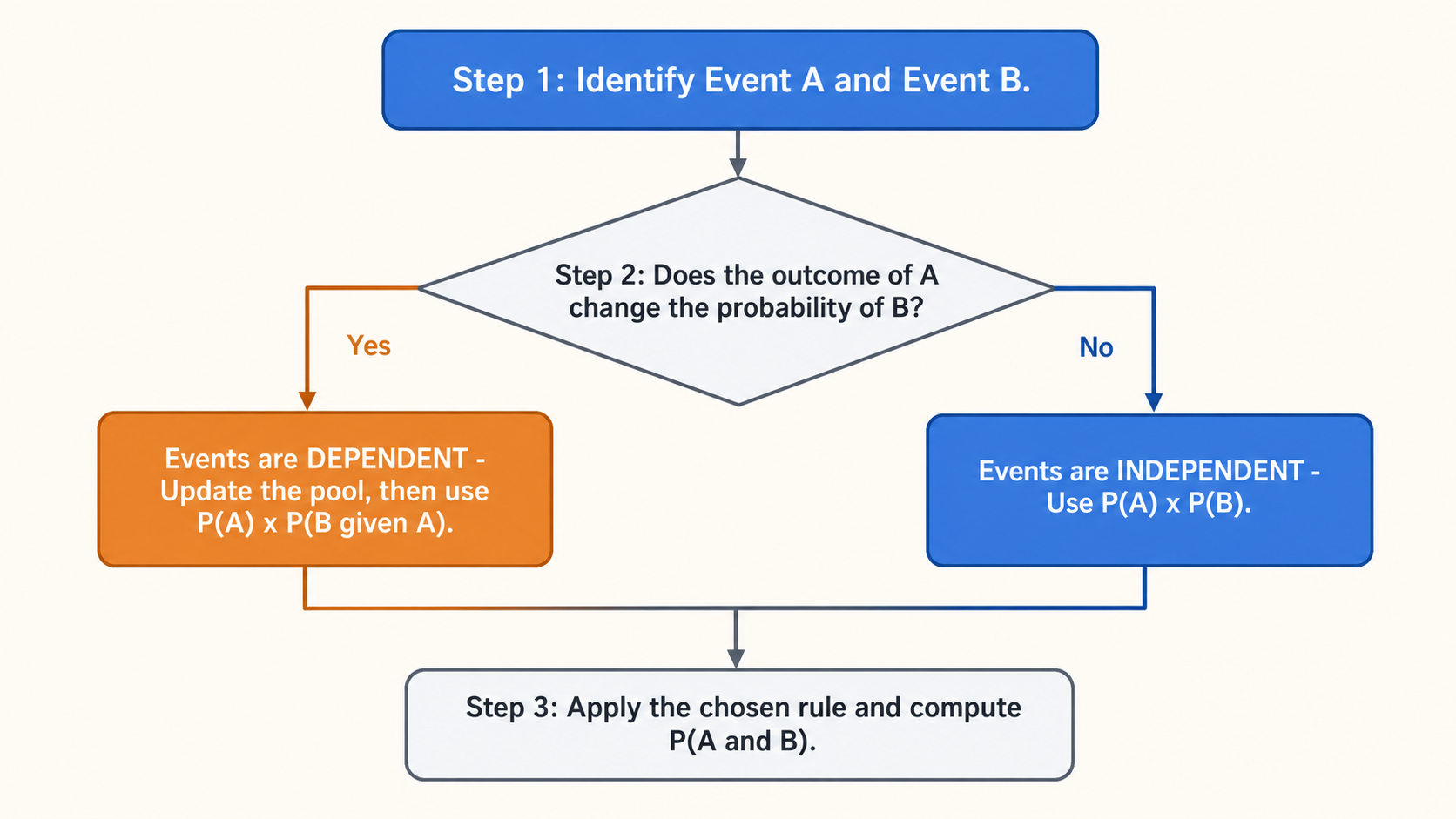
A Three-Step Classification Workflow
Worked Example: Two Traffic Lights
Worked Example: Selecting Items Without Replacement
Be a part of our community of 1M+ users who develop and demonstrate their skills on CodeSignal
Since our goal is to choose between two formulas, let's place them next to each other for quick reference:
Situation
Formula
Independent events
P(A and B)=P(A)×P(B)
Dependent events
P(A and B)=P(A)×P(B given A)
The only difference is the second factor. For independent events, B's probability stays the same no matter what happens with A. For dependent events, we replace P(B) with P(B given A), the updated probability that accounts for how A's outcome changed the pool or conditions. Choosing between these two formulas — and explaining the choice — is the core skill we will practice in this lesson.
When you encounter a new problem, the following workflow will keep you on track every time:
Identify the two events. State clearly what event A and event B are.
Ask the key question. Does the outcome of A change the probability of B? Look for clues such as items removed from a pool, shared physical causes, or the phrase "without replacement."
Choose and apply the rule. If the answer is no, multiply the two original probabilities. If the answer is yes, update the pool first, then multiply using the adjusted second probability.
A helpful shortcut: if the two events involve separate, unrelated random processes — different dice, different machines, different traffic lights — they are almost always independent. If the events draw from the same limited pool without putting items back, they are almost always dependent.
Suppose you drive through two traffic lights on your way to work. The probability of getting a green light at the first intersection is 0.60, and the probability of a green light at the second intersection is 0.45. The signals operate on independent timers. What is the probability of getting green at both?
Step 1 — Identify the events. Event A: green at the first light. Event B: green at the second light.
Step 2 — Ask the key question. The two lights run on separate timers. The color at the first intersection has no effect on the color at the second. These events are independent.
Step 3 — Apply the independent rule:
P(green at both)=P(green1)×P(green2)=0.60×0.45=0.27
There is a 27% chance of sailing through both intersections on green. Notice that we did not need to adjust anything after the first event because neither the total outcomes nor the individual probabilities changed.
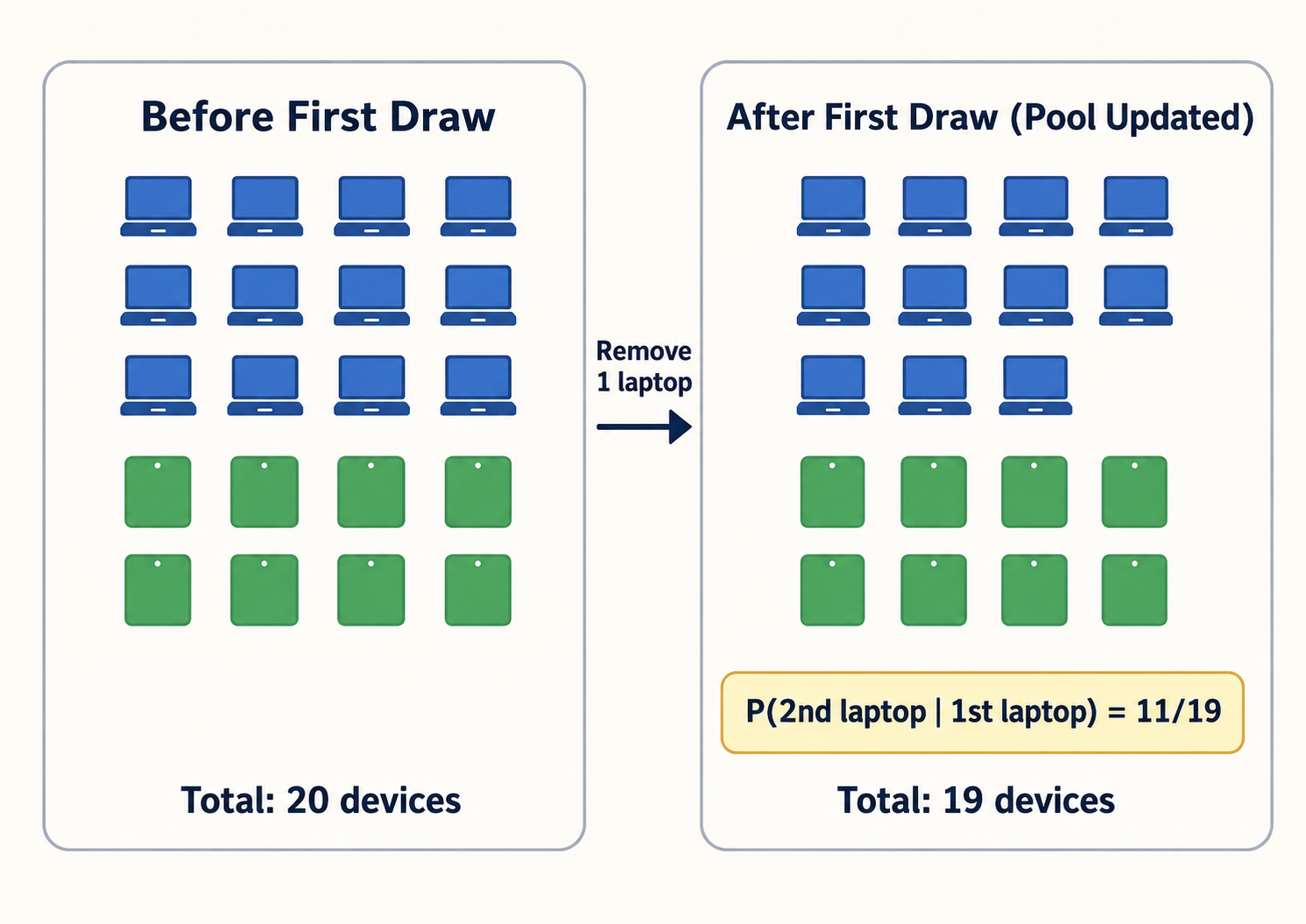
A warehouse shelf holds 12 laptops and 8 tablets (20 devices total). A worker picks two devices at random without replacing the first. What is the probability that both are laptops?
Step 1 — Identify the events. Event A: the first device is a laptop. Event B: the second device is a laptop.
Step 2 — Ask the key question. Both draws come from the same shelf, and the first device is not returned. The total drops from 20 to 19, and the laptop count may drop as well. The first draw changes the pool, so these events are dependent.
Step 3 — Apply the dependent rule. Probability the first device is a laptop:
P(first laptop)=2012=53
After removing one laptop, the shelf holds 11 laptops and 8 tablets, totaling 19 devices. The updated probability is:
P(second laptop given first laptop)=1911P(both laptops)=53×1911=9533≈0.347
The probability is about 34.7%. If we had mistakenly treated the draws as independent and used 2012 for both, we would have obtained 0.36 — a small but meaningful overestimate. Writing out the classification step protects us from this kind of error.
Not every situation screams "independent!" or "dependent!" right away. Consider this scenario: two coworkers, Aisha and Ben, each have a 20% chance of being late to work on a given day. Are their delays independent or dependent?
The answer depends on context. If Aisha drives from the north side of town and Ben bikes from the south side, there is no shared factor linking their commutes. We would classify the events as independent and compute:
P(both late)=0.20×0.20=0.04
But what if both drive the same highway? A traffic jam could make both of them late at the same time. In that case, the events share a common cause and are dependent. We would need additional information — such as the probability that Ben is late given that Aisha is already late — to apply the dependent rule correctly.
The takeaway: when a scenario feels unclear, look for a shared mechanism that could link the two outcomes. If one exists, treat the events as dependent. If the two processes are truly separate, treat them as independent. In both practice problems and real-world analyses, stating your reasoning is just as important as picking a number.
In this lesson, we united every concept from the course into one streamlined workflow: identify the two events, determine whether the first outcome changes the conditions for the second, and apply the matching multiplication rule. Independent events use P(A)×P(B), dependent events use P(A)×P(B given A), and the choice between them always comes down to whether the pool or conditions change. We also saw that ambiguous scenarios become clear once we look for a shared mechanism linking the two outcomes.
Now it is time to put the full workflow to the test. The upcoming practice tasks will challenge you with rapid-fire classification, real-world matching, and complete calculations where you must justify every step. Think of each task as a chance to rehearse the detective process — classify, choose the rule, compute, and explain — so that it becomes second nature.