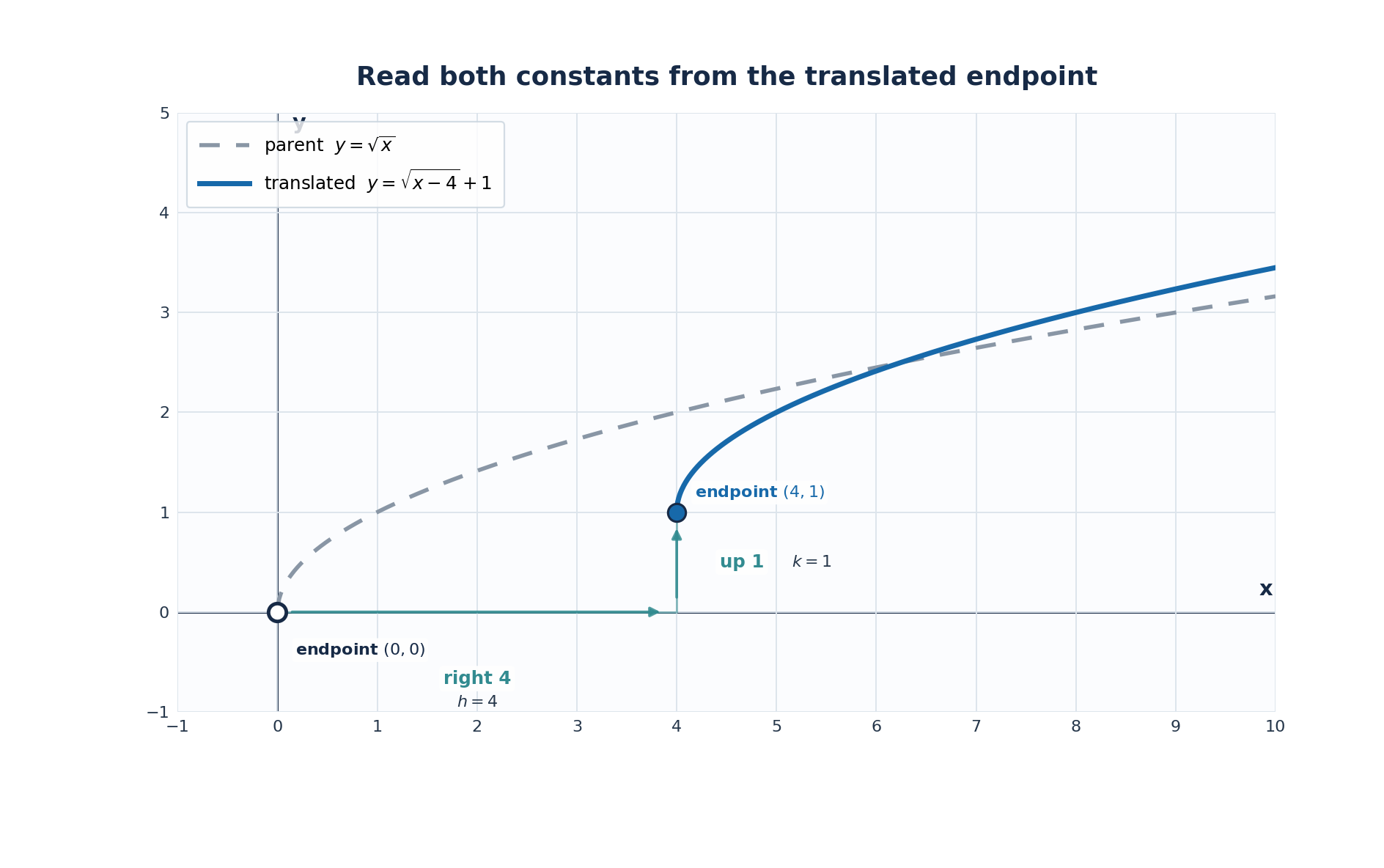
Combining Horizontal and Vertical Shifts
Introduction
Here we are at the third and final lesson of Horizontal Shifts: Sliding Left and Right. The two skills we have built so far — reading a signed constant out of the standard form, and sliding points with a simple map — are about to be used together, twice in a single expression.
So far every translation has moved a graph along one axis only. Real graphs are rarely so cooperative: a curve you meet in the wild has usually been nudged sideways and lifted or dropped. In this lesson we will perform both moves at once, and then run the process backwards, recovering both constants from a picture and writing the complete equation with the correct signs.
Two Instructions That Do Not Interfere
The expression packs two separate instructions into one line, and the good news is that they never compete for the same coordinate. The sits inside the function, where it reaches the input before ever runs, so it moves the graph horizontally. The sits outside, where it waits for to finish and then adjusts the answer, so it moves the graph vertically.
Think of it as two dials on the same machine: one aims the input, the other tunes the output. Because one dial touches only and the other only , the order in which we turn them makes no difference. Sliding right three and then up two lands us in precisely the same place as up two and then right three.
The Combined Point Map
Each translation already came with its own point map, so we simply run them side by side. If , then every point on the graph of obeys
Read it one coordinate at a time. The first coordinate gains , exactly as in the previous lesson; the second gains , exactly as in the vertical shifts course. Notice once more that the map itself carries no minus sign, because the reversal was already absorbed when we wrote the inside in the standard form .
Moving a Graph Twice
Let us put the map to work on the absolute-value parent with
Reading the constants comes first. The inside must be written as , and is , so ; the outside gives directly. Our map is therefore : two units left, three units down.
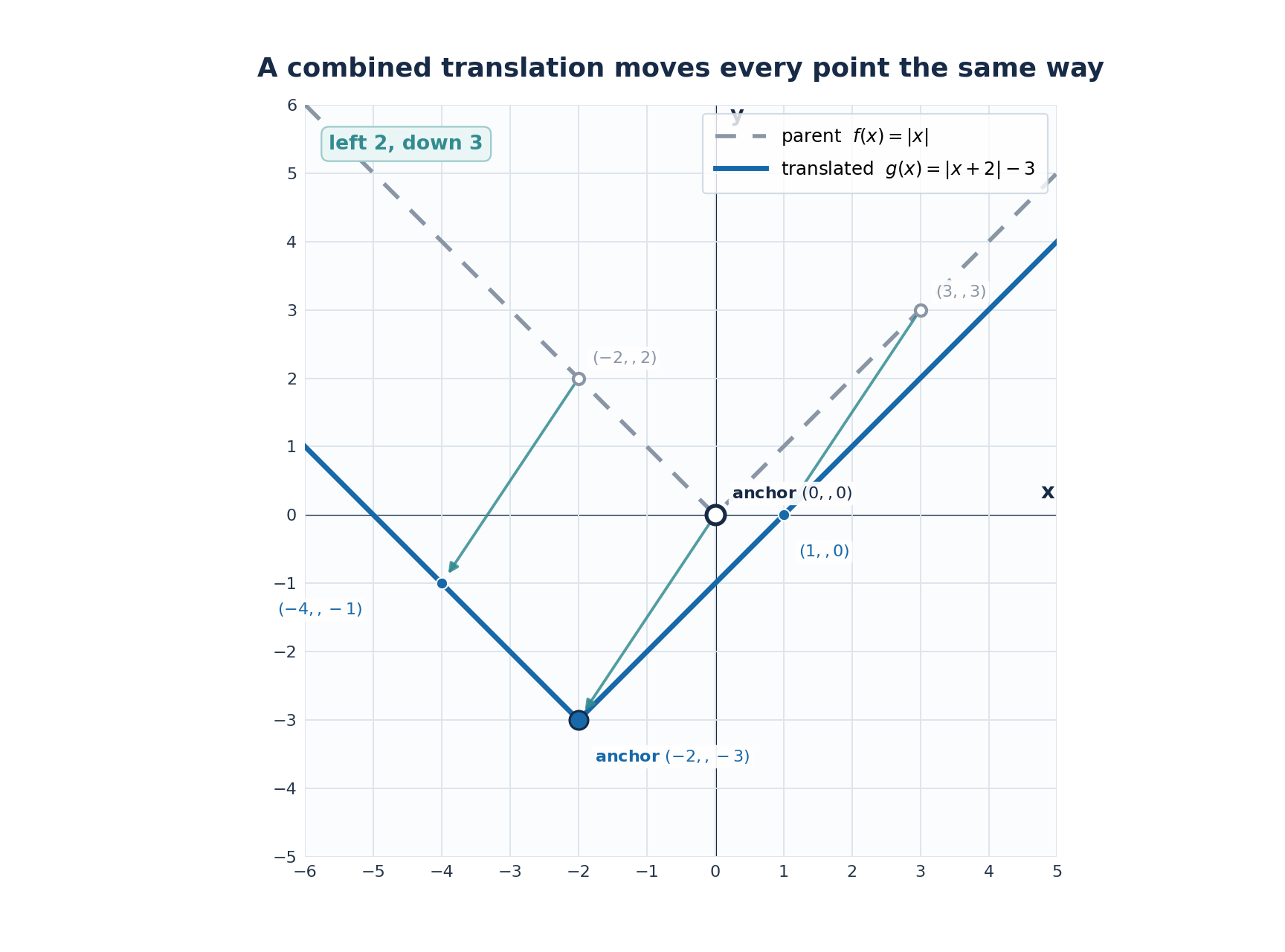
Tracking the corner and two friendly reference points is enough to pin the whole V in place.
| Point on | Role | Point on |
|---|---|---|
| reference | ||
| corner (anchor) | ||
| reference |
The V is identical in width and steepness; only its address has changed. A quick check confirms the corner: .