Linked List Operations
Lesson Overview
Welcome to our tutorial focusing on Linked List Operations in Kotlin. Singly linked lists (or just linked lists) are among the most fundamental data structures used in computer science. They provide an efficient way to manage data that is not necessarily contiguous in memory. While they lack the fast random access of arrays, they excel at sequential traversal and link updates, making them an indispensable tool in a programmer's toolkit.
LinkedList Definition
To work with linked lists, we first need to define a ListNode class, which represents a node in the linked list. In Kotlin, we use a class with a constructor to define the structure and handle the potential absence of a next node using nullability.
In the ListNode class:
valueholds the data of the node.nextis a reference to the next node in the linked list. It is of typeListNode?, which means it can either hold aListNodeobject or benull. It isnullby default, meaning the node does not point to any other node when it is freshly created.
To understand this, first know that a linked list is a linear data structure where each element is a separate object known as a node. A node comprises data and a reference (link) to the next node in the sequence.
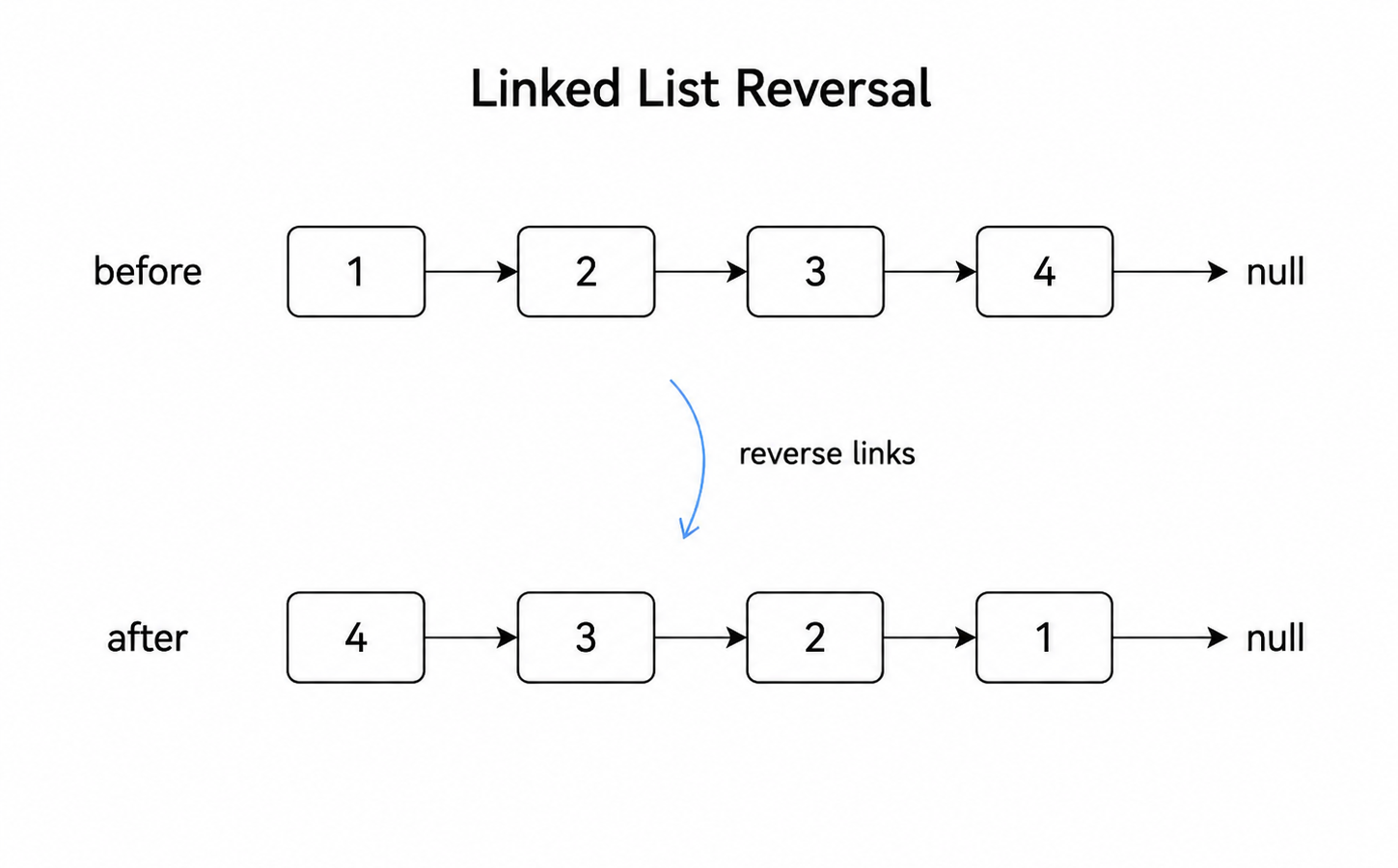
The provided code creates a linked list where each node points to another as follows: 1 -> 2 -> 3 -> 4 -> 5, and the last node points to null.
Task Example