Intuitive Visual Proof
Introduction
Welcome to the final lesson of Foundations of the Pythagorean Theorem! Over the previous four lessons, you learned to spot a right triangle by its angle, label the legs and hypotenuse, connect , , and to the areas of squares on those sides, and state the theorem as .
One big question remains: why must that equation be true for every right triangle, not just the ones we tested? In this fifth and final lesson, we answer that question with a classic visual proof. The reasoning uses nothing more than area and rearrangement, and by the end you will be able to explain exactly why the theorem works universally.
From Specific Numbers to a General Argument
In the last lesson, we verified the theorem with the 3‑4‑5 triangle () and the 5‑12‑13 triangle (). Both checks passed, but no matter how many individual examples we test, we can never cover the infinitely many right triangles that exist.
What we need is an argument built on the general properties of a right triangle, using the letters , , and instead of specific numbers. If the reasoning holds for any values of , , and , the conclusion holds universally. That is exactly what a proof gives us — and it is why mathematicians, engineers, and architects can trust the theorem in every new situation they encounter, without having to re‑check it each time.
The Proof's Building Blocks
Our proof uses just two simple ingredients:
- Four identical right triangles, each with legs and and hypotenuse .
- One large square whose side length is .
The area of each triangle is , so the four triangles together have a combined area of . The large square has a total area of . The strategy is straightforward: place the four triangles inside this big square in two different ways and compare the leftover white space each time.
First Arrangement: One Tilted Square in the Center
Place the four triangles inside the square so that each triangle sits in a corner with its hypotenuse facing inward. The four hypotenuses together outline a tilted square in the center of the big square, and each side of that inner square has length .
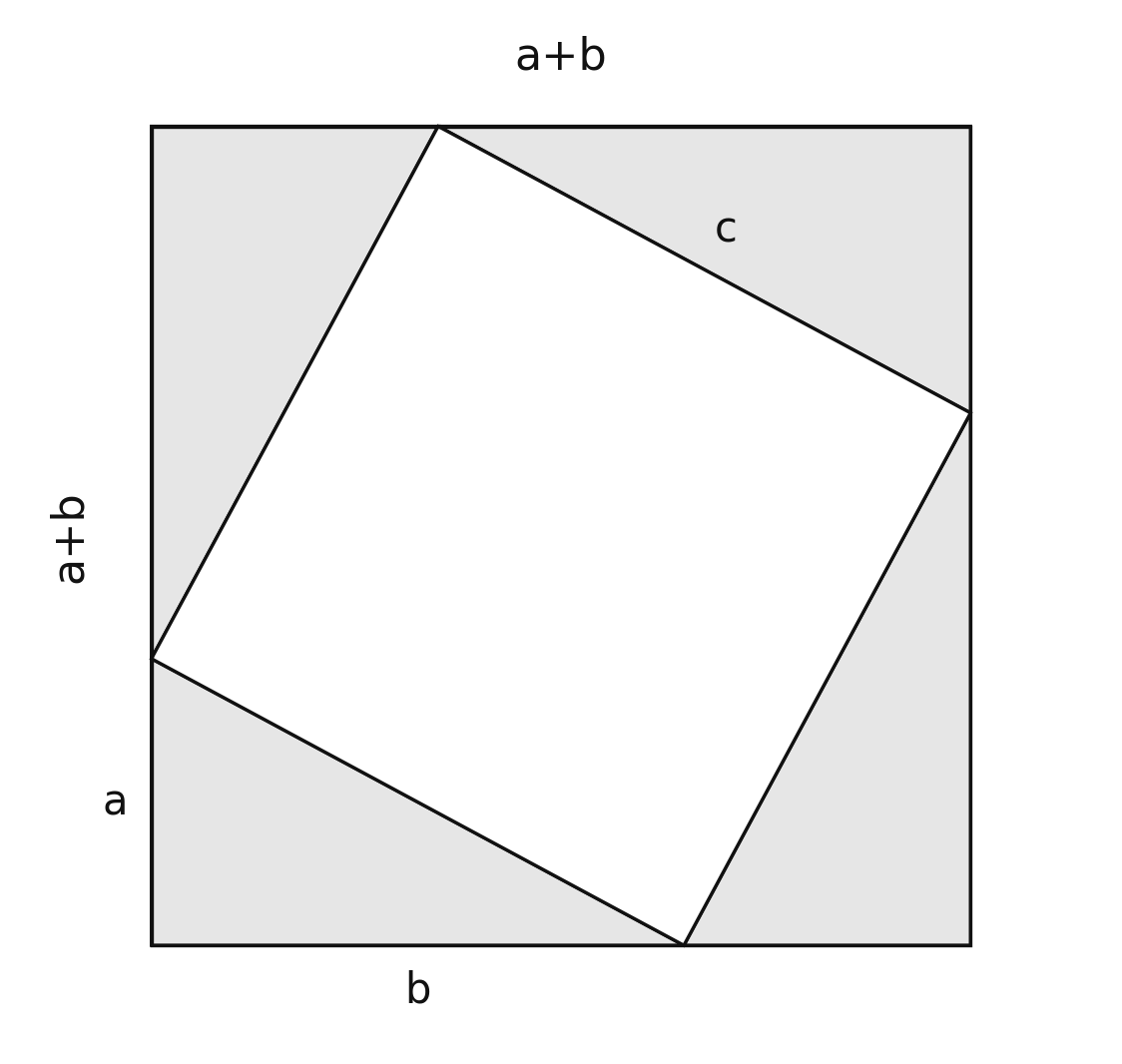
Because the triangles and the inner white square together fill the entire big square, the area equation is:
In plain words: the big square's area equals the four triangles' area plus the leftover white area, which is .
Second Arrangement: Two Smaller Squares
Now rearrange the same four triangles inside the same big square, but this time position them so they leave two separate white squares — one with side and one with side . A simple way to picture this: slide two triangles together to form an rectangle along the top and another rectangle along the bottom. The uncovered white regions that remain are an square and a square.
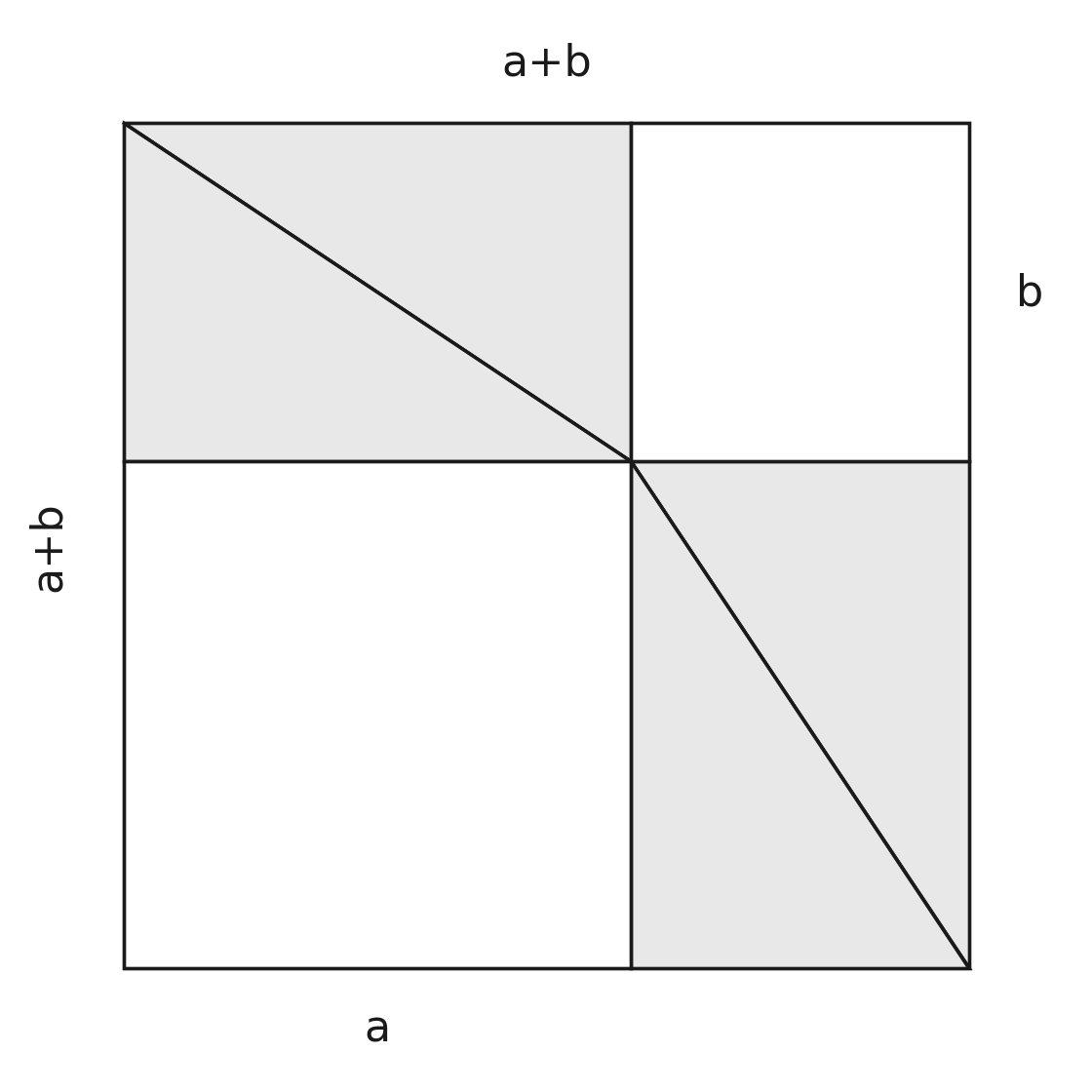
This time the area equation reads:
The big square's area now equals the same four triangles' area plus two leftover white regions: and .
Comparing the Leftover Areas
Both arrangements fill the same large square, so the total area is identical: . Both use the same four triangles, so the triangle area () is also identical. The only part that can differ is the leftover white space — but since everything else matches, that leftover must be equal too:
That single comparison is the entire heart of the proof. No algebra tricks, no advanced math — just one fair observation: if the total is the same and the triangles are the same, the remaining space must be the same. Think of it like a suitcase packed two different ways: if the suitcase and the clothes are unchanged, the empty space left over cannot change either.
Why This Holds for Every Right Triangle
Notice that we never plugged in numbers for , , or . The argument depends on only two facts:
- Each triangle has a right angle, which lets the pieces fit snugly inside the big square without gaps or overlaps.
- All four triangles are identical copies, so their combined area is the same regardless of how we arrange them.
Because the reasoning relies only on these general properties, the conclusion is forced to be true for any right triangle — whether its sides are small whole numbers like , , , awkward decimals like , , , or even irrational lengths you could never write as a neat fraction. The proof covers every possible case at once, which is exactly why a single general argument is more powerful than a million individual checks.
Conclusion and Next Steps
In this lesson, you followed a visual rearrangement proof of the Pythagorean theorem. By placing four identical right triangles inside a large square in two different ways, you saw that the leftover white area must be the same in both arrangements — giving us . Because the argument uses variables instead of specific numbers, it guarantees the theorem for every right triangle that could ever exist.
You now understand not just what the Pythagorean theorem says, but why it must be true — a fitting finish to Foundations of the Pythagorean Theorem. Head into the practice exercises next, where you will step inside the proof yourself, rearrange the pieces, and put the reasoning into your own words!
