Identifying Right Triangles
Introduction
Welcome to Foundations of the Pythagorean Theorem! This is the very first lesson of the course, and we are starting right at the beginning. By the end of this course, you will understand one of the most famous ideas in all of mathematics — but every great journey starts with a single step. Ours begins with learning how to recognize the specific type of triangle that makes the Pythagorean theorem work: the right triangle.
In this lesson, you will learn what a right triangle is, how to spot one in a diagram, and how to tell it apart from other types of triangles. These skills will serve as the foundation for everything else in this course.
A Quick Look at Angles
Before we talk about right triangles, let's make sure we are comfortable with one key idea: angles. An angle is formed wherever two straight lines meet at a point. We measure angles in degrees (°), and a full rotation all the way around is .
A few benchmarks are helpful to keep in mind:
- A straight line spans .
- A quarter turn (like the corner of a piece of paper) is .
- Angles smaller than are called acute.
- Angles larger than but smaller than are called obtuse.
That quarter turn — the angle — is the star of today's lesson.
The 90-Degree Angle
A angle looks like a perfect "L" shape. Think of the corner of a book, a door frame, or a smartphone screen. In everyday life, these square corners are everywhere.
In diagrams, a angle is marked with a small square drawn in the corner. Whenever you see that little square in a triangle's corner, it is telling you: this angle is exactly . No guessing needed.
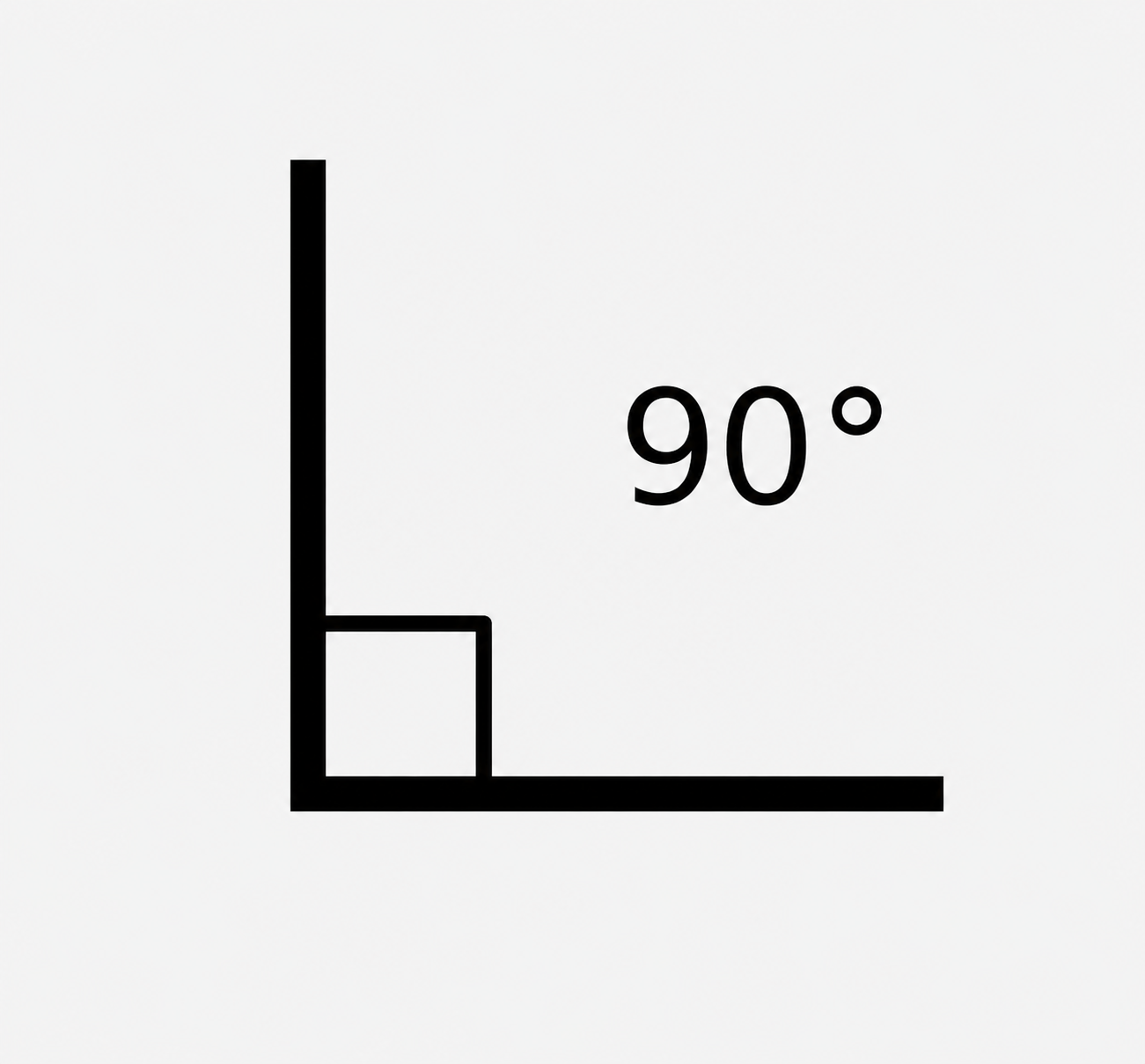
That tiny symbol is our most reliable clue, and we will depend on it throughout this course. Get in the habit of scanning for it every time you look at a triangle.
What Makes a Right Triangle
A right triangle is simply a triangle that has exactly one angle. That is the entire definition. It does not matter how long the sides are, how the triangle is turned, or where on the page it sits — if one of its three angles is , it is a right triangle.
Why can a triangle only have one right angle? Because the three angles inside any triangle always add up to . If one angle already uses , the other two must share the remaining , so neither of them can also reach .
This means the other two angles in a right triangle are always acute (each less than ).
Right, Acute, and Obtuse Triangles
Not every triangle is a right triangle. We classify triangles into three types based on their largest angle:
| Triangle Type | Largest Angle | Example Angles |
|---|---|---|
| Acute | Less than | |
| Right | Exactly | |
| Obtuse | Greater than |
Notice that in every row the three example angles still sum to — that rule never changes. A triangle that almost looks like it has a square corner but lacks the marker is not a right triangle. Appearances can be tricky, so always look for the small square symbol or confirmed angle measurements rather than trusting your eyes alone.
Orientation Does Not Change the Triangle
A common beginner mistake is expecting a right triangle to always appear in one familiar position, with the right angle sitting neatly at the bottom left. In reality, a right triangle can be rotated, flipped, or tilted in any direction, and it remains a right triangle.
Imagine picking up a piece of paper cut into a right triangle and tossing it on a table. It might land with the right angle at the top, at the right side, or anywhere else. The shape has not changed, and neither has the angle.
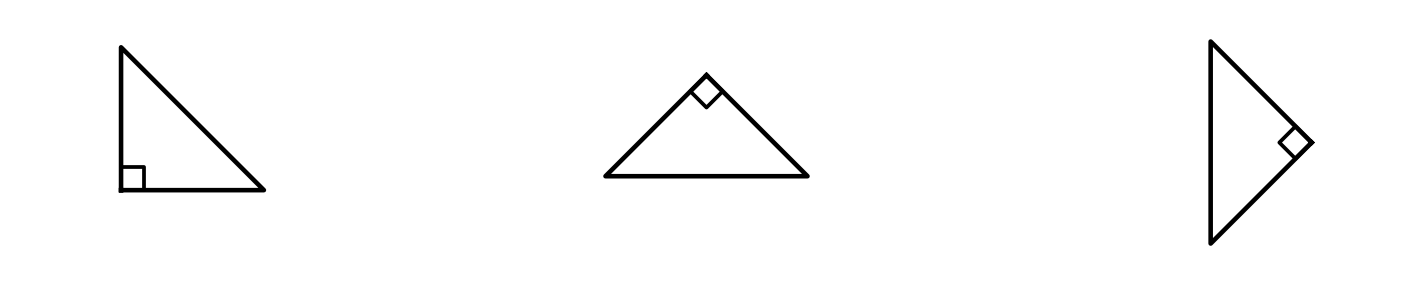
When examining a diagram, scan all three corners for the small square marker — not just the bottom ones. If you find that marker at any corner, you are looking at a right triangle.
Why This Matters for the Pythagorean Theorem
The Pythagorean theorem is a powerful rule that connects the three side lengths of a triangle, but it only works for right triangles. If a triangle does not have a angle, the theorem does not directly apply. This is precisely why identifying right triangles is our first skill to master.
In the lessons ahead, we will label the sides of a right triangle, explore what really means, and eventually build an intuitive visual proof of why it is true. All of that depends on the recognition skill we practiced today: find the angle, confirm it is a right triangle, and proceed with confidence.
Conclusion and Next Steps
A right triangle has exactly one angle, marked by a small square in diagrams. We distinguish it from acute triangles (all angles less than ) and obtuse triangles (one angle greater than ). Orientation does not matter — a right triangle stays a right triangle no matter how it is turned. Most importantly, recognizing this type of triangle is essential because the Pythagorean theorem applies only to right triangles.
Now it is time to put this knowledge into action. Up next are practice exercises where you will spot right triangles, classify different triangle types, and prove that no rotation or flip can fool you.
