Building Trust Architectures
Building Trust Architectures
In the previous lesson, you explored how teams evolve through developmental stages, how sub-groups can fragment collective intelligence, and how balanced participation unlocks better decisions. Each of those dynamics depends on trust. Without it, your team can have perfect facilitation and crystal-clear roles but still underperform because people are hedging or second-guessing each other. As a manager, your job is to understand the mechanics of trust to build it deliberately, monitor it continuously, and repair it skillfully.
Trust operates on two distinct levels: predictive trust and vulnerability-based trust.
Predictive trust is the confidence that someone will do what they say. It is transactional, built through consistency and reliability. While essential, it isn’t enough for high performance.
Vulnerability-based trust is the willingness to be exposed—to say "I made a mistake" or "I need help" without fear of retribution. If predictive trust is about capability, vulnerability trust is about safety. Many teams have high predictive trust but low vulnerability; they are reliable but not honest. People manage impressions instead of sharing reality, which leads to hidden risks and unspoken resentments.
Building this trust starts with you. You must model vulnerability by sharing genuine mistakes, admitting when you don't have an answer, and owning unsuccessful decisions. This teaches your team that vulnerability is the price of admission for real collaboration.
The "Trust Battery": Measuring and Recharging Relationships
The Trust Battery is a mental model for your professional relationships. Every interaction either charges the battery (transparency, following through, giving credit) or drains it (broken promises, micromanagement, canceling one-on-ones).
Develop the habit of assessing the battery level with each team member. Ask yourself: "If I had to deliver tough feedback right now, how would they receive it?" If the answer is "They’d get defensive," the battery is low. Recharging requires acknowledging the specific drain directly and following through with a series of small, consistent actions that demonstrate a change in behavior.
Repairing Trust After a Team Setback
When trust takes a collective hit—due to a failed project, a reorganization, or a broken management commitment—you must lead the repair using three principles:
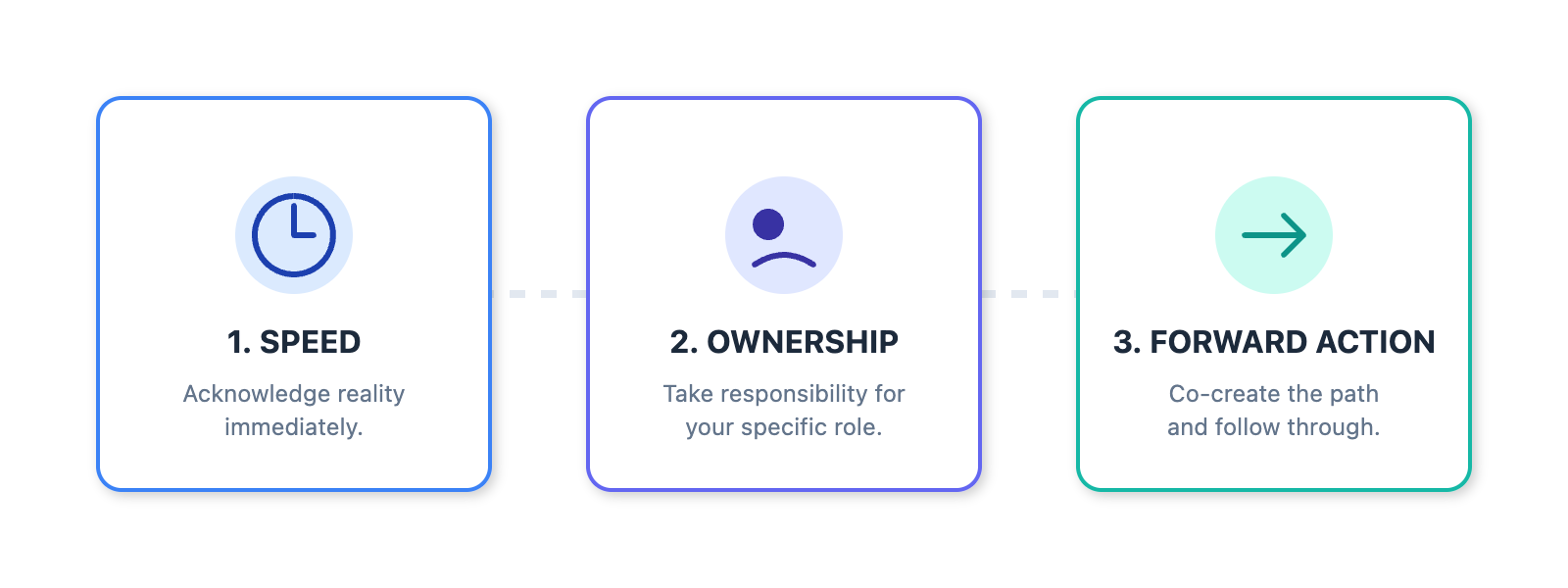
- Speed of Acknowledgment: Silence is interpreted as indifference. Acknowledge the reality immediately, even if you don't have all the answers.
- Owning What’s Yours: Distinguish between what was outside your control and what wasn’t. Take genuine responsibility for your role in the outcome.
- Forward Action: Co-create a path forward. Involve the team in the recovery process to restore their sense of agency, then follow through visibly.
To see these three principles working together, consider the following exchange between a manager and a direct report after the manager failed to flag a scope change that resulted in the team working an entire weekend to meet the original deadline.
- Jessica: Ryan, I want to talk about what happened last week. I knew the scope was shifting on Wednesday, and I should have flagged it to the team immediately instead of waiting to see if it would settle. That delay is what put everyone in weekend-work mode, and that's on me.
- Ryan: Honestly, it felt like we were the last to know. A few of us were wondering if you even realized the impact.
- Jessica: That's fair, and I hear you. I did realize it — too late — and I didn't communicate fast enough. I don't want that to happen again. What I'd like to do is set up a standing rule: any scope change that could affect the team's workload gets shared within 24 hours, even if I don't have full details yet. Would that help?
- Ryan: It would. Even a heads-up like "things might shift" would've let us plan differently.
- Jessica: Then that's what I'll commit to. And I want you to hold me to it — if you ever feel like you're being caught off guard again, tell me directly.
Notice how Jessica leads with a specific acknowledgment of her mistake rather than a vague apology, clearly owns the decision that caused the impact, and then proposes a concrete change while inviting Ryan to hold her accountable. She doesn't deflect, minimize, or rush past the discomfort. Ryan's honesty — "A few of us were wondering if you even realized the impact" — is exactly the kind of candor that only surfaces when a manager creates space for it, and Jessica's response validates that candor rather than punishing it. This is what trust repair looks like in practice: direct, specific, and oriented toward a visible change.
Trust repair is not a one-time event but a sustained campaign. In the upcoming role-play exercise and practice activities, you'll put these skills into practice by stepping into a scenario where you need to own a mistake and demonstrate the accountability that begins the trust repair process.
