Solving HCF Problems
Introduction
Welcome to the final lesson of Finding the Highest Common Factor! You have made it to Lesson 4 of 4, and by now you have a strong toolkit at your disposal. Over the first three lessons, we learned how to identify common factors, pick out the greatest one from factor lists, and use the more efficient prime factorization method for larger numbers. All of those skills were building toward a single goal: using the HCF to solve practical, real-world problems.
In this lesson, we shift our focus from how to calculate the HCF to when and why to use it. We will explore everyday situations where the HCF provides the answer, learn to recognize the structure of these problems, and practice setting up complete solutions with clear reasoning.
The Big Idea Behind HCF Problems
Before we look at specific examples, let's think about what the HCF really represents in everyday terms. Picture yourself with two different collections of items and a task: split everything into equal groups with nothing left over. The HCF tells you the largest number of identical groups you can make.

This idea shows up in many forms. You might be packing supplies into kits, dividing snacks evenly across plates, or cutting materials into equal lengths with no waste. In every case, the underlying question is the same: what is the biggest equal partition that uses up all quantities completely? Once you learn to spot that pattern, you will know exactly when to reach for the HCF.
Recognizing an HCF Problem
Not every word problem involving factors requires the HCF. The key is to look for a few telltale signals in the problem's wording and structure:
- Two or more different quantities that must be split or grouped together.
- A requirement for equal groups, identical sets, or uniform pieces.
- A condition that nothing is left over (no remainder, no waste).
- A question asking for the greatest, largest, or maximum number of groups or size of each piece.
When all of these ingredients are present, you are almost certainly looking at an HCF problem. If the problem instead asks about aligning repeating events or finding the smallest shared quantity, that points toward the Lowest Common Multiple (LCM), which we will cover in the next course.
Setting Up the Solution
Once you recognize an HCF situation, follow a consistent problem-solving process:
- Identify the quantities the problem gives you.
- Find the HCF of those quantities (using factor lists for small numbers or prime factorization for larger ones).
- Interpret the HCF in context to answer what the problem actually asks.
- Calculate any follow-up values the problem requires, such as how many items end up in each group.
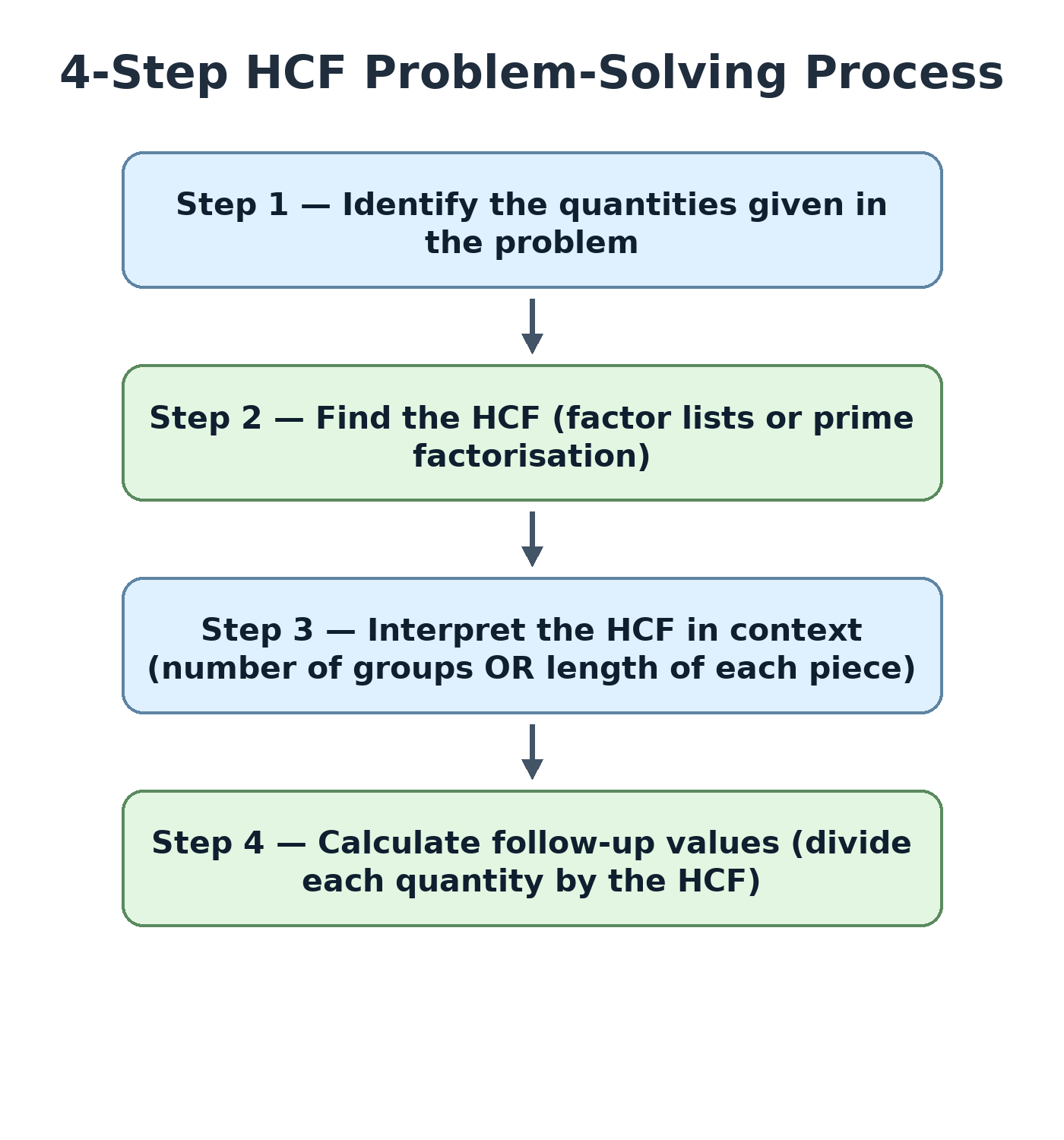
Step 3 is the one that learners sometimes skip, so we will pay special attention to it. The HCF is rarely the only number the problem wants; you usually need to explain what it means in the given situation.
Worked Example 1: Packing Craft Kits
Suppose you have 42 colored pencils and 30 sheets of sticker paper. You want to assemble the largest possible number of identical craft kits using all the materials, with nothing left over. How many kits can you make, and what goes into each one?
Step 1 — Identify the quantities: and .
Step 2 — Find the HCF. Using prime factorization:
The shared primes are and , each at power :
Step 3 — Interpret in context: We can make 6 identical kits.
Step 4 — Follow-up values: Divide each quantity by the HCF to find the contents of one kit:
Each kit contains colored pencils and sticker sheets, and every item is used up.
Worked Example 2: Plating Ingredients
A cook has 84 cherry tomatoes and 56 mozzarella balls and wants to arrange them onto the largest number of identical plates with nothing left over. How many plates can be prepared, and what goes on each plate?
Step 1 — Identify the quantities: and .
Step 2 — Find the HCF. The prime factorizations are:
The shared primes are (lowest power ) and (lowest power ):
Step 3 — Interpret in context: The cook can prepare 28 identical plates.
Step 4 — Follow-up values:
Notice how the prime factorization method, as you learned in the previous lesson, made the calculation quick even though and are not tiny numbers.
Worked Example 3: Cutting Ribbon
HCF problems are not limited to counting items. They also appear when you need to cut continuous materials into equal lengths. Here, the HCF gives the longest possible piece rather than the largest number of groups.
A gift wrapper has two rolls of ribbon: one measuring 120 cm and the other 90 cm. They want to cut both rolls into pieces of equal length, as long as possible, with no ribbon wasted. What is the length of each piece, and how many pieces result from each roll?
Step 1 — Identify the quantities: and .
Step 2 — Find the HCF:
| Prime | Power in | Power in | Lowest power |
|---|---|---|---|
Step 3 — Interpret in context: Each piece should be 30 cm long. This is the longest cut that divides both ribbons exactly.
Step 4 — Follow-up values:
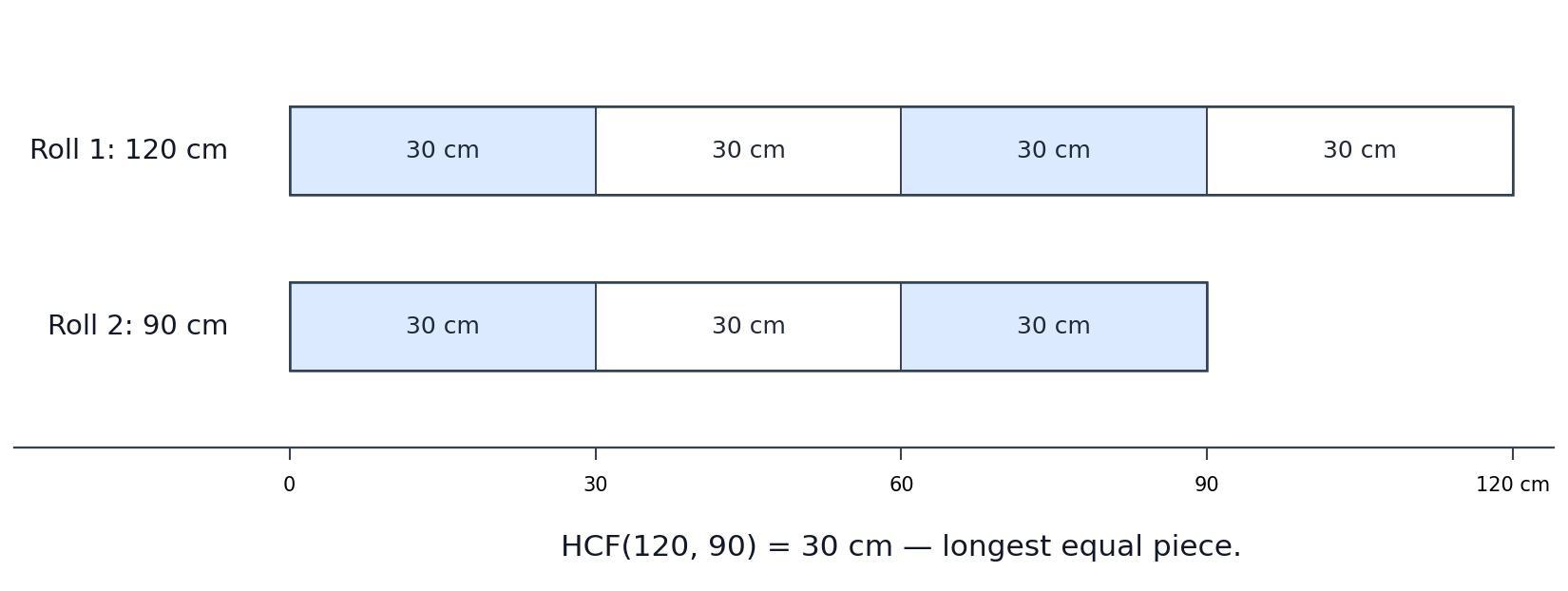
Why is 30 cm the longest possible? Any longer piece would have to divide both and evenly, meaning its length would need to be a common factor of both numbers. Since is the highest common factor, no longer piece can satisfy the zero-waste requirement.
Quick-Reference: HCF Problem Types
The table below summarizes the two main forms you will encounter. Recognizing which type you are dealing with helps you interpret the HCF correctly.
| Problem type | What the HCF represents | Follow-up calculation |
|---|---|---|
| Equal grouping (kits, plates, bags) | Largest number of identical groups | Divide each quantity by the HCF to find the amount per group |
| Equal partitioning (cutting, measuring) | Longest (or largest) uniform piece | Divide each measurement by the HCF to find the number of pieces |
In both types, the setup is the same: find the HCF of the given quantities. Only the interpretation changes.
Common Mistakes to Watch For
As you begin working through problems on your own, keep these pitfalls in mind:
- Forgetting the "nothing left over" condition. If the problem allows leftovers, the HCF may not be the right tool.
- Stopping at the HCF without answering the full question. Many problems ask for more than just the HCF itself, so always re-read the question after you compute it.
- Confusing HCF with LCM. If the problem asks for the smallest quantity that satisfies a condition or involves aligning repeating events, you likely need the LCM instead.
A good habit is to underline the key words in a problem before you start calculating. Words like largest, greatest, equal groups, and no remainder are strong indicators that the HCF is what you need.
Conclusion and Next Steps
In this lesson, we brought together everything from the course and applied it to real-world scenarios. We learned to spot the structure of an HCF problem, follow a clear four-step process, and interpret the result in context — whether that means counting identical groups or measuring the longest possible cut. We also compared equal-grouping and equal-partitioning problems and reviewed common mistakes to avoid.
You have now completed all four lessons of Finding the Highest Common Factor — congratulations! Head into the practice exercises next, where you will identify HCF situations, work through guided problems step by step, and tackle open-ended challenges that let you demonstrate your new problem-solving skills.
