Find the Base Rate
Introduction 🎉
Welcome to Evaluate Rare Events and Test Results! In the previous course, you built a strong foundation for spotting randomness, resisting pattern illusions, and questioning evidence from small samples. Those ideas share a common thread: our intuitions often fail when randomness, uncertainty, and limited information are involved. In this course, you will apply that same caution to test results, alerts, and screening outcomes, especially when the event in question is uncommon.
This first lesson introduces the single most important ingredient in that process: the base rate. By the end of this lesson, you will have learned to:
- Define a base rate as the background frequency of an outcome before any test, filter, or extra information is applied.
- Identify the correct outcome and reference group so you know exactly what the base rate describes and avoid applying it to the wrong population.
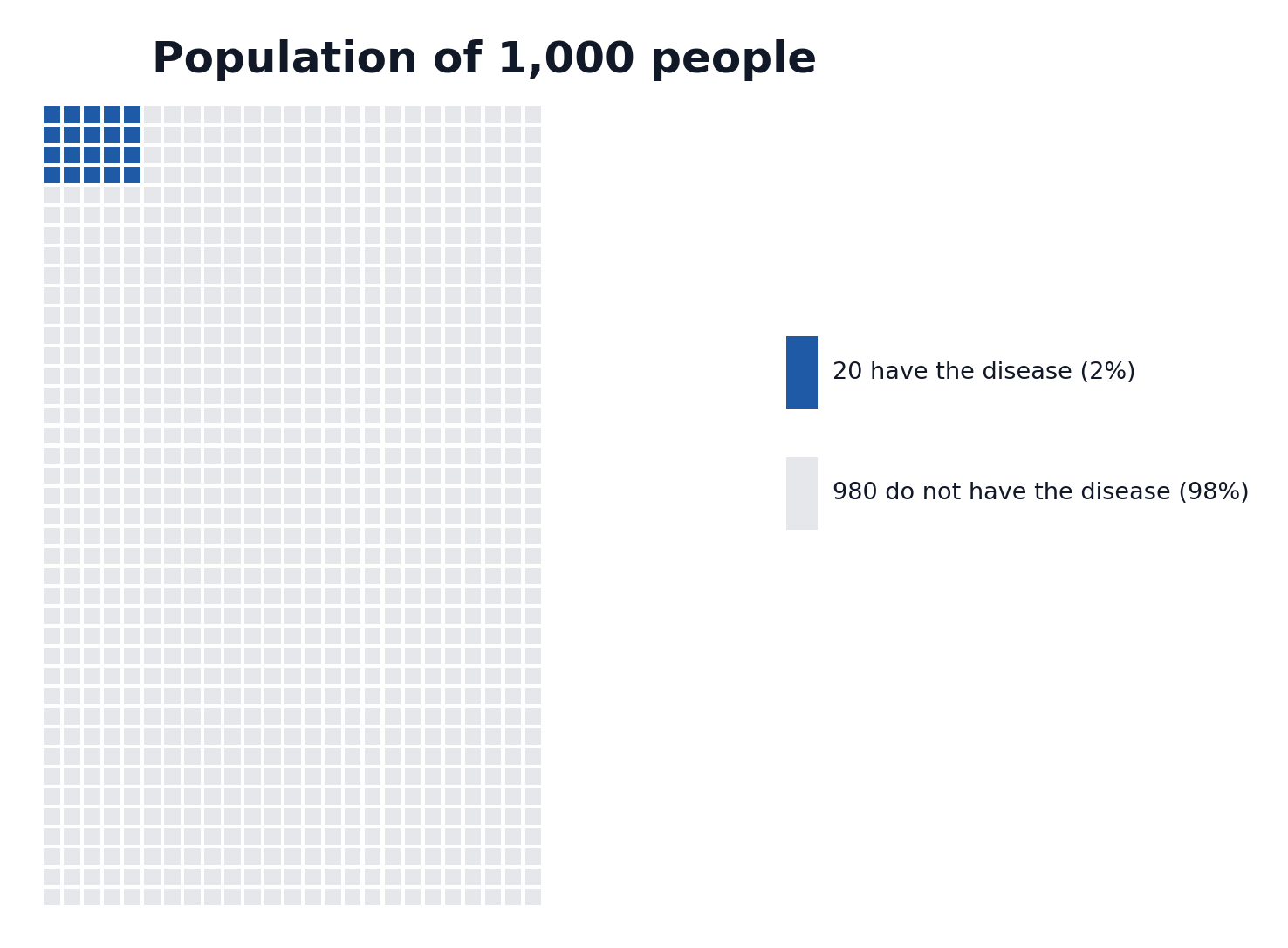
- Convert percentages into natural frequencies such as “20 out of 1,000” to make rare events easier to picture and reason about.
Imagine a doctor tells a patient, "This test is 95% accurate and your result is positive." Most people hear that and assume there is a 95% chance they have the condition. But whether that conclusion is reasonable depends almost entirely on how common the condition was before the test was run. If only 1 in 1,000 people in the relevant population actually has it, the math changes dramatically.
The background frequency acts like an anchor. Without it, even an impressive-sounding accuracy number can lead you to very wrong conclusions. Before you can evaluate any test or alert, you first need to find that anchor.
What Is a Base Rate? 📊
From Percentages to Natural Frequencies 🔄
Tracing a Full Example 🧭
Conclusion and Next Steps
In this lesson you learned that a base rate is the background frequency of an outcome within a clearly defined group, and that every base rate requires two parts: the frequency and the reference group it belongs to. You also practiced converting abstract percentages into natural frequencies — concrete counts that make it much easier to reason about how outcomes spread across a population. These ideas may seem straightforward on their own, but they are the foundation for everything else in this course.
Up next, you will put these concepts into practice with a set of hands-on exercises. You will extract base rates from real-world scenarios, translate percentages into counts, and even explain to someone why ignoring the base rate leads to faulty conclusions — so let's dive in!