Evaluate Rare Event Alerts
Introduction 🎉
Welcome to Evaluate Rare Event Alerts! In the previous lesson, you saw a surprising outcome: a license plate scanner with 95% sensitivity and a 3% false positive rate generated alerts where only about 3% represented actual stolen vehicles. That massive difference between the scanner's accuracy and the usefulness of its alerts wasn't just a quirk of the math — it is a predictable feature of the system. Now, you will explore why this exact dynamic shows up in almost every system designed to catch rare events. In this lesson, you will learn to:
- Understand why rare targets overwhelm screening systems by seeing how a small error rate applied to a massive group easily outnumbers the genuine catches from a tiny group.
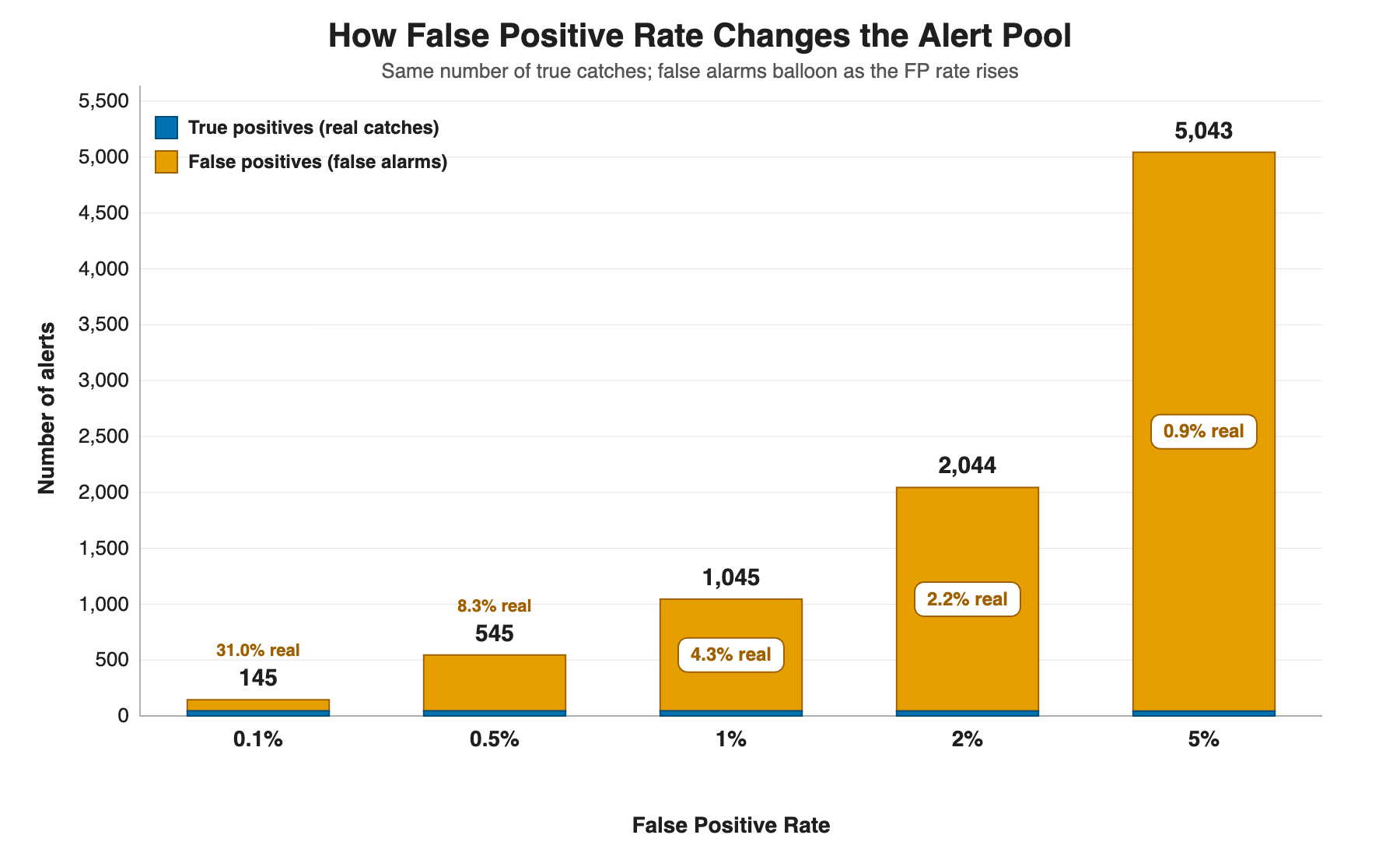
- Evaluate the impact of false positive rates to recognize how even slight changes can drastically shift an alert pool from somewhat useful to almost entirely noise.
- Apply practical takeaways to real-world alerts across domains like fraud, security, and medicine by asking key questions about rarity, error rates, and secondary screening.
Let's build a clear mental picture of why rare targets cause this problem.
When a screening system scans a population, it works on two groups: items with the condition and items without it. When the target event is rare, these two groups are wildly mismatched in size. A fraud system scanning 100,000 transactions where only 50 are fraudulent faces a "without" group that is 2,000 times larger than the "with" group. Even if the system makes mistakes on only a tiny percentage of that massive group, those mistakes can easily outnumber the genuine catches from the small one.
This is not a flaw in the system. It is a direct consequence of arithmetic: a small percentage of a very large number can overwhelm a large percentage of a very small number. Understanding this idea is the key to evaluating any alert from any rare-event screening system.
A Fraud Detection Walkthrough 💳
How the False-Positive Rate Shapes the Alert Pool 🔔
The Same Pattern Across Domains 🌐
Fraud detection is just one example, but the math works exactly the same way whenever you are looking for something rare. You will see this same pattern show up in many different areas:
- Airport security: Prohibited items are extremely rare among all bags scanned. Even highly accurate scanners generate frequent false alarms, which is why flagged bags go through a second manual inspection rather than triggering an immediate response.
- Medical screening: When a disease affects a small fraction of the population, mass screening programs expect most positive results to be false positives. Follow-up testing is standard practice, not a sign that the first test was poor.
- Network security: Intrusion detection systems on corporate networks may flag thousands of events per day. Genuine attacks are rare, so security teams use tiered alert levels to sort through the noise.
- Spam filtering: Interestingly, spam often makes up half or more of incoming email. Because the base rate is high, filters achieve a high share of genuine catches — the same pattern working in reverse, where a common target means fewer false alarms relative to true positives.
In every case, the rarity of the target combined with even a small false positive rate applied to the much larger "no condition" group determines whether alerts are mostly genuine or mostly noise.
Practical Takeaways for Evaluating Alerts 💡
Conclusion and Next Steps
In this lesson, you explored why highly accurate screening systems (high sensitivity, low false-positive rate) naturally generate mostly false alarms when the target event is rare. You walked through a fraud detection example, saw how even small changes in the false positive rate can shift the alert pool from somewhat useful to almost entirely noise, and recognized this same pattern across fields from medicine to cybersecurity. The core insight is straightforward: a small error rate applied to a very large number can easily outnumber the true catches from a very small number, and that is arithmetic, not a system failure.
You have now completed all four lessons in this course. Up next is a hands-on practice section where you will experiment with base rates and error rates, calculate the genuine share of alerts in realistic scenarios, and explain rare-event reasoning to a concerned colleague. Time to put this toolkit to work!