Welcome to the fifth and final lesson of Estimation and Sense of Scale! You have made it through every lesson in this course, and that is worth a moment of appreciation. Over the previous four lessons, we built a library of mental benchmarks for length, weight, volume, time, and speed. Each time, the pattern was the same: anchor to something familiar, compare, and decide whether a number looks right. In this closing lesson, we bring all of those skills together into one focused habit: sanity-checking measurements.
Every day, we encounter numbers on labels, receipts, websites, and instructions. Most are correct, but some contain mistakes that slipped past the person who typed them. A misplaced decimal can turn a safe medication dose into a dangerous one. A unit mix-up can double the flour in a recipe. Our goal here is to learn a simple, repeatable process for catching the three most common types of errors: unit mix-ups, decimal-place slips, and outright typos.
Why Numbers Deserve a Second Glance
Throughout this course, we have used benchmarks to estimate things we could not easily measure. But benchmarks serve a second, equally important purpose: they act as alarm bells. When a number falls far outside the range we expect, our benchmark knowledge flags it before we even pick up a calculator.
Think about how often numbers pass through human hands. A pharmacist types a dosage into a system. A clerk enters a price at a register. A weather app converts between Fahrenheit and Celsius behind the scenes. At every step, there is a chance for a digit to slip, a decimal to shift, or a unit label to be swapped. The person who catches these errors is usually not the one who made them. It is the reader who pauses and thinks, "Does this number make sense?" That reader, after this lesson, will be you.
Order-of-Magnitude Reasoning
Join the 1M+ learners on CodeSignal
Be a part of our community of 1M+ users who develop and demonstrate their skills on CodeSignal
The core tool for sanity-checking is order-of-magnitude reasoning. Instead of calculating an exact answer, we simply ask whether a stated value is in the right ballpark. Specifically, we check how far the value deviates from our expected benchmark.
The mental process has three steps:
Recall a benchmark for the quantity. (What should this roughly be?)
Compare the stated value to that benchmark.
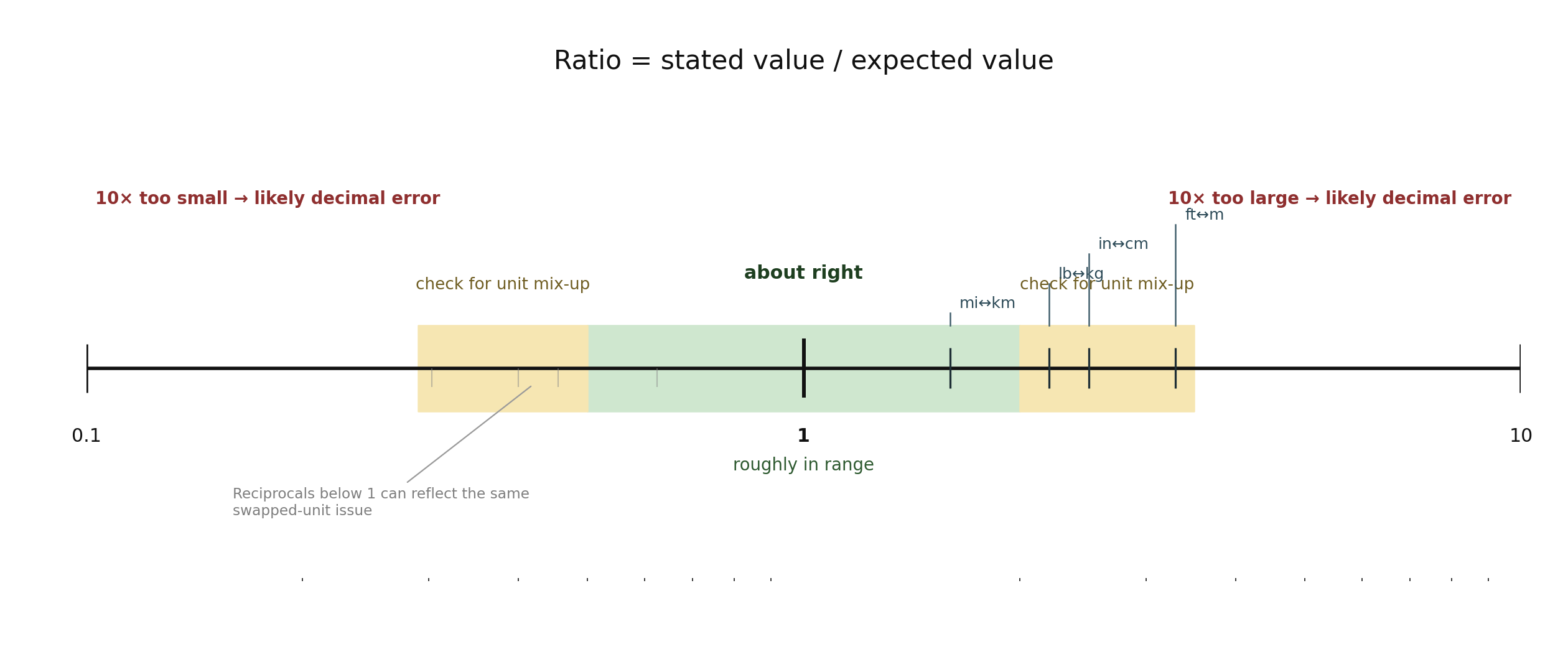
Check the ratio. If the value is off by a factor of 10 or 100, suspect a decimal error. If the ratio matches a common conversion factor (like 2.2 for lb/kg or 30 for fl oz/mL), suspect a unit mix-up.
It can help to picture those ratios on a simple scale:
For example, suppose a product listing says a kitchen table weighs 350 lb. As we practiced in Lesson 2, a typical kitchen table weighs somewhere around 50 to 80 lb. The ratio is roughly 70350=5, which is suspicious. A quick check: could the weight have been entered in kilograms and then incorrectly converted? Or perhaps 35.0 lb lost its decimal point. Either way, the benchmark tells us to pause and investigate.
Catching Unit Mix-Ups
Catching Decimal-Place Errors
Scanning a Grocery List for Errors
Conclusion and Next Steps
In this lesson, we combined the estimation skills from the entire course into one practical habit: sanity-checking measurements. We learned to use order-of-magnitude reasoning to compare a stated value against an expected benchmark, diagnosing unit mix-ups by looking for known conversion ratios and decimal-place errors by looking for factors of 10 or 100.
Whether you are scanning a recipe or reviewing a product listing, the process is always the same: benchmark, compare, diagnose. Always remember: if you are checking something critical like a medical dose or a structural measurement, use your sanity check as a reason to stop and verify the information with a professional.
Congratulations on completing all five lessons in Estimation and Sense of Scale! Now it is time to put your detective instincts to the test in the practice exercises ahead. Trust your benchmarks, follow the three-step process, and enjoy the hunt!
A unit mix-up happens when the correct number is paired with the wrong unit, or when a value meant for one unit system is read as though it belongs to another. The telltale sign of a unit mix-up is that the value is off by a factor that matches a known conversion ratio. While many common mix-ups (like miles to km or lb to kg) involve factors between 1.5 and 3, others can be much larger.
Unit Pair
Approx. Factor
Example of a Mix-Up
lb ↔ kg
×2.2
Newborn listed as 8 kg instead of 8 lb
miles ↔ km
×1.6
A 10 km race advertised as 10 miles
inches ↔ cm
×2.5
Monitor listed as 27 cm instead of 27 inches
°F ↔ °C
varies
Forecast showing 72 °C instead of 72 °F
feet ↔ meters
×3.3
Ceiling height written as 8 meters instead of 8 feet
fl oz ↔ mL
×30
Bottle labeled 500 fl oz instead of 500 mL
Quick tip: When a value seems out of range, check if dividing it by a common conversion factor brings it back to your benchmark. If the gap matches a conversion ratio, the mystery is likely solved.
A decimal-place error occurs when the decimal point lands in the wrong spot, making a value 10, 100, or even 1,000 times too large or too small. These tend to be the easiest errors to catch because the result is dramatically out of range. Let's look at a few examples:
"A loaf of bread costs 42.00."∗∗Atypicalloafcostsaround3 to 5.Thestatedpriceisabout10\timestoohigh.Thelikelyintendedpricewas∗∗4.20, with the decimal shifted one place to the right.
"Ibuprofen dose: 2,000 mg." A standard adult dose is 200 to 400 mg. The value 2,000 mg is 10× the upper end of that range, suggesting a likely typo for 200 mg.
"Room temperature: 720 °F." A comfortable room sits at about 68 to 72 °F. The value 720 is exactly 10× too high, clearly a typo for 72 °F.
Important Safety Note: While sanity-checking is a vital skill, you should never act on an inferred correction for safety-sensitive items like medication. If a dose looks suspicious, do not take it; instead, verify the correct amount with a doctor, pharmacist, or trusted medical professional.
The diagnostic formula is straightforward. Compute the ratio of the stated value to the expected value:
ratio=expected valuestated value
If the ratio comes out close to 10, 100, or 0.1, the decimal point almost certainly shifted. One place to the right multiplies by 10; one place to the left divides by 10.
Now that we have covered both error types individually, let's practice the full three-step process on a realistic scenario. Imagine a friend texts us the following grocery list:
Item
Stated Quantity or Price
Bag of apples
3 lb
Milk
1 gallon
Ground beef
50 lb
Dozen eggs
$0.45
Bag of flour
5 kg
Orange juice
640 fl oz
We work through each line using our benchmark → compare → diagnose approach:
Apples, 3 lb. A typical bag of apples is about 3 to 5 lb. ✔ This looks fine.
Milk, 1 gallon. Standard grocery size. ✔ No issue here.
Ground beef, 50 lb. A normal family purchase is 1 to 3 lb; even a big bulk buy would be 5 to 10 lb. The ratio is roughly 550=10, so this is a likely decimal error. The intended amount was probably 5.0 lb.
Eggs, $0.45. A dozen eggs typically costs around $3 to $6. The stated price is about 101 of the expected value, suggesting the decimal shifted one place to the left. The likely price is $4.50.
Flour, 5 kg. In the US, flour is commonly sold in 5 lb bags. Since 5 kg≈11 lb, this is roughly double what we would expect. The conversion factor of ≈2.2 matches the lb-to-kg ratio, so this is a unit mix-up. The label should read 5 lb.
Orange juice, 640 fl oz. As we learned in Lesson 3, a standard carton holds about 64 fl oz (half a gallon). The stated value is exactly 10× too large, a clear decimal error. The correct amount is 64 fl oz.
Notice that every check followed the same three-step rhythm: recall a benchmark, compare the ratio, and diagnose the error type.