Estimating Irrational Expressions
Introduction
You have spent the last three lessons building a powerful toolkit: trial squaring to pin down irrational square roots, rounding calculator displays to a target precision, and ordering mixed sets of real numbers side by side. Every one of those skills focused on individual values. Now, in this fifth and final lesson of Estimating and Comparing Real Numbers, we zoom out and tackle the bigger picture — estimating the value of entire expressions that contain irrational numbers. By the end, you will be able to substitute approximations into a formula, carry out the arithmetic, and round the result to a precision that fits the real-world situation at hand.
From Single Values to Full Expressions
Up to this point, our work has centered on individual numbers. We found, for instance, that or recalled that , and that was the end goal.
In everyday math and science, though, irrational numbers rarely stand alone. They appear inside formulas: the area of a circle is , the diagonal of a rectangle is , and expressions like come up in physics and engineering. To get a usable numeric answer from any of these, we need to plug in our approximations and carry out the arithmetic, then decide how precisely to report the result.
The Substitute-Then-Compute Strategy
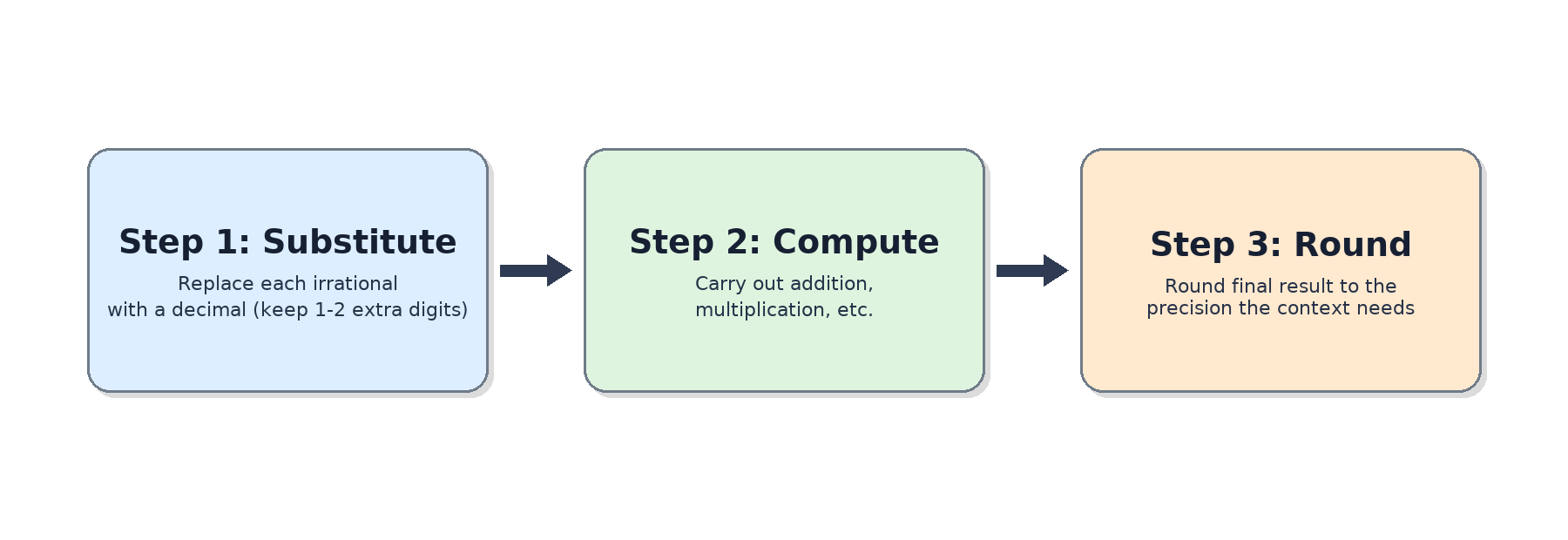
The good news is that we already know how to approximate each irrational piece. The new part is combining those approximations through addition, multiplication, or other operations, and then rounding the final result. The strategy breaks down into three clear steps:
- Substitute a decimal approximation for every irrational number in the expression.
- Compute the arithmetic using those decimals.
- Round the result to a precision that fits the situation.
One important detail in Step 1: carry one or two extra decimal places beyond the precision you want in the final answer. Those extra digits act as a safety buffer so that small rounding errors during computation do not spoil the last digit of the result. For example, if the goal is a result rounded to the hundredths place, work with approximations out to at least the thousandths place.
Worked Example: Evaluating 2π + √3
Let's estimate and round to the nearest hundredth.
Step 1 — Substitute. We want hundredths in the final answer, so we use approximations to the ten-thousandths place for a comfortable buffer:
Step 2 — Compute. We handle the multiplication first, then the addition:
Step 3 — Round. The thousandths digit is , so we round up:
Notice how keeping four decimal digits during the calculation made the final two-digit rounding clean and reliable.
Worked Example: Evaluating √5 × √7
Let's try a product: estimate to the nearest tenth.
Step 1 — Substitute. Since our target is tenths, we work with thousandths:
Step 2 — Compute.
Step 3 — Round. The hundredths digit is , which is less than , so we round down:
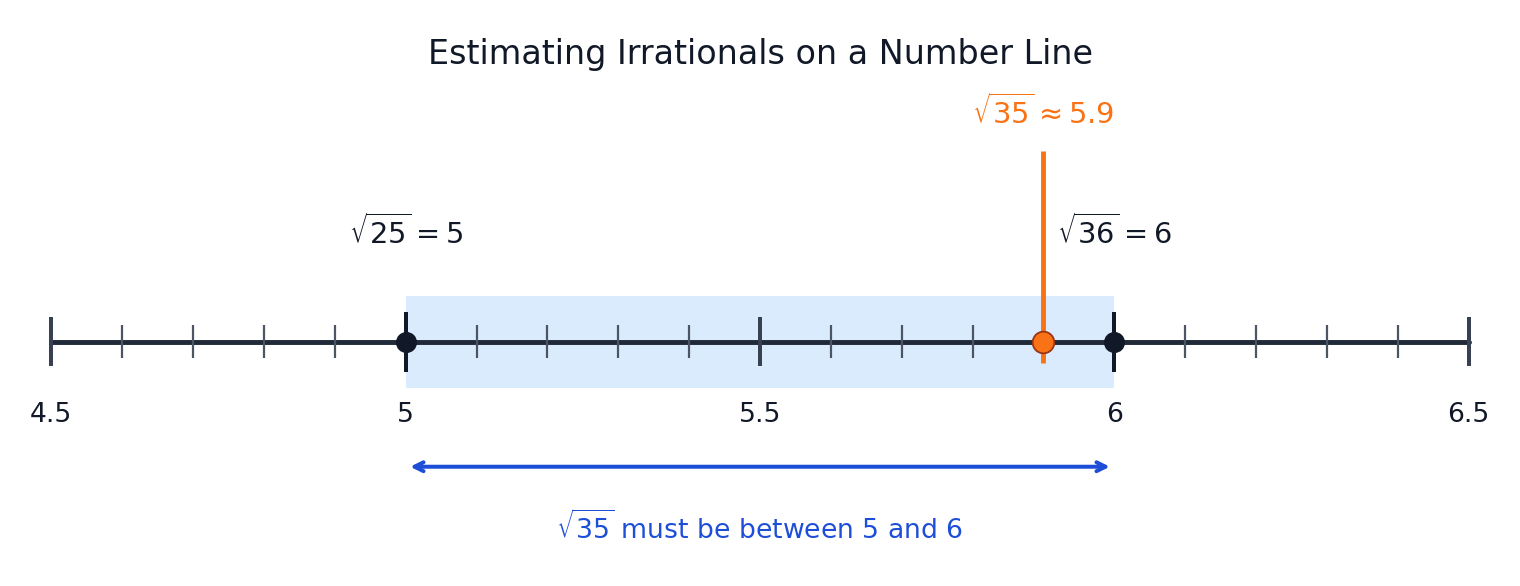
As a quick sanity check, recall that . Since and , the answer should land just under . Our estimate of fits that expectation perfectly. Building the habit of a brief reasonableness check like this can catch arithmetic mistakes before they become a problem.
Choosing the Right Precision for the Situation
In a textbook exercise, the problem tells you exactly how many decimal places to report. In real life, you choose the precision, and the right choice depends on the decision the number supports.
| Context | Typical precision | Reason |
|---|---|---|
| Buying fabric or flooring | Nearest tenth of a unit | Stores measure in simple increments |
| Checking if furniture fits a space | Nearest tenth of an inch | Fractions of an inch below that rarely matter |
| Scientific measurement | Hundredths or thousandths | Lab instruments detect fine differences |
| Quick mental estimate | Nearest whole number | We just need a ballpark sense |
The guiding principle is: match the precision to the decision. Extra decimal places beyond what the situation can actually use add clutter without adding value. When in doubt, ask yourself, "What is the smallest difference that would actually change my choice?" That is the level of precision you need.
Real-World Example: Area of a Round Table
Suppose you have a round table with a diameter of feet and you want to estimate its surface area so you can buy a tablecloth. The area of a circle is:
The radius is half the diameter, so ft. Substituting gives:
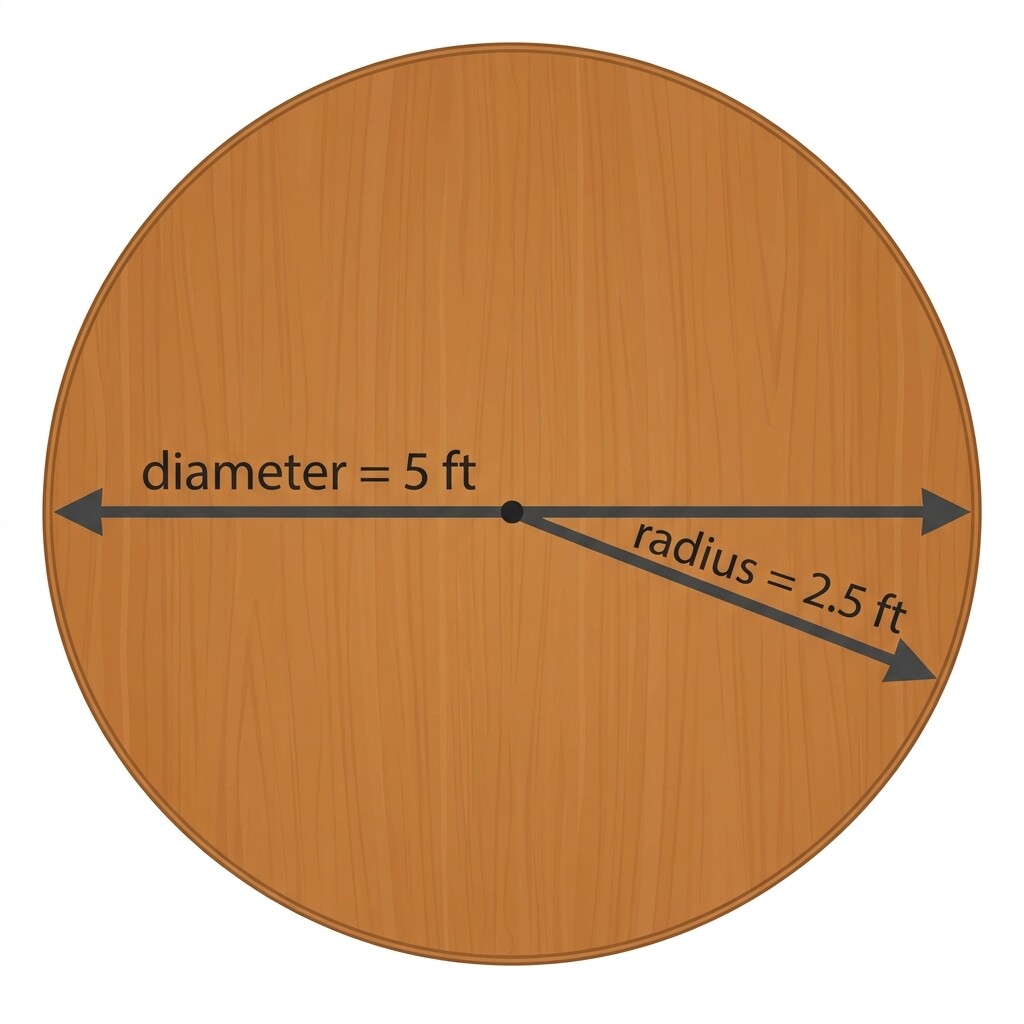
Now we replace with a decimal approximation. Since we are shopping for a tablecloth, precision to the nearest tenth of a square foot is more than enough. We use for a safe buffer:
Rounding to the nearest tenth:
Why stop at tenths? Because tablecloths are sold in rough size categories, not in hundredths of a square foot. Reporting would suggest a level of exactness that serves no purpose when we are simply picking a cloth off the shelf. The rounded value of sq ft tells us exactly what we need to make the purchase.
Real-World Example: Diagonal of a TV Screen
Here is another practical scenario. You are shopping for a TV that is inches wide and inches tall, and you need to confirm that the screen will fit a wall mount rated for diagonals up to inches. The diagonal of a rectangle is given by:
Step 1 — Substitute and compute the value inside the square root. Both the width and height are whole numbers, so this part is exact:
We now need to estimate . Since and , the diagonal falls between and inches. A calculator gives .
Step 2 — Round. We are checking whether the TV fits a mount with a whole-number spec of inches, so rounding to the nearest tenth is plenty of precision:
That leaves about inches of clearance — the TV fits comfortably. We did not need hundredths or thousandths here because the decision is simply "fit or no fit," and a tenth of an inch resolves that with confidence.
Conclusion and Next Steps
In this lesson, we learned how to estimate expressions involving irrational numbers using a three-step process: substitute decimal approximations with extra precision for safety, compute the arithmetic, and round the result to match the context. We also practiced choosing the right number of decimal places by thinking about the real-world decision the answer supports. Together with the approximation, rounding, placement, and ordering skills from the earlier lessons, this completes your toolkit for working confidently with any real number.
Now it is time to put the whole course to work! In the practice exercises ahead, you will evaluate expressions combining multiple irrationals, estimate the area of a circular table for a shopping decision, and calculate a TV diagonal to check whether it fits a wall mount. Let's dive in and bring all five lessons together!
