Comparing Autoencoder Optimizers
Introduction and Goal
Greetings, and welcome to the exciting lesson on Comparing Different Optimizers for Autoencoders! In prior lessons, we've learned about Autoencoders, their role in dimensionality reduction, elements like loss functions, and optimizers. Now, it's time to apply this knowledge and delve deeper into the fascinating world of optimizers.
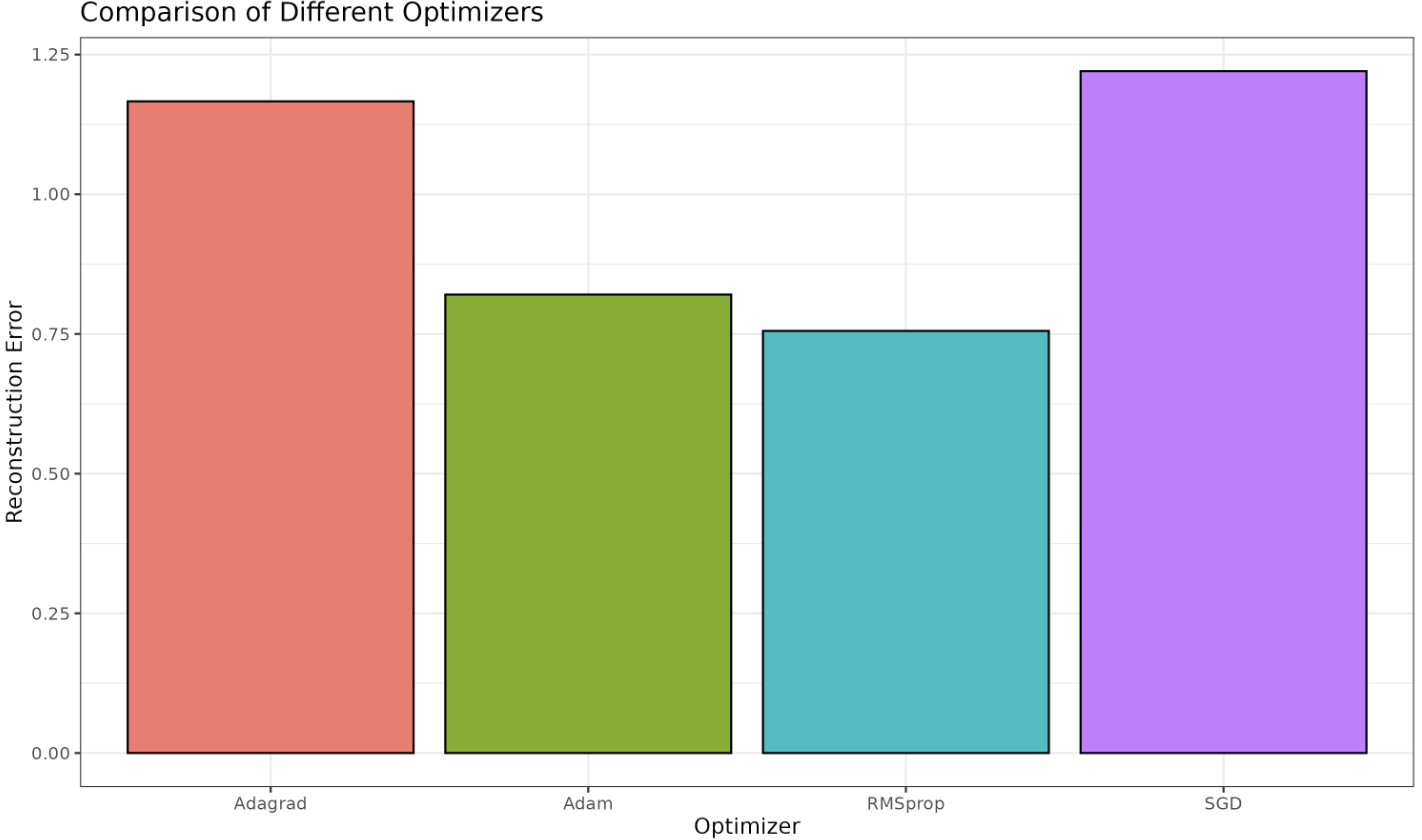
In this lesson, we will train our Autoencoder using different optimizers and then compare their performance based on the reconstruction error. Our goal? To understand how different optimizers can impact the Autoencoder's ability to reconstruct its inputs.
Understanding Optimizers
Recalling from our previous lessons, optimizers in machine learning algorithms are used to update and adjust model parameters, reducing errors. These errors are defined by loss functions, which estimate how well the model is performing its task. Some commonly used optimizers include Stochastic Gradient Descent (SGD), Adam, RMSprop, and Adagrad. Although they all aim to minimize the loss function, they do so in different ways, leading to variations in performance. Understanding these differences enables us to choose the best optimizer for our machine learning tasks.
Building an Autoencoder Model
As a starting point, we need an Autoencoder, but before moving there, let's generate a dataset using the mlbench package. We'll use the mlbench.waveform dataset, which is suitable for demonstrating dimensionality reduction:
Next, we define a simple Autoencoder with a Dense input layer and a Dense output layer; both layers have the same dimensions:
This R function creates a simple Autoencoder using keras3. The function accepts the dimensions of the input layer, the encoded layer, and the optimizer as arguments. In the end, it compiles the Autoencoder with the specified optimizer and binary_crossentropy as the loss function.