Estimating Population Mean
Introduction
Welcome back to Drawing Conclusions from a Sample! This is our second lesson, and the momentum is building. In the first lesson, we drew a clear line between sample statistics and population values, and we saw that a statistic serves as an estimate of its matching population value. Today we put that idea into action with one of the most useful moves in statistics: using a sample mean to estimate a population mean.
Why the Sample Mean Is a Natural Estimate
We already know that a sample mean and a population mean are two different things. One is a number we can calculate from collected data; the other is a number we almost never get to see because measuring every member of the population is rarely practical. So a natural question arises: why should the sample mean be a good stand-in for the population mean?
The intuition is straightforward. When we draw a random sample, each member of the population has a fair chance of being selected. That means the sample will tend to include a mix of higher and lower values that roughly mirrors the mix in the full population. As a result, the center of the sample — its mean — lands close to the center of the population. The sample mean won't be a perfect copy of the population mean, but it is a principled starting point, and no extra formula or adjustment is needed to turn it into an estimate.
Computing the Sample Mean
As you may recall from the earlier course on summarizing data, the mean of a sample is the sum of all observed values divided by the count of values. If our sample contains values labeled , the formula is:
This single number captures the center of our sample data. In the context of this lesson, that same number also serves as our estimate of the population mean — no further calculation required.
The Key Move: Sample Mean Becomes Population Estimate
Let's make the idea concrete. Suppose we want to know the average word length in a 300-page novel. Counting the letters of every word would take hours, so instead we select a random sample of 10 words from the book and record the number of letters in each:
| Word | Letters |
|---|---|
| the | 3 |
| chapter | 7 |
| run | 3 |
| of | 2 |
| brilliant | 9 |
| on | 2 |
| story | 5 |
| lamp | 4 |
| is | 2 |
| world | 5 |
We compute the sample mean:
You can think of the process like this:
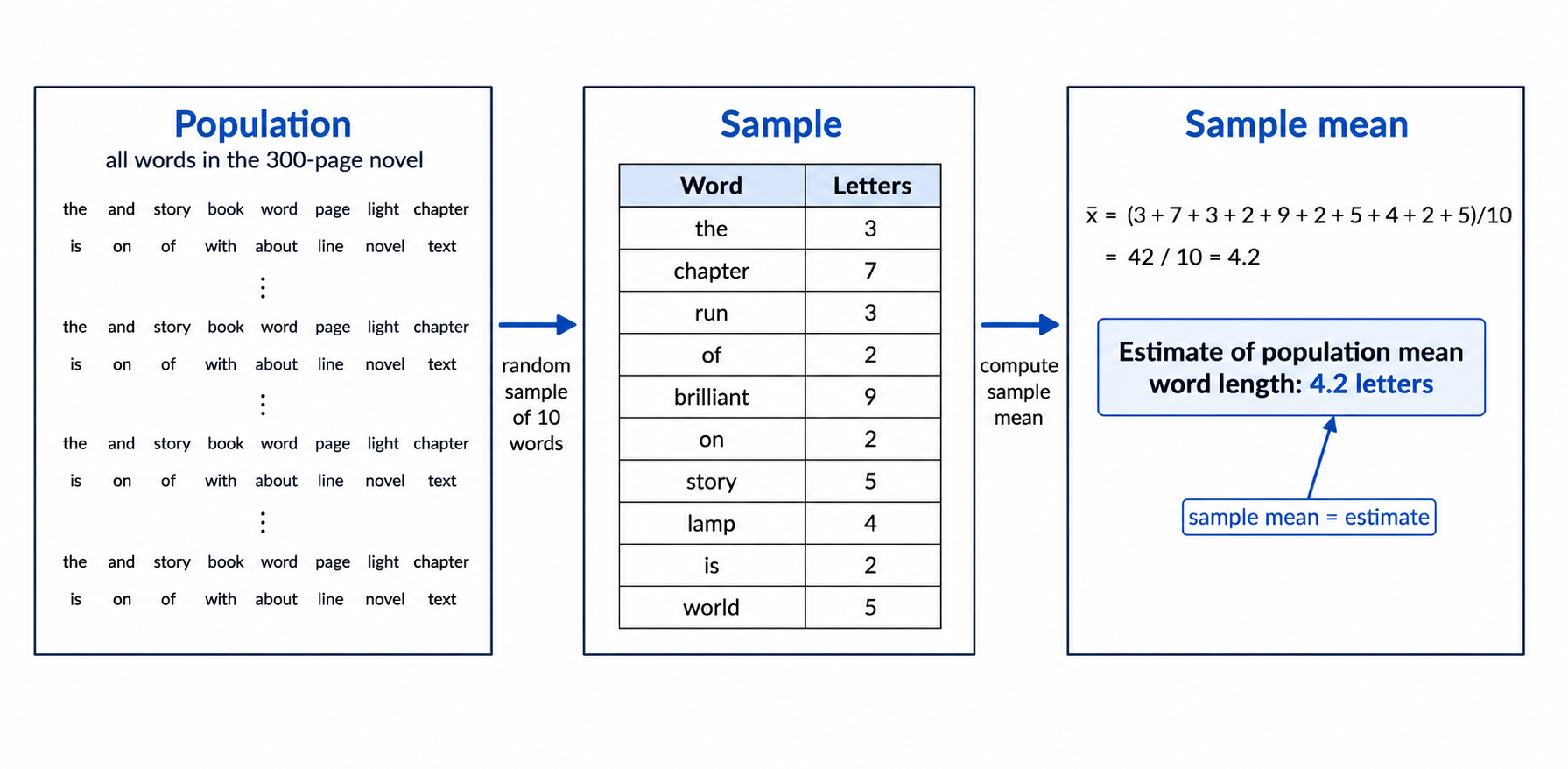
Once we have , we carry that value over directly as our best estimate of the population mean. There is no second formula and no adjustment step. Our estimate of the average word length in the entire book is 4.2 letters — the best guess we can make from this particular sample.
