Last Digit Divisibility Rules
Introduction
Welcome to Divisibility Shortcuts, the second course in our learning path! In the previous course, Foundations of Factors and Multiples, we built a solid understanding of factors, multiples, and prime versus composite numbers. Now we begin putting that knowledge to work with quick tests that tell us whether one number divides evenly into another — no long division required.
This is the first lesson of five in the course, and our focus today is on divisibility by 2, 5, and 10. By the end of this lesson, you will be able to check divisibility by any of these three numbers just by looking at a single digit. Even better, you will understand why that shortcut works.
What Does "Divisible By" Mean?
As you may recall from the previous course, when we say a number is divisible by another number, we mean the division comes out exact with no remainder. For example, is divisible by because exactly. In factor language, is a factor of , and is a multiple of .
Checking divisibility by performing full division works, but it can be slow for larger numbers. Imagine testing whether is divisible by by working out the entire division. Divisibility rules give us a faster way: reliable shortcuts rooted in how our number system is built.
Divisibility by 2: The Last-Digit Test
A whole number is divisible by 2 if its last digit is 0, 2, 4, 6, or 8. These are the even digits. If the last digit is odd (1, 3, 5, 7, or 9), the number is not divisible by 2.
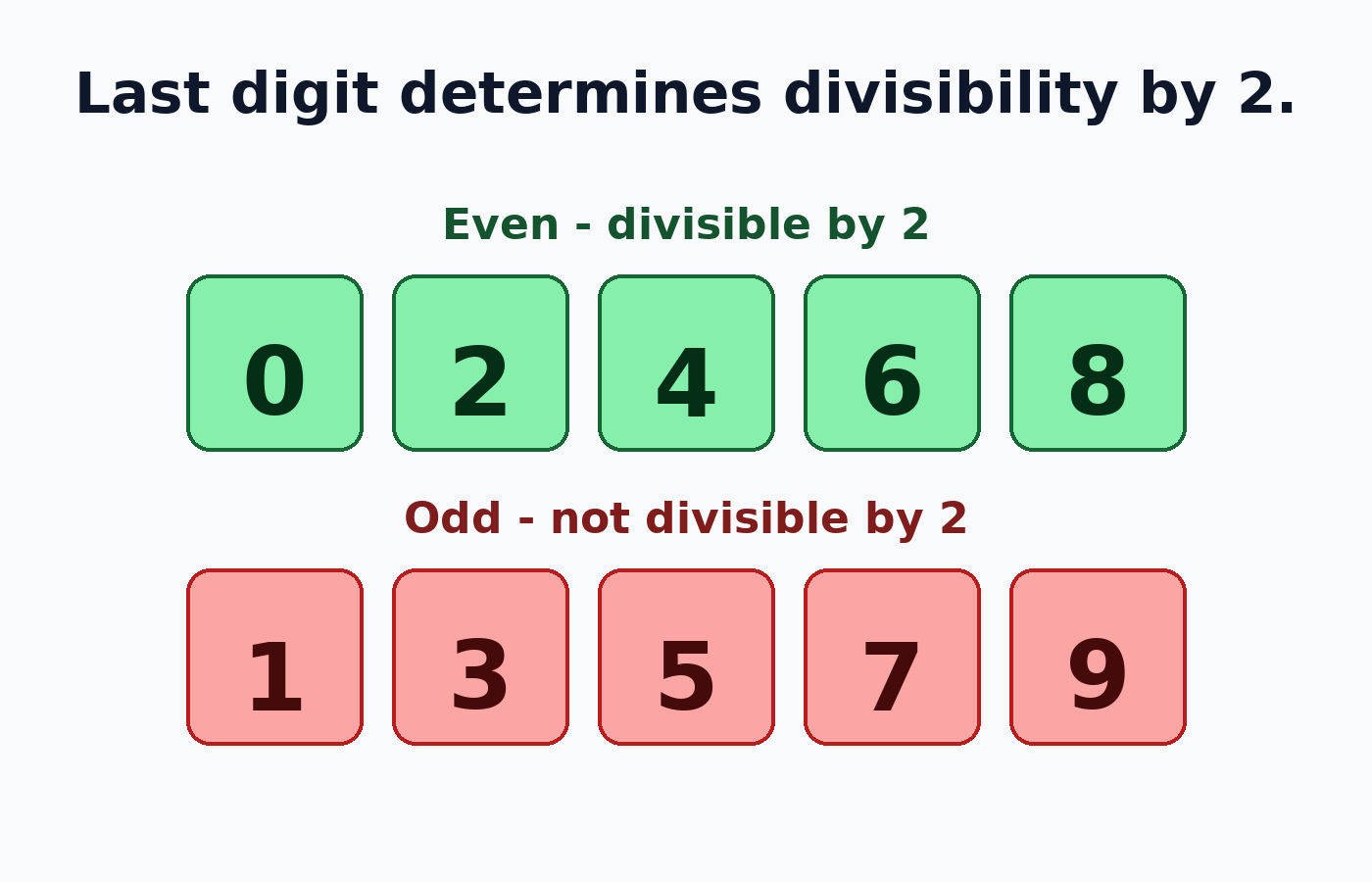
Let's try a few examples:
| Number | Last Digit | Even? | Divisible by 2? |
|---|---|---|---|
| 136 | 6 | Yes | Yes |
| 2,481 | 1 | No | No |
| 7,940 | 0 | Yes | Yes |
Notice that the size of the number does not matter. Whether you have a three-digit number or a ten-digit number, only the last digit decides divisibility by 2.
Divisibility by 5: Another Last-Digit Test
A whole number is divisible by 5 if its last digit is 0 or 5. That's it — just two possible endings.
Think about counting by fives: Every multiple of ends in either or , and this pattern never breaks. So a number like is divisible by (last digit is ), while is not (last digit is ).
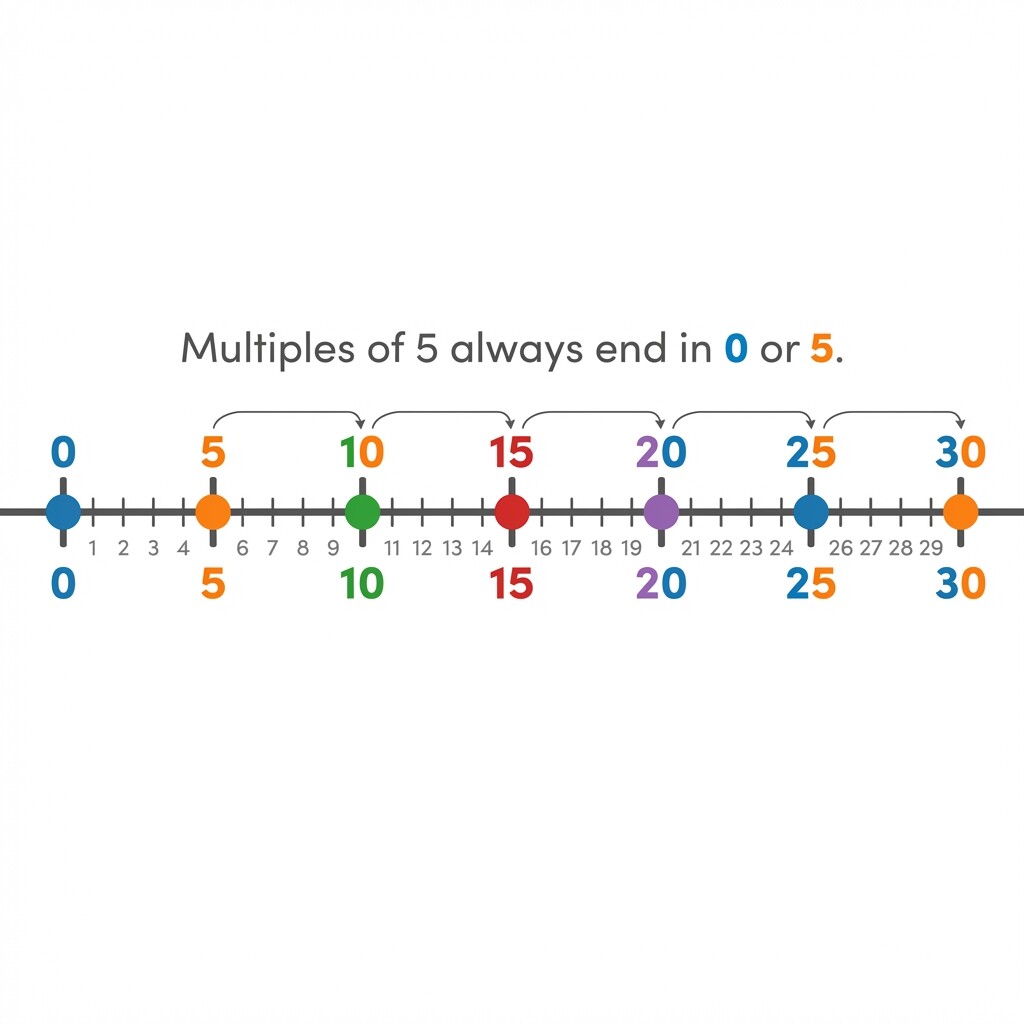
This rule is especially handy in everyday life. If you are splitting a restaurant bill among five people, a quick glance at the total's last digit tells you instantly whether it divides evenly.
Divisibility by 10: The Simplest Test of All
A whole number is divisible by 10 if its last digit is 0. This is the easiest rule to remember because our entire counting system is based on groups of ten.
Consider . Its last digit is , so it is divisible by . What about ? The last digit is , so it is not divisible by , even though it is divisible by .
This highlights an important relationship: every number divisible by 10 is also divisible by both 2 and 5, because . However, being divisible by just one of them is not enough to guarantee divisibility by . For example, is divisible by but not by , and is divisible by but not by — so neither is divisible by .
Why the Last Digit Is All You Need
So far, the three rules may feel like facts to memorize. But there is a satisfying reason they work, and it lives in place value. In base ten, any whole number can be split into two parts: everything except the last digit (which forms a multiple of ) and the last digit itself. For instance:
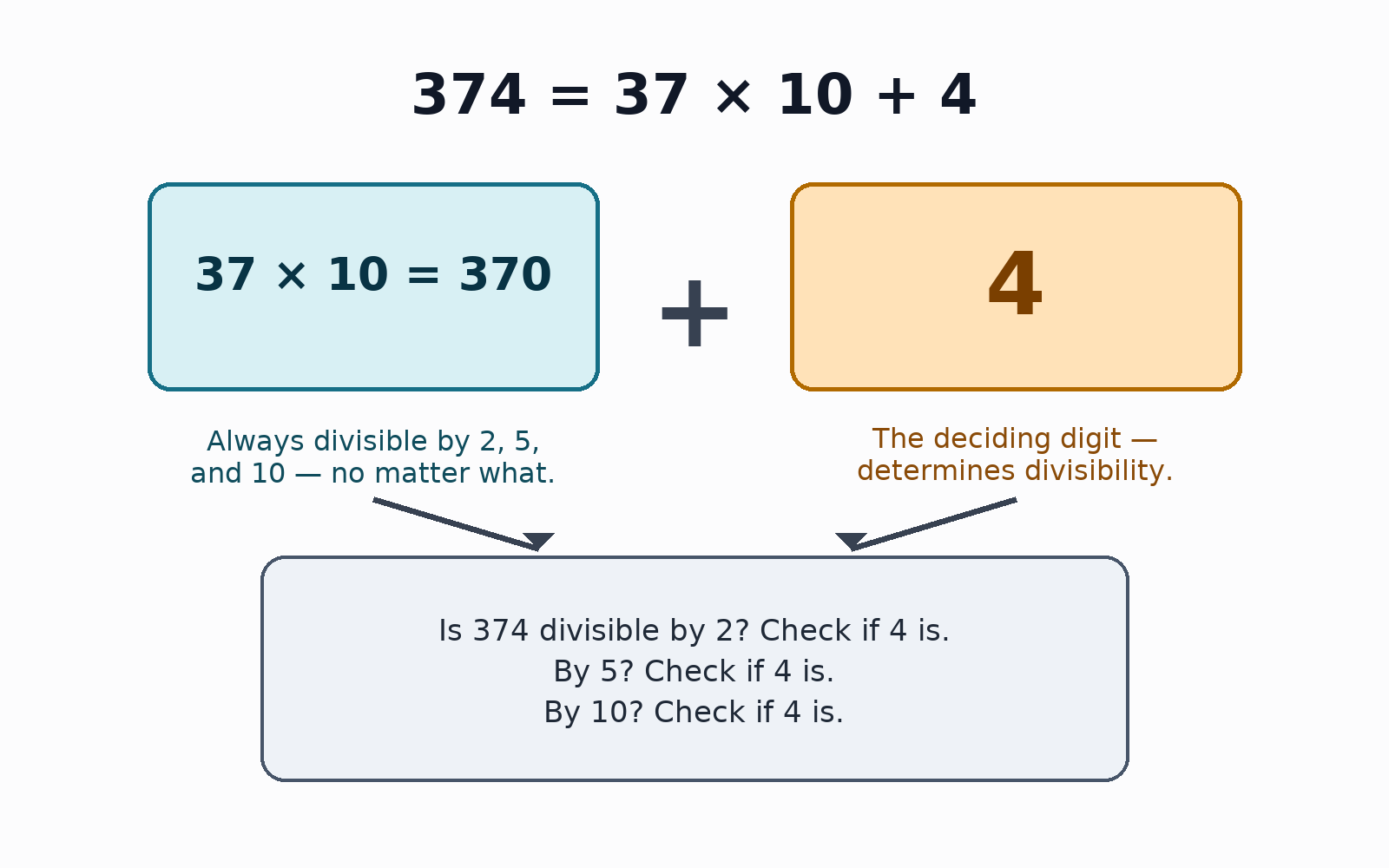
The first part, , is always a multiple of . Since is divisible by , by , and by , that first part is automatically divisible by all three. So the entire number's divisibility comes down to just the remainder contributed by the last digit. Let's spell this out for :
- Divisibility by 2: is divisible by no matter what. So is divisible by only if is divisible by . It is, so is divisible by .
- Divisibility by 5: is divisible by no matter what. So is divisible by only if is divisible by . It is not, so is not divisible by .
- Divisibility by 10: is divisible by no matter what. So is divisible by only if is divisible by . It is not, so is not divisible by .
This reasoning applies to any whole number, no matter how many digits it has, because every digit except the last sits in a place worth some multiple of . That is the beauty of base ten.
Quick-Reference Table
Before you head into practice, here is a compact table worth keeping in mind:
| Divisor | Last Digit Must Be | Example (Yes) | Example (No) |
|---|---|---|---|
| 2 | 0, 2, 4, 6, or 8 | 4,718 | 4,719 |
| 5 | 0 or 5 | 4,715 | 4,718 |
| 10 | 0 | 4,710 | 4,715 |
Notice the overlap one more time: divisibility by requires the last digit to satisfy both the rule for and the rule for . The only digit that is both even and equal to or is 0 itself.
Conclusion and Next Steps
In this lesson, you learned that divisibility by 2, 5, and 10 can each be tested by examining just the last digit of a number. You also explored why this works: in base ten, every digit except the last contributes a multiple of , so only the final digit determines whether the number is divisible by , , or . These three rules are fast, reliable, and will serve as building blocks for the more advanced tests coming later in this course.
Up next, you will put these shortcuts into action with a set of hands-on practice tasks — from checking stockroom quantities and sorting numbers into overlapping categories to explaining the place-value reasoning in your own words. Let's see how quickly you can spot those last digits!
