Ecommerce and Programmatic Buys
Executing E-Commerce and Programmatic Buys
Display and native put your brand in front of cold audiences; now we shift to two engines that do heavier lifting on the sales side. Shopping ads turn product data into revenue, and programmatic buying automates how you purchase inventory at scale. Both come up constantly when a stakeholder asks "how does this actually work?", so your job in this unit is to explain the mechanics plainly, then pick the right buying approach for the goal in front of you.
How Shopping Ads and Product Feeds Drive Sales
When someone searches for a product and sees those image-plus-price cards at the top of the results, that's a Shopping ad. What separates them from a text search ad is where the content comes from: you don't write a headline for each product. Instead, the platform builds the ad automatically from your product feed, a structured file of every item you sell, with titles, images, prices, availability, and identifiers.
That feed is the whole game. This is the E-Commerce Inputs idea: Shopping ads and product listings are only as good as the product feed and the shopping campaign strategy behind them. If a title is vague, a price is stale, or an image is missing, the platform either shows the wrong product or doesn't show it at all. So when a client complains that Shopping "isn't working," your first move is to audit the feed, not the bids. Clean titles built around the terms buyers actually search, accurate pricing, and complete attributes are what get the right product in front of the right shopper at the moment of intent.
Programmatic Buying vs. Direct Buying
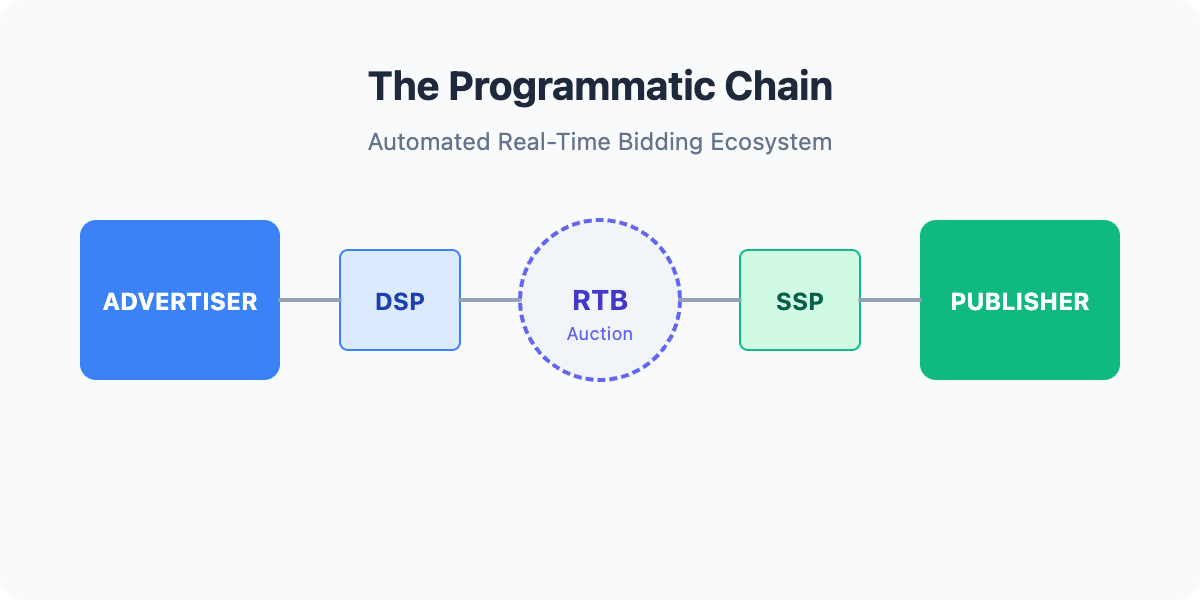
The second engine is about how you buy inventory, not what you sell. There are two paths. Direct buying is the negotiated way: you agree with a publisher on a fixed placement at a set price, no auction involved. Programmatic buying automates the purchase through the Programmatic Chain: advertisers buy through a DSP (demand-side platform), publishers sell through an SSP (supply-side platform), and the two connect through RTB (real-time bidding), an auction that runs in the milliseconds a page loads.
The acronyms trip people up, so keep an analogy ready.
- Jake: Just tell me what "programmatic" means in plain English.
- Chris: Think of a stock exchange for ad space. The DSP is your broker buying on your behalf, the SSP is the publisher's broker selling their inventory, and RTB is the trading floor where a bid happens automatically every time a page loads.
- Jake: So nobody's on the phone negotiating a price?
- Chris: Right. Direct buying is the phone call for one guaranteed spot. Programmatic is the automated auction, bidding across millions of impressions and targeting the exact person, not just the site.
Notice how one clear metaphor lands DSP, SSP, and RTB together without a glossary.
Choosing Programmatic or Direct for a Scenario
Once a stakeholder gets the mechanics, they'll ask which one to use. Weigh the choice across four levers. Start with the campaign goal: broad, efficient reach and precise audience targeting favor programmatic, while a specific brand moment favors a guaranteed spot. Then consider inventory, since programmatic opens up vast, varied inventory across the web, whereas direct locks in one premium placement like a homepage takeover on a marquee site. Next is targeting flexibility, where programmatic's real-time, person-level bidding wins decisively. Finally, weigh control: direct buying gives you negotiated certainty over exactly where and when your ad runs, which matters for premium or brand-sensitive placements.
The pattern to carry is simple: programmatic buys scale and precision through automation, direct buys guarantee and control through negotiation. Name the goal first, and the other three levers usually point the same direction.
So the takeaway is twofold: Shopping ads live or die on the product feed, and the buy-side call comes down to scale versus guaranteed control. Next, a quick self-check will test whether you can spot how product feeds power Shopping ads across a few scenarios, the pattern-recognition rep before you take these concepts live, first explaining programmatic to a non-technical stakeholder, then writing a buy recommendation you could hand to a team. For now, try one habit: whenever "programmatic" comes up, reach for the stock-exchange analogy before you reach for the acronyms.
