Updating Your Diagnosis
🧩 Combining the Diagnosis as Conditions Change
Over the last few units you've built two separate reads: what someone can actually do on a task (competence) and how they're showing up for it (commitment, which you now know splits into motivation, confidence, and willingness to own the work). Those reads only become useful once you combine them into a single picture, and, just as importantly, keep updating that picture as things change. This unit brings the two halves together and shows you why a diagnosis has a shelf life.
In this unit, you will learn to:
- Combine competence and commitment into a single, per-task read on one grid.
- Separate genuine skill gaps from shaken confidence when the two point in different directions.
- Keep a diagnosis current as evidence and conditions change, and check that differentiated leadership rests on evidence rather than bias.
📊 Putting Competence and Commitment on One Grid
The tool that pulls it all together is the Competence-and-Commitment Grid. Picture two sliders for one specific task: how much skill and knowledge the person brings, and how much genuine commitment they have (motivation, confidence, willingness to own it). Both are read per task, never per person, so the same report can sit in a different spot depending on what you've handed them.
Combine the two sliders and four common situations appear, each pointing to a matching style through the Four-Style Matching Guide:
- Low competence, high commitment — the willing but untested beginner who wants it and simply doesn't know how yet. Style: Directing.
- Some competence, low or variable commitment — the learner who's past the first burst of enthusiasm and is grinding through the hard middle. Style: Coaching.
- High competence, low or variable commitment — the capable contributor who's clearly able but has gone quiet or cautious. Style: Supporting.
- High competence, high commitment — the self-reliant performer you can genuinely hand things to. Style: Delegating.
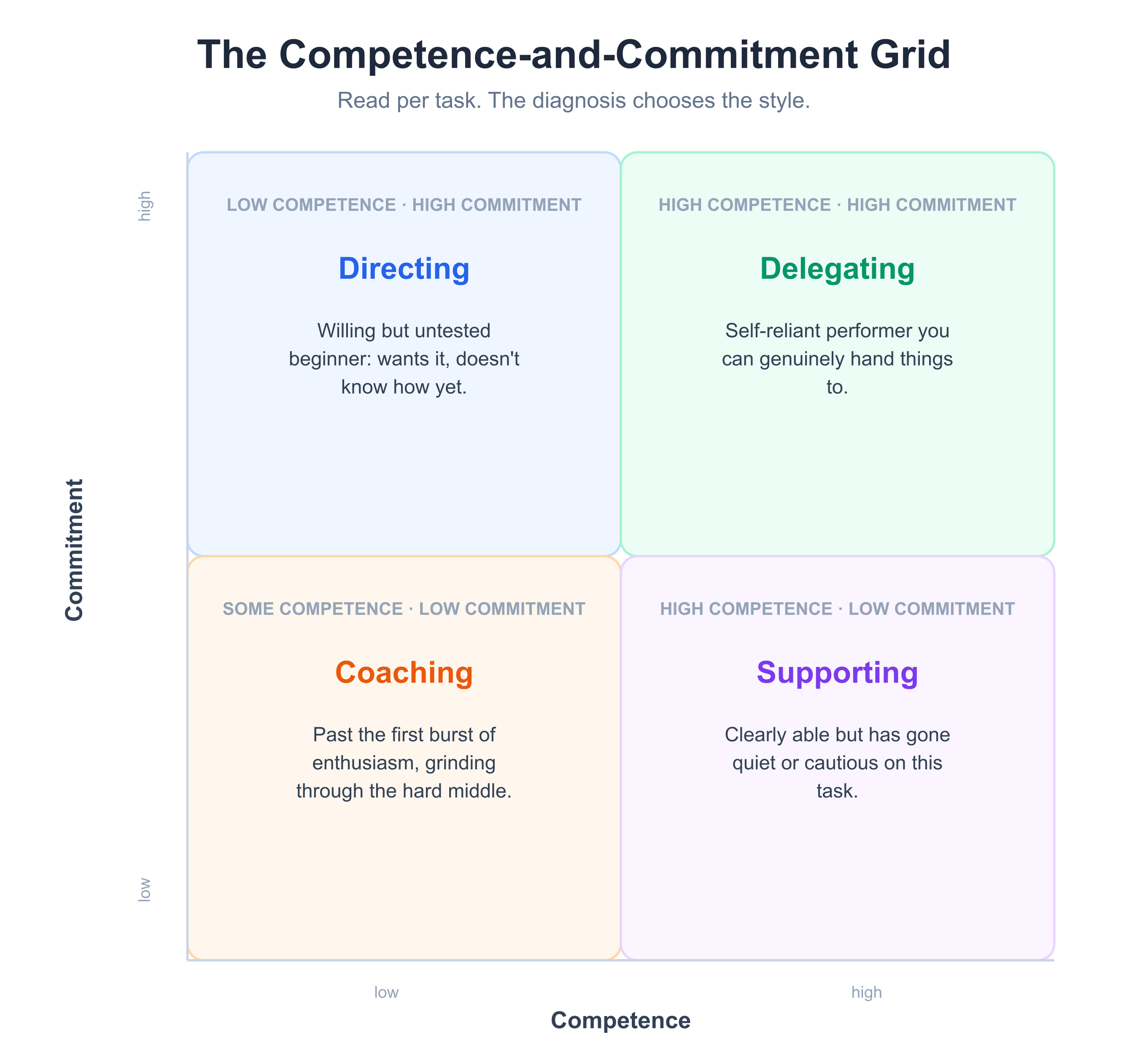
The point is simple and more powerful than any single style: the diagnosis chooses the style, not your habit or your mood. One case deserves a flag. Low competence paired with genuinely low motivation or ownership (not just the natural rawness of being new) is its own thing. Don't treat it as a plain beginner. Add the support of Coaching to the direction, and diagnose why the commitment is low before you do anything else.
🔀 When Skill and Confidence Point in Different Directions
The trickiest reads are the mixed ones, where competence and commitment pull in opposite directions. The classic version: a genuinely skilled person facing a first-time, high-stakes version of something they normally do well. Their skill is real and transferable, but their confidence wobbles because the context is unfamiliar. If you misread those nerves as a competence problem and start teaching them the basics, you'll insult the very skill you need them to lean on.
The move is to separate the two out loud, then aim your help only at the part that's actually new. Watch how Tom does exactly that with Jessica, who is skilled at the work but nervous about the audience:
- Jessica: I've built dozens of these decks, but this one goes to the executive committee. What if they pick apart my numbers?
- Tom: Let's separate two things. The deck itself, is that new territory for you?
- Jessica: No, honestly the analysis is solid. It's the room I'm nervous about.
- Tom: That's what I figured. Your skill isn't the gap here, the unfamiliar audience is. So let's leave the analysis with you and just prep for how that room tends to push.
- Jessica: Okay, that actually makes it feel manageable.
Notice that Tom didn't coach her on how to present. She can already do that. He affirmed the proven skill and pointed his light direction at the one genuinely new thing, which leans the whole response toward Supporting rather than taking over.
⏳ Diagnosis Is a Moving Read, Not a Label
Here's the part managers most often skip: a diagnosis expires. New performance evidence, a shift in someone's motivation, or a change in the task itself can all move a person on the grid, sometimes within a single week. A strong rehearsal is fresh evidence that raises your read of their competence. A suddenly shortened deadline is a task-condition change that can spike anxiety and knock their confidence back down. Those are two distinct shifts, and a good re-diagnosis weighs each one rather than restating last week's plan.
So treat every diagnosis as provisional. When conditions move, re-run the grid and let the style follow. And whenever you differentiate how you lead people, giving one autonomy while directing another closely, run the Evidence-and-Fairness Check before you commit to the difference:
- Evidence: What task-specific evidence supports treating these people differently right now?
- Explainability: Could I explain the difference out loud without leaning on personality, reputation, or who I simply like?
- Fairness over time: Is everyone getting fair access to stretch and development, not just the same few people?
If a choice can't clear all three, it's resting on bias rather than diagnosis, and that's worth catching before it hardens into a pattern.
Your diagnosis is competence and commitment read together on one grid, per task, and kept current as evidence and conditions move, never a label you stamp once and forget. Next, you'll place task profiles on the grid, then step into a live 1:1 with a skilled-but-anxious report to practice separating skill from confidence, and finally write a short updated diagnosis when the picture shifts.
