Reading Commitment Accurately
🧭 Reading Commitment Accurately
So far your diagnosis has focused on competence: what a person can actually do on a specific task. But competence is only half the picture. You've probably watched someone who clearly has the skill to do a task, and yet the work still stalls. When that happens, the missing piece is usually commitment. And commitment is harder to read than competence, because it rarely announces itself. This unit gives you a way to read it accurately, so you respond to the real problem instead of guessing at it.
In this lesson, you will learn to:
- Break commitment into its three separate ingredients: motivation, confidence, and willingness to own the work.
- Create enough safety in a conversation that a person will tell you which ingredient is really low.
- Match your response to the specific gap instead of reaching for a generic morale boost.
🍳 Motivation, Confidence, and Willingness Are Three Different Things
Here's the mistake that trips up most managers: treating commitment as one big feeling, so a struggling report gets filed under "low commitment," or worse, "attitude problem." Commitment is actually three separate ingredients, and they move independently of one another:
- Motivation: Does the person actually want to do this task, and do they find it worthwhile? This is about desire and the pull of the work itself.
- Confidence: Do they believe they can do it well? This is different from motivation; someone can badly want a task and still quietly doubt they're up to it.
- Willingness to own it: Are they ready to take responsibility, make the calls, and be accountable for how it turns out? This goes beyond wanting the task and feeling capable; it's about putting their name on the outcome.
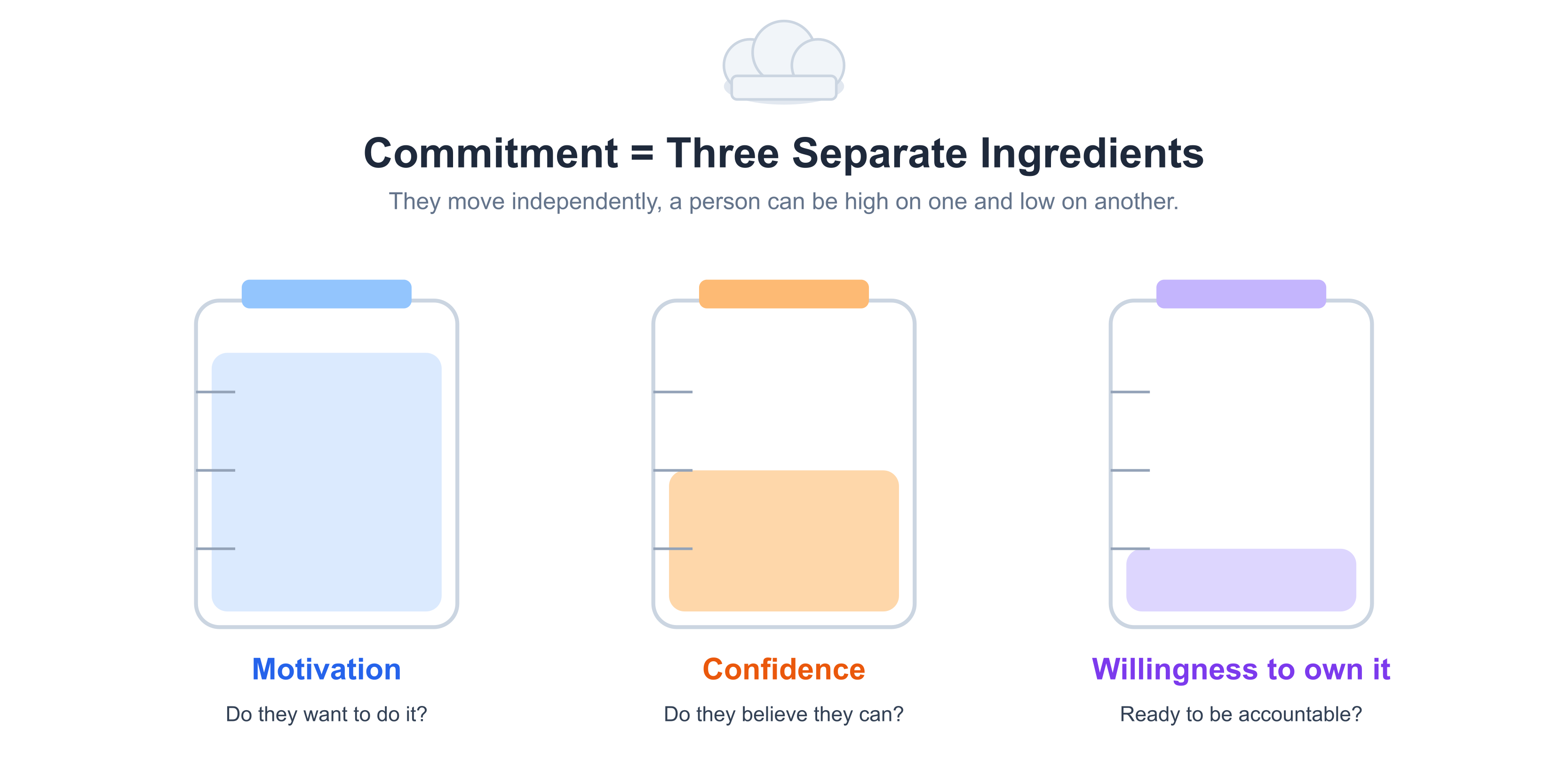
Why does splitting these apart matter so much? Because a person can be high on one and low on another, and the mix tells a completely different story. A report can be eager to do the work but privately worried they'll get it wrong. Another can be confident and interested yet quietly unwilling to own it, because the last time they took the reins it went badly. Lump all of that into "not committed" and you'll reach for the wrong fix every time.
🛟 Creating Enough Safety to Hear the Truth
Those three ingredients live on the inside, so the surest way to learn which one is running low is to help the person tell you themselves, and people share the real thing when they feel safe. That makes your job in the conversation simple and generous: make it genuinely comfortable for them to be honest, stay curious, and let them lead you to what's really going on.
A few moves make this work:
- Lead with curiosity, not a verdict. Come in wanting to understand, not to confirm what you already suspect.
- Acknowledge what they've contributed so they don't feel cornered or judged before they've said a word.
- Make it explicit that there's no wrong answer, so honesty feels welcome rather than risky.
- Give them space: ask, then let the silence sit rather than rushing to fill it.
- When they open up, stay with them instead of immediately solving it or debating how they feel, because that's the fastest way to close the door again.
Watch how Nina, Ryan's manager, creates that safety and holds it until Ryan names the real thing:
- Nina: You've handled forecasts like this before, so I'm not worried about the how. I just want to understand what's behind the pause on taking this one.
- Ryan: Honestly? I'm fine. Just busy.
- Nina: Fair, and there's genuinely no wrong answer here. I've just noticed you've gone quieter in our planning meetings lately, and I'd really like to understand why.
- Ryan: ...I guess I don't really see the point of this one. We build the forecast, it gets filed, and nothing downstream ever seems to change because of it.
- Nina: Thank you for telling me that, it really helps. So it's less about whether you can do the work and more about whether the work actually leads anywhere. That's something we can absolutely work on together.
Notice that Nina didn't rush in with a pep talk about attitude. She held the space until Ryan named the real thing, which turned out to be a motivation gap: he'd stopped seeing the work as worthwhile, not a doubt about his ability or a reluctance to own it.
🎯 Matching Your Response to the Real Gap
Once you know which ingredient is low, your response almost picks itself, and this is where accurate reading pays off. Each gap needs a different fix, and pointing the wrong fix at it usually makes things worse:
| Commitment gap | What helps | What backfires |
|---|---|---|
| Motivation (doesn't see the point) | Connect the work to something they care about, or reshape the task itself. | Reassuring them about their ability. |
| Confidence (wants it, fears they'll fail) | Show evidence of past success, offer a smaller first step, or coach to steady them. | A motivational speech about how much it matters. |
| Willingness to own it (capable and willing, but won't take responsibility) | Address why ownership feels risky: rebuild trust, clarify real authority, show that their input lands. | Cheerleading or more training. |
This is why the generic "boost his morale" response fails so often. Morale-boosting is aimed at motivation. Point it at a confidence problem or an ownership problem and it bounces right off, leaving the person feeling unheard, which usually makes things worse.
Commitment is motivation, confidence, and willingness to own the work, and hearing the difference between "I don't want to" and "I'm not sure I can" is what lets you respond to the real gap instead of a generic one. Next, you'll check your read of the three components against real statements, then step into a live 1:1 where you'll create the safety to surface what's really going on, and finally write a short action note that pins the gap and its targeted fix.
