Compare Absolute and Relative Risk
Introduction 🎉
Welcome to Decode How Risk Gets Framed! In the courses before this one, you explored how randomness behaves, why small samples can lead us astray, and how to read test results for rare events. This course takes a different turn: instead of the underlying facts, you will focus on how risk information is presented — and why the same number can feel alarming or reassuring depending on the words wrapped around it.
This first lesson digs into one of the most common sources of confusion in health news, advertising, and policy debates: the gap between absolute risk and relative risk. In this lesson, you will learn to:
- Distinguish absolute risk from relative risk by recognizing when a claim states a standalone probability versus when it describes how one group's risk compares to another's.
- Translate between the two framings using the relationship to turn a proportional change into a concrete number.
- Judge whether a scary-sounding headline deserves attention by always hunting for the baseline and measuring the actual absolute difference it implies.
A Tale of Two Headlines 📰
Imagine reading these two statements about the same medical finding:
- Headline A: "New study finds treatment cuts risk of heart attack in half!"
- Headline B: "New study finds treatment lowers heart attack risk from 2 in 1,000 to 1 in 1,000."
Both describe exactly the same result, yet Headline A sounds dramatic while Headline B sounds modest. The difference is not in the science; it is in the framing. Headline A uses relative risk language ("cuts in half"), and Headline B uses absolute risk language ("from 2 in 1,000 to 1 in 1,000"). Learning to move between these two framings is the core skill you will build in this lesson.
A quick visual makes the equivalence easier to see:
![[Chart showing that cutting risk in half means going from 2 to 1 heart attack per 1,000 people]](https://k3-production-bucket.s3.us-east-1.amazonaws.com/uploads/9EveH9nzgozShCcmd_image.png)
What Is Absolute Risk? 🎯
Absolute risk is the straightforward probability that something happens. It answers the question: Out of a given number of people (or trials), how many experience the outcome?
You can express it as a fraction, a decimal, or a percentage. For example, if 30 out of every 10,000 people develop a certain condition in a year, the absolute risk is:
The key feature of absolute risk is that it does not require a comparison group. It does not compare one group to another or describe a proportional change. Instead, once the relevant population, denominator, and time window are defined, it tells you how common the outcome is. For example, " of people develop this condition in one year" is meaningful in a way that "50% higher risk" is not. You still need context about who is being measured and over what period, but you do not need another group’s risk to interpret the basic probability.
What Is Relative Risk? ⚖️
Relative risk describes how the risk in one group compares to the risk in another. Instead of stating a standalone number, it expresses a ratio or a proportional change.
The basic formula is:
If the baseline group has an absolute risk of and the comparison group has an absolute risk of , then:
A relative risk of means the comparison group's risk is 1.5 times the baseline, or 50% higher. A useful anchor point is a relative risk of , which means the two groups have identical risk — no difference at all. Values above signal increased risk, while values below signal reduced risk. Here are a few common phrasings and what they mean in relative-risk terms:
| Phrase you might see | Relative risk value | What it means |
|---|---|---|
| "Doubles the risk" | 2.0 | Risk is 2× the baseline |
| "Triples the risk" | 3.0 | Risk is 3× the baseline |
| "Cuts risk in half" | 0.5 | Risk is half the baseline |
| "Reduces risk by 25%" | 0.75 | Risk is 75% of the baseline |
Notice that every one of these phrases is incomplete without knowing the baseline absolute risk. "Doubles the risk" could mean going from to , or from to . Those are very different situations.
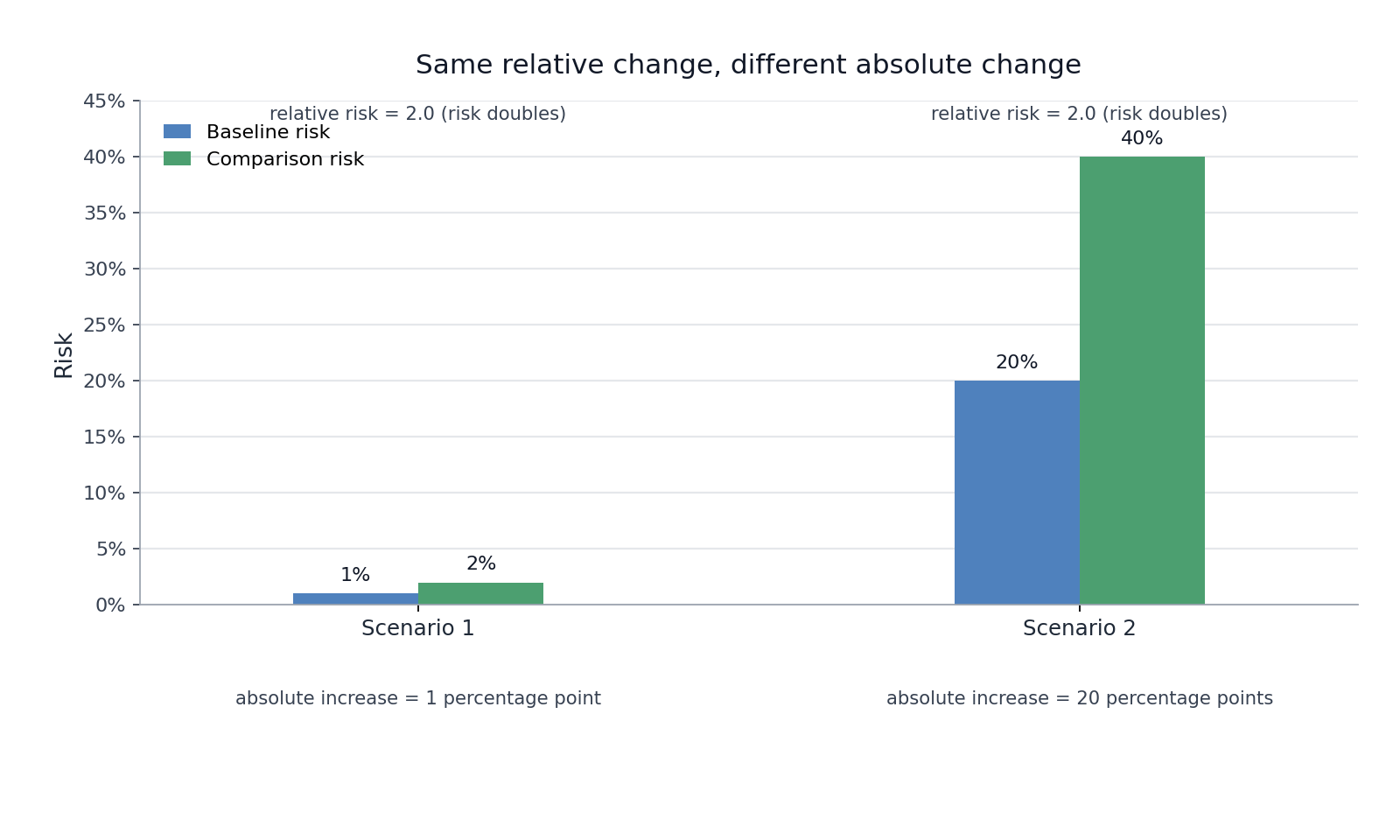
Translating Relative Risk into Absolute Terms 💬
Whenever you encounter a relative risk claim, you should ask: "What is the baseline?" Once you know it, converting is simple multiplication.
Let's walk through two examples to see how dramatically the baseline changes our interpretation.
Example 1. A report says a dietary supplement "reduces the risk of catching a cold by 40%." The baseline risk of catching a cold in a given winter is about . A 40% reduction means the relative risk is . So the new absolute risk is , and the absolute reduction is percentage points. Moving from a chance to an chance is a genuinely noticeable change.
Example 2. A headline warns that a food additive "doubles the risk of a rare liver condition." The baseline risk is (1 in 10,000). Doubling means the relative risk is , so the new absolute risk is . That is an absolute increase of just percentage points, meaning 1 extra case per 10,000 people. "Doubles the risk" sounds alarming, but the absolute change is tiny.
The table below puts these two examples side by side to highlight how the same relative language can describe vastly different real-world impacts:
| Example 1 (cold) | Example 2 (liver condition) | |
|---|---|---|
| Relative claim | Reduces risk by 40% | Doubles the risk |
| Baseline risk | 30% | 0.01% |
| New absolute risk | 18% | 0.02% |
| Absolute change | 12 percentage points | 0.01 percentage points |
Without the baseline, you cannot judge whether a relative change matters in practice.
Why Framing Matters 🖼️
Relative risk is not wrong or dishonest by itself. It is genuinely useful when scientists compare treatment and control groups. The problem arises when relative risk is presented without the baseline, because our brains tend to fill in the gap with a much larger number than reality warrants.
A helpful habit is to always perform a quick mental translation. When you see a relative claim, run through three questions:
- What is the baseline absolute risk? (If it is not stated, that is a red flag.)
- What is the new absolute risk after applying the change?
- How large is the absolute difference?
These three questions turn a dramatic-sounding headline into a concrete fact you can actually evaluate. With a little practice, this check becomes second nature and takes only a few seconds.
Conclusion and Next Steps
In this lesson, you learned that absolute risk tells you how likely an outcome is on its own, while relative risk tells you how one group's risk compares to another's. You practiced converting between the two using the formula and saw that the same finding can look enormous or trivial depending on which framing is used. The single most important takeaway is: always look for the baseline.
Up next, you will put this skill to work in a set of hands-on practice tasks. You will identify risk types in real-world claims, convert relative changes into absolute numbers, and explain what headlines like "Risk Doubles" actually mean in concrete terms.
