Welcome to the Course

Every organization runs on data, but data only helps people if they trust it. As someone who works with data every day without writing a line of code, you are exactly the person who feels the pain when two teams bring two different "true" numbers to the same meeting. This course gives you a plain-language, tool-free foundation for fixing that, treating data governance as a business discipline you can lead, not a technical project you wait on IT to deliver.

By the end of this course, you'll be able to:

  • Distinguish data governance from data management, data quality, data security, and analytics
  • Connect a recurring data problem to the business value of fixing it
  • Build a shared, trusted definition for a critical business term
  • Map the stakeholders who define, supply, use, protect, and approve a dataset
  • Reframe common governance myths and move resistant colleagues toward shared responsibility

This first unit starts at the beginning: what data governance actually is, the few building blocks that make data trustworthy, and how to turn a problem that keeps coming back into a question someone can finally own.

What Data Governance Is, and What It Isn't

Picture a familiar scene. Sales reports one revenue figure, Finance reports another, and your team gets pulled in to reconcile them. Again. The instinct is to "fix the number," but next month the gap reappears. That repeating gap is the clue that you are looking at a governance problem, not just a data problem.

So let's define the term plainly. Data governance is how an organization agrees to define, own, protect, and use its data so people can trust it. Notice the word "agrees." Governance is mostly about decisions and accountability, not about the technical machinery underneath.

That becomes clearer when you separate governance from four neighbors it often gets confused with. Data management is the hands-on work of moving, storing, and organizing data so it is available. Data quality is keeping that data accurate, complete, and current.

Data security is controlling who is allowed to access it, while analytics is turning the data into insight, like a dashboard or a churn report. Each of these answers a "how" or a "what" question. Governance answers the "who decides" question that sits above all of them.

A simple way to hold the difference: management builds and maintains the road, quality keeps the road in good condition, security controls who gets the keys, analytics is the trip you take. Governance is the rules of the road and the body that agrees on them. When you can tell these apart, you stop trying to patch a definition problem with an access fix, or a decision problem with a better dashboard.

How Policies, Roles, Standards, and Decision Rights Build Trust

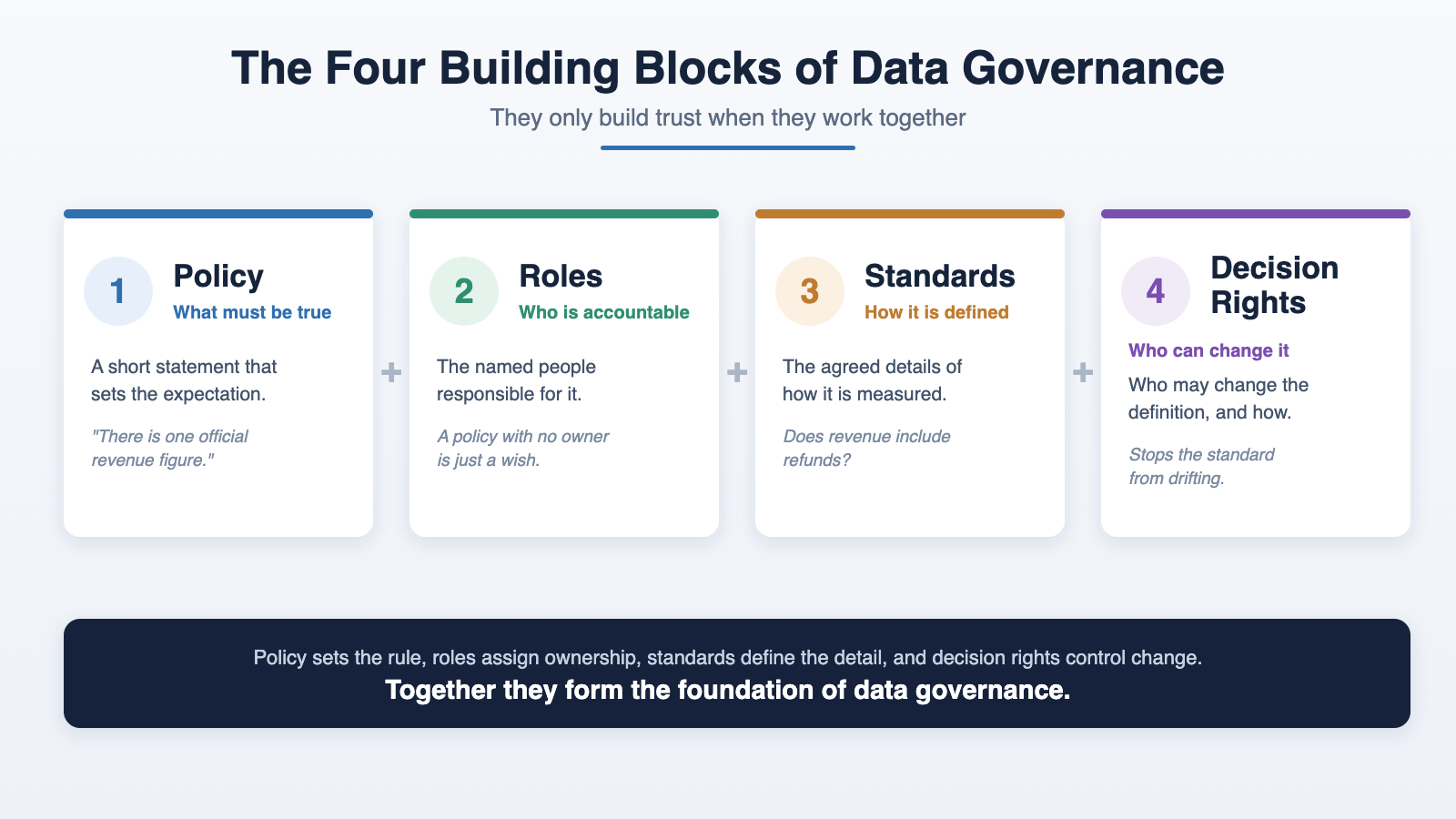
If governance is about agreements, what exactly do you agree on? Four building blocks do most of the work, and they only create trust when they operate together.

The four building blocks of trust: policies, roles, standards, and decision rights

The first is a policy, a short statement of what must be true. For example, "there is one official revenue figure for the company." A policy sets the expectation but does not yet make it happen. The second is roles, the named people who are accountable. A policy with no owner is just a wish, so trust depends on someone actually being responsible.

The third building block is standards, the agreed details of how something is defined or measured, such as whether revenue includes refunds or counts the sale on order date or ship date. Without a standard, two honest people produce two different numbers and both believe they are right.

The fourth, and the one most teams forget, is decision rights: who is allowed to change the definition, and how. This is what stops the standard from quietly drifting every time someone reinterprets it. Put the four together and the effect is cumulative. The policy says one number exists, a role makes a person accountable for it, a standard says precisely how it is calculated, and decision rights govern how that calculation can ever change. That combination is what lets a busy colleague pull a number and trust it without re-checking everyone else's math.

Turning a Recurring Problem into a Governance Question

Here is the move that makes you useful in the moment. When a data problem keeps returning, resist the pull to "fix it" one more time. Instead, reframe the complaint into a governance question with three parts: an owner (who is accountable), a decision (what needs to be decided), and a next action (one concrete, low-effort step). That reframe is the difference between firefighting forever and resolving something once.

  • Dan: The Sales and Finance numbers don't match again. Can you just get IT to fix the report this month?
  • Victoria: I can, but we patched it last month and it came back. The real question isn't the number, it's who owns the definition of revenue and how a change to it gets approved.
  • Dan: So who decides that?
  • Victoria: That's exactly the decision we need to name. If Finance owns the official definition, the next step is a short session to write it down so the report stops drifting.
  • Dan: Okay, that I can get behind. Set it up.

Notice what shifted. Victoria renamed a "patch the number" request (a quality or management fix) as a governance question, then offered a single, low-effort next step rather than a heavy process. That is what moves a skeptical colleague from another patch to a real resolution.

The heart of this unit is one idea: governance is the layer of agreed decisions and accountability that makes data trustworthy, and your job is to spot when a recurring problem is really asking "who owns this and how is it decided?" The first thing waiting for you is a quick sorting exercise, where you'll separate everyday situations into governance, management, quality, security, or analytics. As you go through it, try the habit you just saw Dan respond to: before reaching for a fix, ask yourself who owns the decision.

Sign up
Join the 1M+ learners on CodeSignal
Be a part of our community of 1M+ users who develop and demonstrate their skills on CodeSignal