Connecting Governance to Value
Connecting Governance to Business Value
In the last unit you learned to recognize when a recurring data problem is really a governance question. That's the diagnosis. The trouble is that diagnosing a problem and getting permission to fix it are two very different things. The moment you propose a governance step, someone busy will ask, "Why does this matter, and why now?" If your best answer is "because data should be trustworthy," you'll lose them, because trustworthy data is not a goal anyone funds on its own. This unit gives you the language to turn a governance problem into a business case a time-pressed colleague or leader will actually back.
What Governance Actually Buys the Business
When someone asks "so what?", you need a concrete answer ready, and there are really only four. The first is reduced rework: every hour your team spends reconciling two versions of the same number is an hour stolen from the actual job, and governance removes the disagreement that creates the rework. The second is reduced risk: when a number might be wrong, every decision built on it is a quiet gamble, and governance is what lets people act without hedging.
The third is reduced compliance exposure: regulated data handled inconsistently invites audit findings and penalties, so clear ownership and standards are what keep you defensible if anyone asks. The fourth is reduced decision friction: picture the meetings that stall because two teams argue over whose figure is right instead of deciding anything, and notice that governance ends the argument so the decision can finally happen.
Notice that none of these is "better data" for its own sake. Each one is a cost the business is already paying, usually without naming it. Your job is to name it.
Putting a Number on the Pain
Once you know which costs governance removes, you estimate how big they are. These value lenses deliberately echo the four benefits above: the benefits name what governance removes, while the lenses are simply how you size each removal, so some overlap in wording is expected. A simple way to do this is to run any pain point through four value lenses: time saved, trust gained, risk reduced, and decisions improved. Time saved is the most countable, in hours, days, or headcount. Trust gained is softer but real, showing up as decisions delayed or re-argued because no one believes the report. Risk reduced is the cost of being wrong if you act on a bad number. Decisions improved is the upside: faster, better-aimed actions once people trust the data.
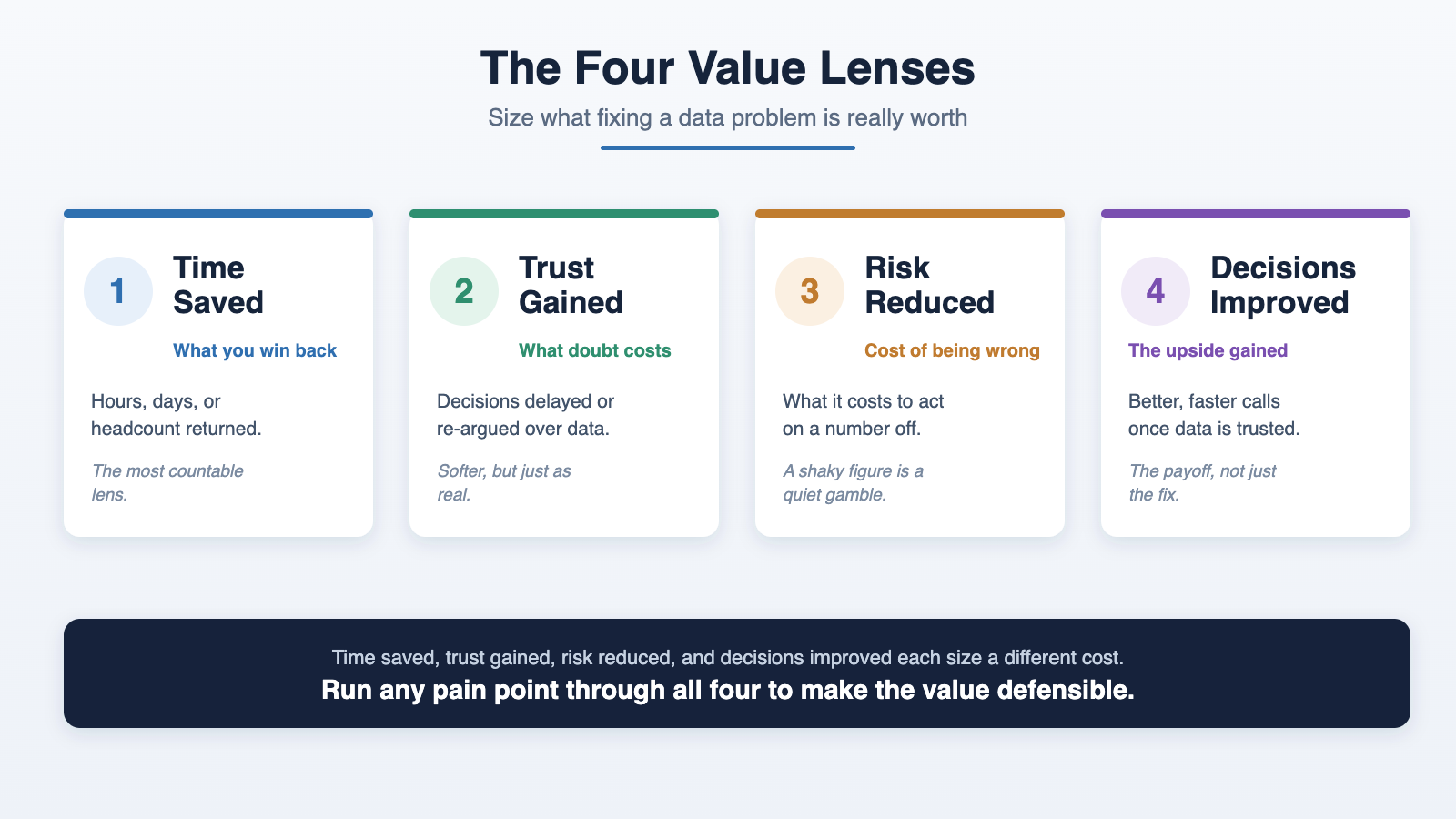
You don't need precision. A defensible estimate beats a vague benefit every time. Watch how splitting one complaint across the lenses sharpens it:
- Dan: This pipeline forecast eats three days of my team's month, and half the time Sales doesn't even believe the final number.
- Matt: So that's two costs, not one. There's three days of work we could win back, and there's forecast decisions getting second-guessed because nobody trusts the figure.
- Dan: I hadn't split it like that. The trust part is honestly the bigger headache.
- Matt: Then that's your lead. "We're making forecast calls on a number people doubt" lands harder than "the report takes three days."
- Dan: Right. One's a chore, the other's a risk to the plan.
What Dan did was move from a single annoyance to two named, sizeable costs. That's the whole move: take the pain everyone feels and translate it into the lenses, so the value stops being a feeling and becomes something you can put in front of a decision-maker.
