Identifying Authentic Differentiators
Welcome to the Course
You've spent your career making campaigns perform across channels, but a campaign can only ever amplify the strategy underneath it. This course is where you build that strategy: the sharp, differentiated foundation that tells every email, ad, and landing page what to say and why anyone should care. Without it, you're optimizing the volume on a message that doesn't actually stand for anything.
By the end of this course, you'll be able to:
- Distinguish authentic, ownable differentiators from generic claims any competitor could copy
- Map customer jobs, pains, and gains to your offering using the Value Proposition Canvas
- Write a positioning statement that claims a clear, defensible space in customers' minds
- Define a brand personality that attracts your ideal customer and guides every message
This first unit starts at the root of all of it: finding the difference that makes your brand worth choosing instead of the cheaper option next to it.
Spotting a Differentiator vs. a Generic Claim
Here's the situation you'll walk into again and again. You're in a brand strategy session, someone confidently names the differentiator, and it's "quality." Or "service." Or "we really care about our customers." Everyone nods. The problem is that none of those is a differentiator, because every competitor in your category says the exact same thing.
Your move in that moment is a single test: could a competitor put this exact line on their homepage without lying? If the answer is yes, you've found table stakes, not a differentiator. Quality, great service, innovation, and customer focus all fail this test instantly. They're the price of entry, not a reason to choose you.
- Natalie: Our differentiator is easy. We have genuinely great customer service.
- Jake: Quick test - could any competitor put that exact line on their homepage?
- Natalie: ...Honestly? All of them already do.
- Jake: Right, so that's table stakes, not a differentiator. The real question is: what can we claim that they can't?
Notice that Jake didn't argue that the service is bad. It might be excellent. The point is that a true claim everyone can also make won't move a single buyer.
Mining Your Research for Genuine Uniqueness
So where does a real differentiator come from? Not from a whiteboard brainstorm, and not from what the team wishes were true. It comes from the audience research you've already gathered: the reviews, the social listening, the verbatim language of people who actually use the product.
You're hunting for one thing: a specific pain you relieve better than anyone else, stated in the customer's own words. When buyers repeatedly praise something concrete ("setup took ten minutes and just worked," "I didn't have to call my tech-savvy nephew"), that's a signal pointing at genuine uniqueness. A generic claim is an adjective; an authentic differentiator is a specific, provable outcome tied to a recurring need.
The discipline here is to resist inventing the answer and instead let the evidence name it. If three patterns in your review mining all circle the same relieved frustration, you're not guessing anymore. You're reading a differentiator straight off the data, and you can point to the exact comments that prove it.
Stress-Testing for "Copycat" Risk
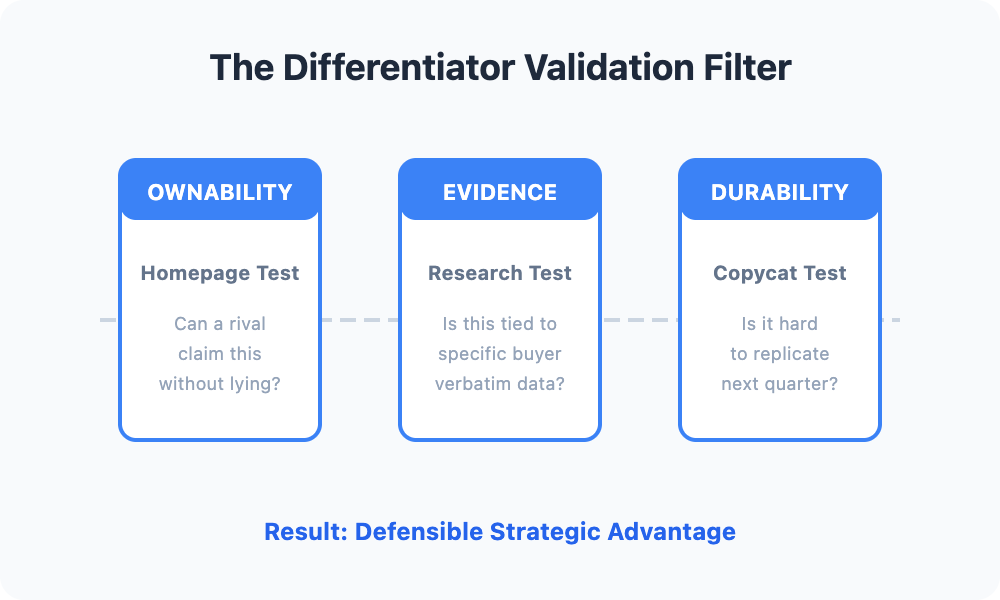
Finding a candidate isn't the finish line, because not every genuine strength is durable. The final filter is the copycat test: how quickly could a competitor replicate this once they noticed it?
Some differentiators are fragile. A feature, a faster shipping window, or a price point can be announced by a rival next quarter, and then your edge evaporates. Durable differentiators are harder to copy because they rest on something accumulated: a proprietary process, deep customer trust built over years, or an integrated end-to-end experience that no single competitor move can match. When you assess each candidate, you're really asking two questions: how easily could this be copied, and what specifically makes it hard? The differentiators that survive both questions are the ones worth building a whole strategy around.
The single takeaway to carry out of this unit: a real differentiator is specific, rooted in customer evidence, and hard for rivals to replicate, which is exactly why "quality" and "service" never qualify. This is where it gets concrete. First you'll run a quick pattern-spotting check to sharpen your eye for which claims are ownable and which are filler. Then you'll take that instinct into a live working session where someone is attached to a generic claim, and finally into a written matrix that scores each candidate on copycat risk. Next time you hear "our differentiator is great service," try the homepage test out loud and watch how fast the conversation gets honest.
