Reading Coordinate Grids
Introduction
This is the first of four lessons in Coordinate Skills in the Real World. Imagine a floor plan that labels only a few grid lines, while an office or storage bin sits between them: to read its location correctly, you need to know how much the coordinate changes from one small space to the next. You already know that an ordered pair gives before ; in this lesson, you’ll use that skill with a grid’s stated interval and subdivisions.
This course is an application-focused review of coordinate skills from earlier courses. Use them to interpret plans, choose meeting points, and measure real-world shapes.
Why Grid Labels Matter
On a map or floor plan, each label gives the coordinate value of a grid line; it is not a count of how many lines you have crossed. The equal spaces between labeled lines show how the coordinate changes as you move across the grid, so the labels—not the number of large squares alone—set the value of a location.
Start by finding how many coordinate units one space represents. These are coordinate values, not miles or another geographic measurement, so no geographic scale conversion is needed.
Find the Value of One Subdivision
A subdivision is one equal space between consecutive grid lines. Count the spaces, not the lines, when calculating the coordinate change.
Suppose two labeled vertical grid lines are at and , with four equal spaces between them. Divide the difference between the labels by the number of spaces:
Coordinate units per subdivision
Along that axis, the coordinate values are , so each subdivision represents coordinate units. If the map states that the horizontal and vertical intervals are equal, the same calculation applies to both axes.
Read a Location from the Grid
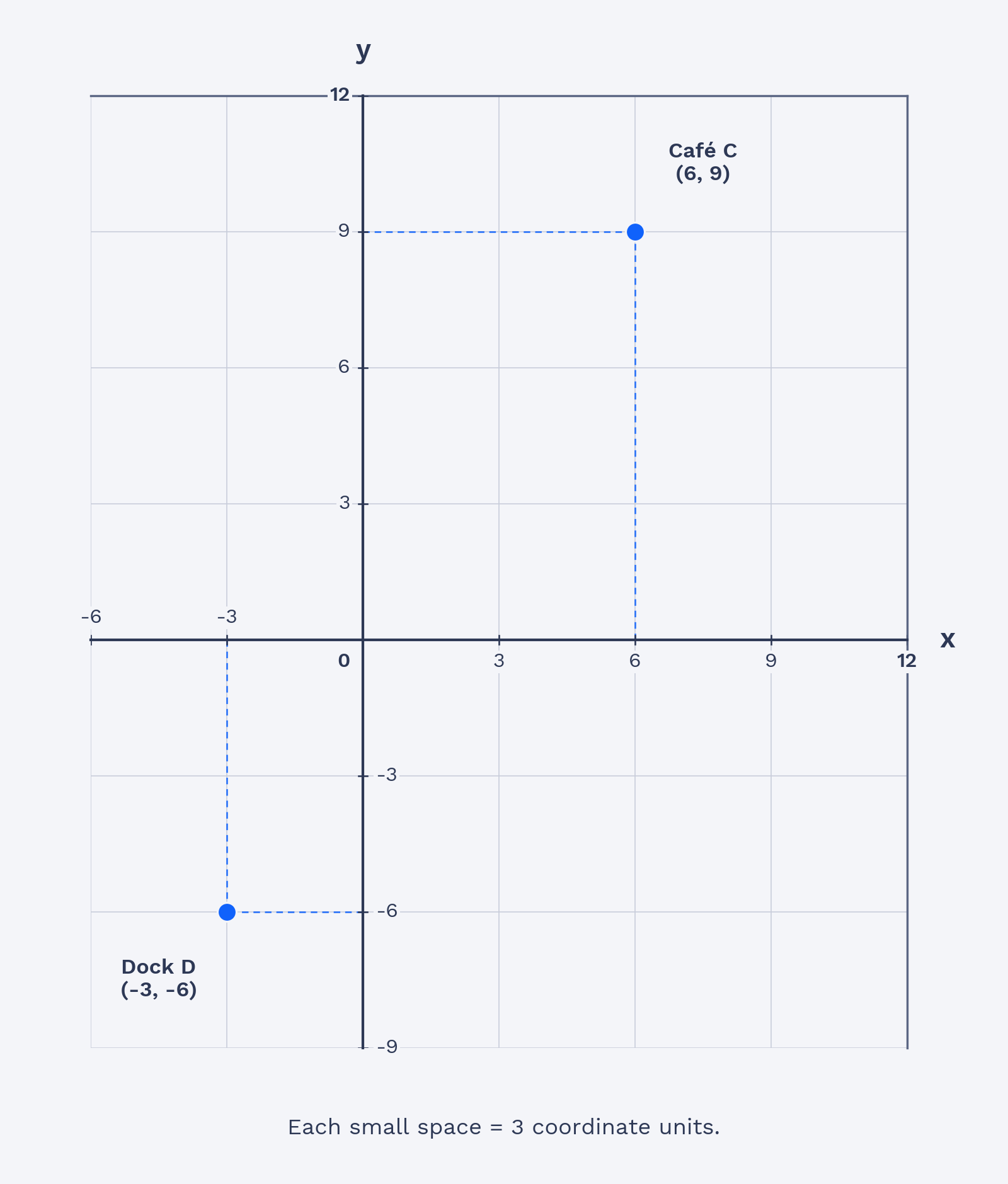
The subdivision value lets you interpret a position between labeled lines. On this example grid, each space is coordinate units, so count from the origin horizontally for , then vertically for .
| Location | Position from the origin | Coordinates |
|---|---|---|
| Café C | 2 spaces right, 3 spaces up | |
| Dock D | 1 space left, 2 spaces down |