Handle Challenges to Your Data
Handle Challenges to Your Data
Navigating questions and pushback is a natural part of sharing data-driven insights. In this unit, you'll use concepts drawn from the HBR Guide to Data Analytics Basics for Managers to learn how to turn scrutiny into an opportunity for clarity, trust, and better decision-making. Rather than seeing challenges as threats, you'll discover how to use them to strengthen your analysis and your credibility.
Why Scrutiny Makes Your Work Stronger
When stakeholders question your data or methods, it is usually because your findings have intersected with their professional intuition or real-world experience. While your gut reaction may be to perceive pushback as a threat to your credibility, try instead to treat it as a form of partnership. You should view this scrutiny as a positive sign of engagement; it indicates that your analysis is being treated as a relevant and serious factor in the business decision. When a colleague says, "This doesn't match what I'm hearing from the field," they are essentially offering a new hypothesis. By treating their skepticism as a prompt to explore exactly where the data and reality diverge, you move the conversation from defending a report to jointly discovering the truth.
This rigorous questioning is often what uncovers the critical "why" behind the numbers. A deep dive prompted by a stakeholder’s doubt might reveal that your analysis has a blind spot, such as an unaddressed outlier that is skewing the average or a data set that isn't truly representative of the current environment. Other times, these challenges provide the necessary qualitative context to make a quantitative recommendation actually work in practice. By inviting this scrutiny and viewing the colleague who is challenging your findings as an ally in the investigation, you ensure that the final decision is based on the most robust and accurate version of the facts available.
Responding with Curiosity and Clarity
The most effective way to handle critiques is to approach them with genuine curiosity. Start by listening carefully and asking for specifics to identify exactly where the doubt lies. You want to distinguish between a disagreement with the results and a disagreement with the underlying assumptions.
When explaining your approach, avoid technical jargon. Instead of getting bogged down in statistical formulas, focus on the logic of your process. If a stakeholder points out a gap, view them as an ally in the search for high-quality information. You might say, "Let’s look at the source of this data together to see if it represents the current environment." This shifts the dynamic from a confrontation to a collaborative investigation.
Here’s a realistic dialogue that demonstrates these skills in action:
- Jake: I’ve been hearing from our sales team that customer churn is actually getting worse, but your report shows improvement. I'm struggling to trust these numbers.
- Jessica: I appreciate you being direct, Jake. To help me understand, are there specific regions or types of accounts where the team is seeing this?
- Jake: Mostly in the Northeast—several big clients have left in the last quarter, and the team is concerned.
- Jessica: That’s a great catch. It sounds like the Northeast might be an outlier that's being masked by the broader company-wide averages. Let’s dig into that regional data together. If we find that the Northeast is a leading indicator for the rest of the country, we’ll need to adjust our strategy.
- Jake: I’d feel much better if we verified that.
- Jessica: Agreed. Let’s treat this as a chance to refine the model. If the regional trend changes the overall conclusion, I’ll update the findings immediately.
In this exchange, Jessica listens without defensiveness, asks for specific variables, and proposes a constructive next step. She treats Jake as a partner in refining the data quality, which builds trust and keeps the focus on the governing objective: making the right decision.
Knowing When to Stand By, Revise, or Rerun
Not every challenge requires a full rework of your analysis. The key is to evaluate the risk of being wrong. If a critique reveals a fundamental flaw—like a "spurious correlation" where two things seem related but aren't—you must address it immediately. However, if the data is "directionally correct" but slightly noisy, you can acknowledge the limitation while standing by the recommendation.
When deciding how to react, consider these three paths:
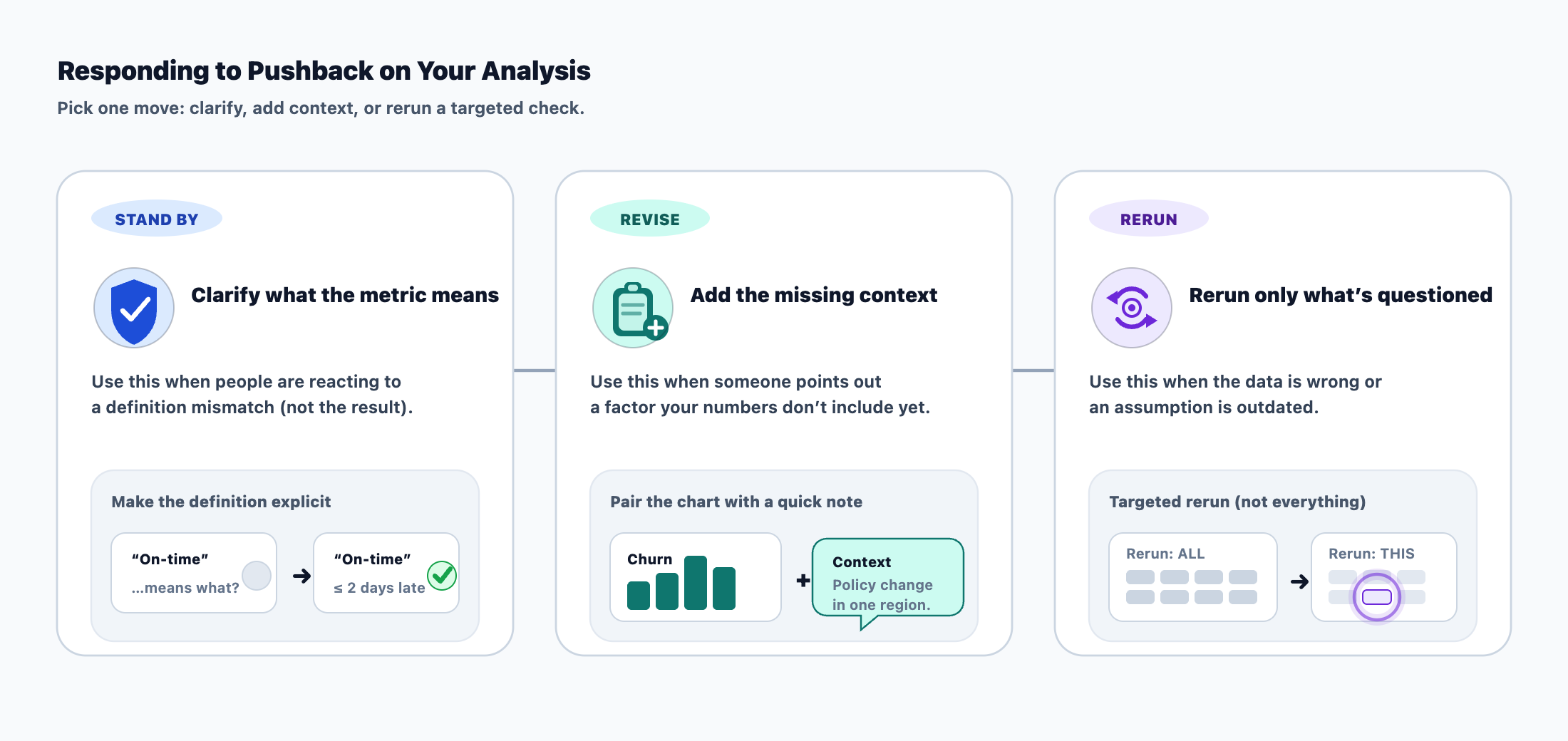
- Stand By: If the challenge is based on a misunderstanding of the metrics, clarify the definition. Explain the "why" behind your choice of variables and show how the findings hold up even when the assumptions are slightly adjusted.
- Revise: If the pushback reveals a missing piece of context (like the Northeast region in the example above), supplement your quantitative data with qualitative insights. This "washes" the data to provide a cleaner, more accurate picture.
- Rerun: If the challenge exposes a significant data quality issue or an outdated assumption, propose a targeted rerun. Focus only on the specific areas under question to avoid a never-ending "fishing expedition" for different results.
By handling questions with openness and professionalism, you don't just protect your credibility—you help your organization avoid cognitive traps and make smarter, more confident decisions based on evidence. In the upcoming exercises, you’ll get to practice responding to skeptical stakeholders and demonstrate how to keep the conversation constructive and focused on learning.
