Explain the "Why" of Your Decision
Welcome to the Course
Think about a time when a decision was made in your group or community and left you confused or frustrated. Chances are, the problem wasn't the decision itself but rather how it was communicated. When people don't understand the why, they resist. When next steps are vague, nothing happens. When questions go unanswered, trust erodes.
This course will equip you to avoid those pitfalls entirely. You'll learn to explain the reasoning behind your choices in ways that resonate with different audiences. From there, you'll practice translating decisions into concrete, actionable next steps that reduce confusion and friction. You'll also master a simple framework for sharing decisions with clarity, and you'll build confidence in handling pushback without becoming defensive. By the end, you'll be equipped to turn every decision into a clear call to action that others can rally behind.
Explain the "Why" of Your Decision
When you announce a decision without explaining why you made it, you leave people guessing, which often leads to skepticism. Sharing the context, data, and reasoning behind your choice transforms what might feel like a decree into a meaningful conversation.
Start by briefly setting the stage. What problem were you solving, and what constraints were in play? From there, point to the evidence that shaped your thinking. You don't need to overwhelm anyone with details. Simply highlight the key points that mattered most. Finally, walk through your reasoning by connecting the dots between the problem, the data, and your conclusion. A simple structure works well: "Given X situation and Y evidence, we decided Z because it best addresses our goal of..." This kind of transparency invites understanding rather than blind compliance. Even if someone disagrees with your conclusion, they can engage with your logic rather than dismiss the decision outright.
Here's how this might sound in practice when Chris explains a decision to switch messaging apps for a community group:
- Chris: Hey Dan, just a heads up—given that old app kept dropping messages, and it’s been hard to keep everyone in the loop, we’re moving our group chats to the Signal app starting next week. I decided on Signal because we’ll get all updates in one place, and it’s easier to share photos from events.
- Dan: That’s great. I missed a few updates last time. Thanks for letting me know.
- Chris: Also, I wanted to share a bit more about why we’re making the switch. We looked at how many messages were missed or delayed and found it was affecting about a third of our group. Signal should help us keep everyone connected, especially as we plan the summer festival.
- Dan: Good call! Communication has been a challenge. Let me know if you need help with the transition.
Notice how Chris started with the immediate context and frustration, then added the data and reasoning behind the decision. This approach makes the decision feel grounded, transparent, and relevant to Dan.
Tailor Explanations to Different Audiences
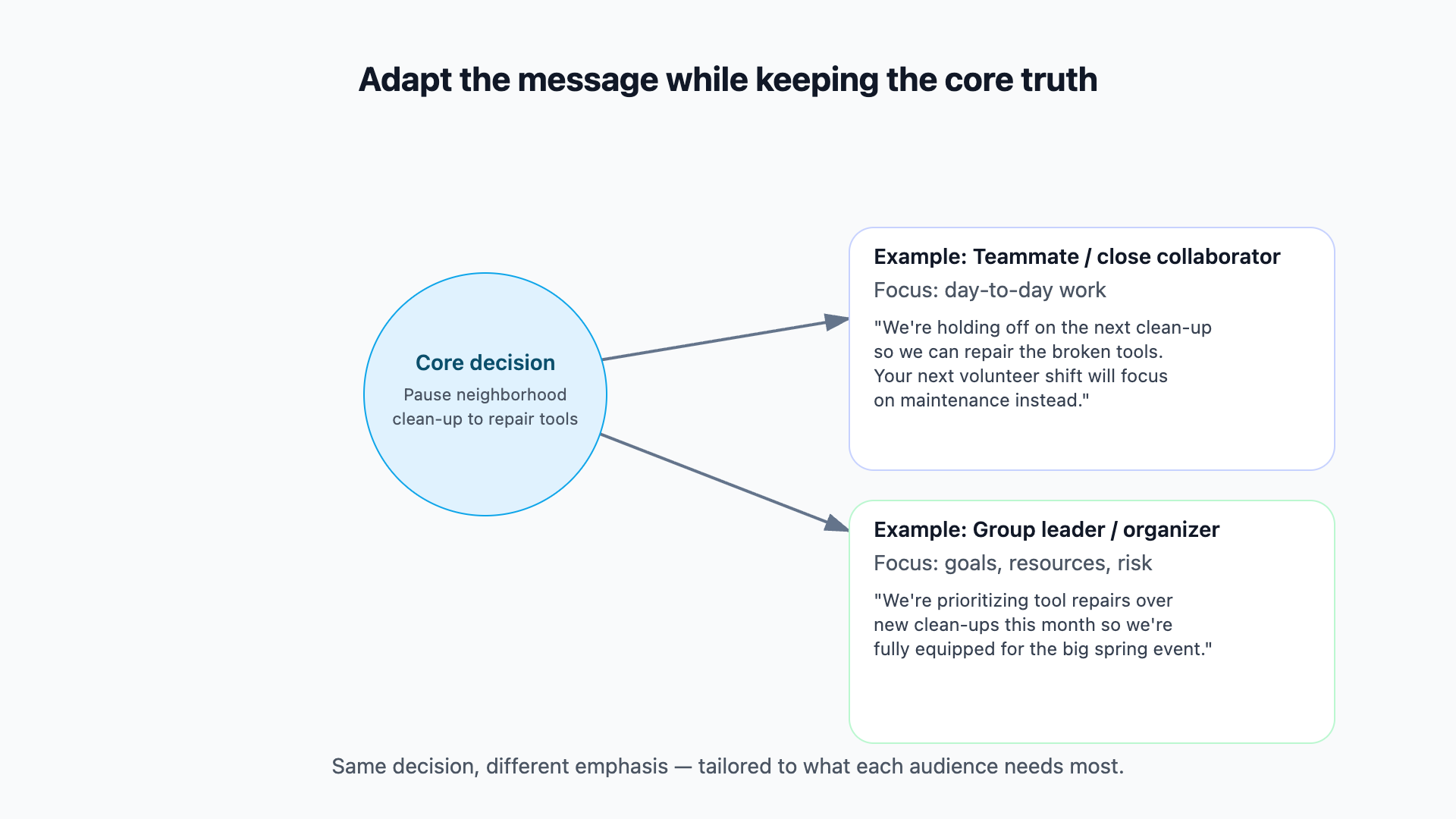
Not everyone needs the same explanation. A peer working alongside you wants different details than a group leader or organizer reviewing strategy, and effective communicators adapt their message without changing the core truth.
The key is to consider what each audience cares about most. A close collaborator likely wants to know how the decision affects their day-to-day involvement and what they need to do differently. A group leader or organizer, on the other hand, typically cares about alignment with broader goals, resource implications, and risk. When you explain the same decision to both groups, you'll naturally shift your emphasis accordingly.
Consider the practical example provided in the graphic:
Before any conversation about a decision, ask yourself: what does this person need to understand to feel informed and aligned? When you answer that question thoughtfully, your explanations become sharper, more persuasive, and far more likely to land well.
Connect Decisions Back to Group Needs
People support decisions that serve their interests. When you explicitly connect your choice to what the group or community cares about, you turn potential resistance into genuine buy-in. Begin by identifying what matters to each group affected by the decision. This might include efficiency, cost savings, personal growth, community satisfaction, or reduced workload. Once you've identified those priorities, make the connection explicit rather than hoping people will see the benefit on their own. You might say something like: "This new sign-up process will make it easier for everyone to join events, so you’ll spend less time on paperwork and more time actually volunteering."
Of course, sometimes a decision won’t benefit everyone equally, and honesty matters here more than how you can spin the decision to look good for them. If there’s a short-term inconvenience for a long-term gain, acknowledge it directly: "I know switching meeting days is inconvenient this month, but it means we can use the larger room for our annual potluck, which everyone’s been looking forward to." Recognizing trade-offs shows respect for people’s reality and builds your credibility in the process. When people see themselves reflected in your reasoning, they move from passive recipients to active supporters. That alignment is what transforms individual choices into shared commitments.
Now that you’ve explored how to explain the why behind your decisions, you’ll have a chance to put these skills into practice during an upcoming role-play session. You’ll work through explaining the same decision to different audiences, adjusting your approach based on what each person cares about most. This hands-on practice will help you make these techniques second nature.
