Leading Through Change
The Change and Resilience Playbook
Change is the test that separates the manager who has a system from the one who's improvising. Your team will read everything you do during a reorg, a strategy pivot, or a leadership transition through a different lens than they read your behavior in steady state. The same words that landed last quarter as confident now land as evasive; the same scope decision that felt energizing now feels like a setup. This unit gives you the diagnosis behind that shift, the way to communicate through it, and the levers that keep your team intact on the other side.
Why People Resist Change
Most resistance isn't about the change itself. It's about what the change threatens. The reliable diagnosis runs through four drivers: loss of status (standing, recognition, the seat at the table they earned), loss of certainty (about role, scope, who decides what), loss of autonomy (the decision rights they had on Tuesday that they're not sure they have on Wednesday), and loss of relatedness (the working relationships and trust networks that took years to build). Name which of those is firing for a given teammate and you've already moved from "they're being difficult" to a problem you can actually work.
What happens underneath is predictable. Focus drops because cognitive bandwidth gets eaten by ambient threat monitoring. Trust degrades, even in leaders who haven't done anything wrong, because every ambiguous signal now reads as a possible loss. Discretionary effort, the work nobody assigned but your strongest people used to do anyway, contracts first. People still show up; they just stop volunteering. Watching for that contraction is one of your most sensitive instruments during change.
The trap is to read this as a personality issue. The teammate who was bought in last month isn't suddenly a cynic; their threat response is engaged. Treat the resistance as information about which driver got hit, not a verdict on the person.
Communicating Change Without Triggering Threat
Once you know what's firing, the communication move is to reduce uncertainty where you can and name it cleanly where you can't. The mistake is the false reassurance. When you say "everything's going to be fine" about a reorg you don't fully understand yet, you don't lower threat, you raise it, because your most senior people know you can't possibly know that, and now they're recalculating how much else you say can be trusted.
The discipline is a three-part frame, run live as concerns surface. What's stable: the things you can credibly commit to (your team's mission, this quarter's roadmap, your own commitment to them). What's changing: the things that are confirmed, named directly, with as much detail as you actually have. What's unknown: the things you don't know yet, with a specific commitment to who you'll ask and when you'll come back. The unknown column is where most managers chicken out. Filling it with confident-sounding nothing is worse than saying "I don't know, I'll have an answer by Friday."
- Chris: So is our team actually staying intact through this, or are we getting absorbed?
- Nova: Honest answer: I don't know yet. The mission is staying. The reporting line above me is changing. Whether the team boundary holds, I'll know after my Thursday with the new VP.
- Chris: That's not the answer I wanted.
- Nova: I know. But I'd rather you trust the next thing I tell you than feel better right now.
- Chris: Fair. What can I actually decide this week?
- Nova: The architecture review process is yours to redesign. That's not changing, regardless of what comes back Thursday.
Notice the move at the end. Giving Chris a concrete lever of agency he can exercise this week is what actually reduces threat, not the reassurance he asked for.
Workload, Autonomy, and Recognition as Resilience Levers
The communication keeps people in the room. The Burnout Prevention Levers keep them functional once they're there. Three levers do most of the work, and you pull them deliberately rather than waiting for someone to flame out.
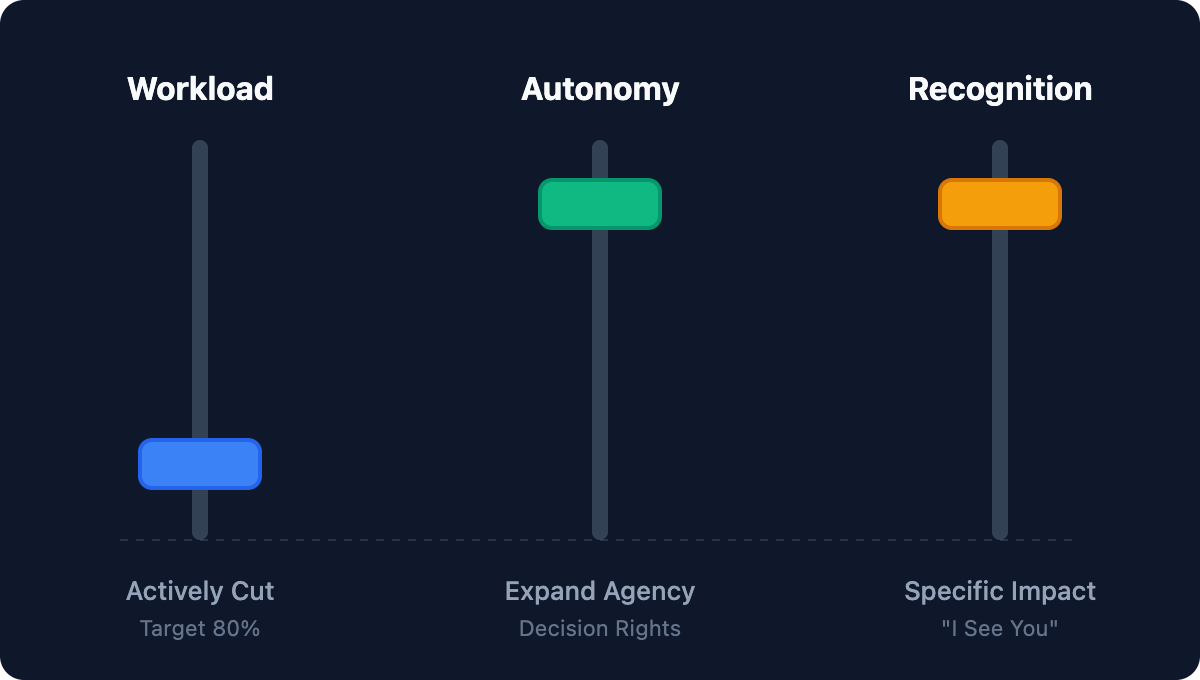
- Workload is the first lever and the one most managers under-use. During change, you have to actively cut, not just prioritize. Ask yourself what you would stop if the team were at 80% capacity, and then act as if it is, because under change conditions it effectively is.
- Autonomy is the counterweight to the loss of control the change created. Where can you deliberately expand decision rights to give people a sense of agency that the reorg took away? It doesn't have to be big. The architecture review process, the on-call rotation, the hiring loop format, all of these are real.
- Recognition is the third lever and the cheapest, but only if it's specific. Generic praise during change reads as managing morale; specific recognition tied to concrete impact reads as "I see you, even in the noise."
The diagnostic that ties this together is watching for early-warning signs in each individual: behavioral signals (shorter standup updates, fewer Slack messages in their usual channels, declined optional meetings), emotional signals (flatness, irritability, sudden over-politeness from someone normally direct), and output signals (the discretionary effort drop). Pair the lever to the person. The teammate signaling loss of status responds to recognition; the one signaling loss of autonomy responds to expanded decision rights; the one signaling load saturation responds to scope you take off their plate, not to a pep talk.
The single takeaway: resilience isn't a wellness program, it's a set of specific levers you pull on specific people in response to specific signals, run as a discipline through the entire arc of the change.
This is where it gets concrete. A quick pattern-spotting exercise on resistance drivers comes first, then a live 1:1 where you'll communicate a fresh reorg to an anxious teammate without overpromising, and finally a 90-day resilience plan tight enough that you could actually run it on a busy Tuesday without inventing it on the fly.
