Running Improvement Loops
Running Improvement Loops 🔁
You now have a decision log filled with time-to-decide data and satisfaction ratings, but evidence alone doesn’t create improvement. Today you will turn your logs into actionable insights with a repeatable weekly loop: ten minutes, one evidence-backed diagnosis, and one focused experiment.
By the end of this lesson, you’ll be able to:
- Facilitate a 10-minute Weekly Retro using log entries rather than memory
- Diagnose one recurring source of delay and defend it against rival explanations
- Design a one-week Improvement Sprint with one metric, a public commitment, and a scheduled review
⏪ Facilitate a 10-Minute Weekly Retro
The weekly retro turns your decision log into a repeatable improvement habit. Set a ten-minute timer and create three columns: What worked, What stalled, and What to tweak. These questions turn experience into experiment design. Spend roughly three minutes on each. You own the clock, so announce each column, work it, and move on when time expires — even if the analysis feels unfinished.
Work through each column in order:
- What worked: Look for decisions that moved efficiently or earned strong satisfaction ratings. Maybe external deadlines work better than self-imposed ones. Maybe morning decisions feel clearer than evening ones. Then double down on what already works for you.
- What stalled: Find decisions that took longer than expected or produced lower satisfaction ratings. Ask where the delay occurred: Did you postpone starting, wait for information, or reopen the decision?
- What to tweak: Pick one small change for next week — not a complete overhaul. Maybe set morning deadlines instead of evening ones. Maybe brief decisions to a friend before announcing them.
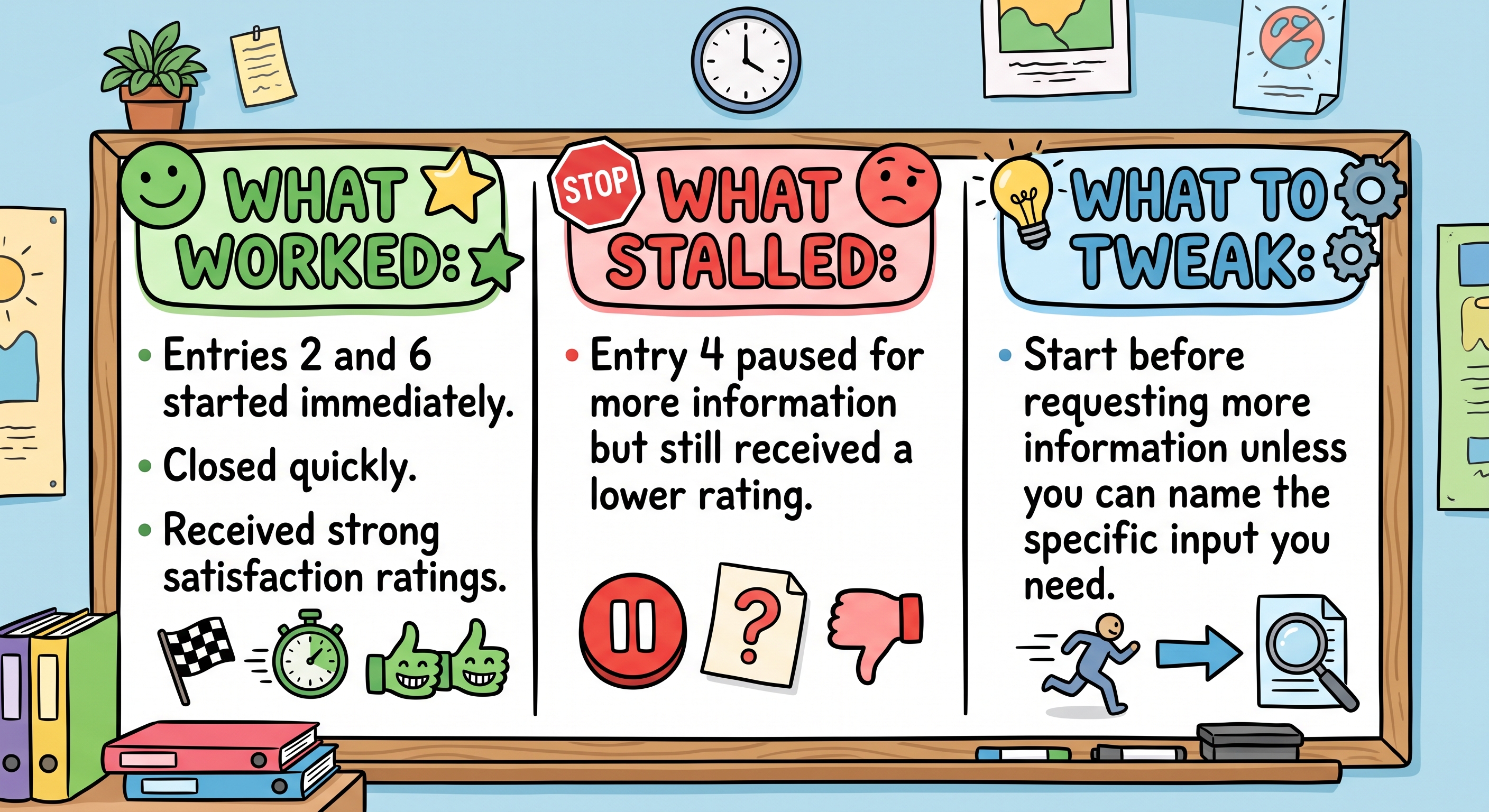
As you complete each column, cite the log, not your memory. "I felt slow this week" is an impression. "Entry 4 took 90 minutes and received a day-7 satisfaction rating of 5" is evidence. Specific entries reveal patterns and prevent you from overvaluing whichever decision you remember most clearly.
If your retro runs beyond ten minutes, record that as data. It usually means you stopped reviewing a closed decision and started re-deciding it. The goal is not to determine whether every choice was perfect. It is to find one pattern worth testing next week.
🔍 Diagnose One Recurring Source of Delay
The What stalled column is where the most useful analysis happens. "It was complicated," "I was busy," or "the stakes were high" may explain one decision. A recurring source of delay is a pattern that appears across several slow entries, regardless of topic.
Pull out this week’s decision logs and look for patterns in timing, satisfaction scores, and frameworks used. Ask yourself:
- Did shorter decision times coincide with lower satisfaction?
- Did certain types of decisions consistently take longer?
- Did one framework lead to faster or more satisfying outcomes?
- What recurring features distinguish the longest recorded start-to-end intervals from the shortest?
- For information you waited for, can you verify whether it changed your choice, ruled out an option, or confirmed a constraint?
Keep your diagnosis within the evidence your log captures. The recorded start and end times cannot reveal how long you delayed before starting. Likewise, an input’s absence from a one-sentence rationale does not prove it was unnecessary. If your log lacks the detail needed to test an explanation, treat it as a hypothesis and add a brief observation note during next week’s sprint.
Then stress-test your diagnosis against rival explanations, such as workload or stakes. Use specific log entries to show why your diagnosis fits the pattern better.
Emily notices that her longest recorded decision intervals often involved waiting for extra information. Marcus challenges her to test that diagnosis against other patterns in her log.
- Marcus: Your longest decisions happened during your busiest week. Could workload or higher stakes explain the delay instead?
- Emily: Not by themselves. Entry 8 happened that same week and closed in fourteen minutes with a day-7 rating of 8. Entry 5 was a low-stakes call about which caterer to book for a team lunch, yet its recorded start-to-end interval was a day and a half.
- Marcus: Does the log show that waiting for information caused the delay?
- Emily: Not on its own. I added observation notes to the next few entries. In two more slow decisions, I waited for information after starting, but the information neither changed my choice, ruled out an option, nor confirmed a constraint.
- Marcus: So what recurring source of delay fits the evidence better?
- Emily: Waiting for information that doesn’t affect the decision looks like a recurring source of delay within my recorded decision time. I’ll test a rule for requesting information next week.
Watch how Emily challenged both rival explanations with specific entries. Against workload, she cited entry eight: same busy week, closed in fourteen minutes, day-seven rating of eight. Against stakes, she cited entry five: a low-stakes caterer choice that still took a day and a half. Those comparisons weaken the rival explanations without ruling them out completely. Her additional observation notes then supported the information-waiting diagnosis. That's the difference between a complaint and a testable diagnosis. "I overthink" is too broad to test. "I spend recorded decision time waiting for information that doesn’t affect the choice, eliminate an option, or confirm a constraint" points directly at next week's experiment.
Design a One-Week Improvement Sprint 🧪
Your weekly retros reveal patterns in your decision-making. But noticing a problem isn’t enough — you need focused action to improve it. An Improvement Sprint turns one diagnosis into a seven-day test with five parts: one metric, one experiment, a public commitment, a scheduled review, and a next hypothesis.
Start by choosing one metric. Don’t aim to "make better decisions." Set a focused target, such as "cut my average recorded time-to-decide by 25%." Choose a metric your existing log supports: time-to-decide, day-1 score, day-7 score, or the drift between those scores. Use your log to establish a baseline, then choose the metric where a small improvement would have the greatest impact. Deadline adherence and the share of decisions closed with a capsule would require additional tracking fields; they cannot be calculated from the existing seven-field log.
Next, create a rule you can follow without judgment. "Try to start sooner" is too vague. Instead, think like a scientist and define a testable hypothesis:
Hypothesis: If, before requesting more information, I name the choice it could change, the option it could rule out, or the constraint it could confirm — and skip the request if I cannot name one — I’ll reduce my recorded time-to-decide.
Success measure: Across this week’s logged decisions, my average recorded time-to-decide will be at least 25% below last week’s baseline.
Then make a public commitment. Tell someone your sprint goal and ask them to check in with you midweek. A witness creates accountability, while a firm review date ensures the experiment gets evaluated. Ask yourself: Who can I trust to hold me accountable this week?
Schedule your sprint review before you begin. Friday afternoon often works well because you can assess the results while planning your next experiment. Without a scheduled review, experiments can fade into forgotten good intentions.
Finally, decide in advance what you’ll do if the metric stays flat. The answer should be a new hypothesis — not "try harder." If reducing unnecessary information requests doesn’t improve your time-to-decide, your next hypothesis might be that unclear briefs are causing the delay. A flat result is still useful because it tells you your diagnosis may be wrong.
The loop remains simple: one diagnosis supported by log entries, one metric, and one week.
You now have a repeatable improvement loop: review your log in a 10-minute Weekly Retro, diagnose one recurring source of delay using specific entries, and test one measurable change through a seven-day Improvement Sprint.
Step back and the four moves of this course connect into a single cycle: you commit by closing a decision, communicate it so others can act, measure what happened in your log, and improve by testing one change the following week. Each pass through that cycle makes the next decision cheaper to close and easier to defend. Next, you’ll practice applying the three retro columns to real evidence, narrowing multiple tweaks to one, defending your diagnosis against rival explanations, and creating a sprint plan you can share publicly.
