Linking Work to Value
Linking Work to Value
Having developed the mental fortitude to sustain momentum through obstacles and setbacks, you now face a critical communication challenge: translating your carefully chosen priorities into language that resonates with stakeholders who care less about your productivity systems and more about business outcomes. The most perfectly executed work means nothing if stakeholders cannot see how it drives the metrics they care about. Throughout this lesson, you will transform from someone who simply does good work into someone who can articulate and defend why that work deserves resources, time, and organizational focus.
As a team member, you carry the responsibility of not just linking your own work to value, but also coaching your team to make these connections visible and compelling when necessary. You will learn methods covered in the HBR Guide to Getting the Right Work Done that translate abstract priorities into concrete value pathways and, most importantly, defend your stop-doing choices when well-meaning stakeholders try to add just one more thing to your plate.
Translating Focus Areas to Revenue, Cost, Risk, and Customer Outcomes
The disconnect between doing impactful work and getting credit for that impact often stems from speaking different languages than your stakeholders. While you think in terms of deliverables and project completion, executives think in terms of revenue growth, cost reduction, risk mitigation, and customer satisfaction. Bridging this gap requires deliberately translating every focus area into at least one of these four value dimensions, creating a clear line of sight from your daily work to organizational success metrics.
Consider how you might map each of your top priorities to its primary value driver. When leading a system integration project, resist describing it as modernizing our tech stack and instead frame it as reducing operational costs by $2M annually through automated workflows while decreasing customer issue resolution time from 48 to 24 hours. This translation is not about inflating importance but rather making existing value visible and measurable. The integration project already had this value potential; you are simply articulating it in terms stakeholders track and care about.
Let's observe how a manager coaches a team member through this translation process:
- Victoria: Jake, I saw your project update about the database migration. How are you framing this for the leadership review?
- Jake: I was going to explain how we are moving from the legacy Oracle system to PostgreSQL with better performance metrics.
- Victoria: That is technically accurate, but leadership will not connect with that. What problem does this migration actually solve?
- Jake: Well, it reduces our licensing costs significantly and speeds up report generation.
- Victoria: Good start! Can you quantify those benefits?
- Jake: The licensing alone saves about $300K annually. And report generation... hmm, it goes from 45 minutes to about 5 minutes.
- Victoria: Excellent. Now connect that speed improvement to business value. What happens when reports are faster?
- Jake: Our sales team can respond to customer inquiries during the call instead of promising to email later. Actually, they mentioned losing deals because competitors respond faster.
- Victoria: Perfect! So your migration is not about technology—it is saving $300K in costs while improving customer win rates by enabling real-time responses. That is the story leadership needs to hear.
- Jake: That completely changes how I think about presenting this. Instead of leading with technical details, I lead with business impact.
- Victoria: Exactly. Always translate your work through their lens, not yours.
Notice how Victoria guided Jake from a technical description that would have fallen flat with executives to a value-focused narrative that connects directly to cost savings and revenue protection. This coaching conversation demonstrates the shift from activity-based thinking to outcome-based communication.
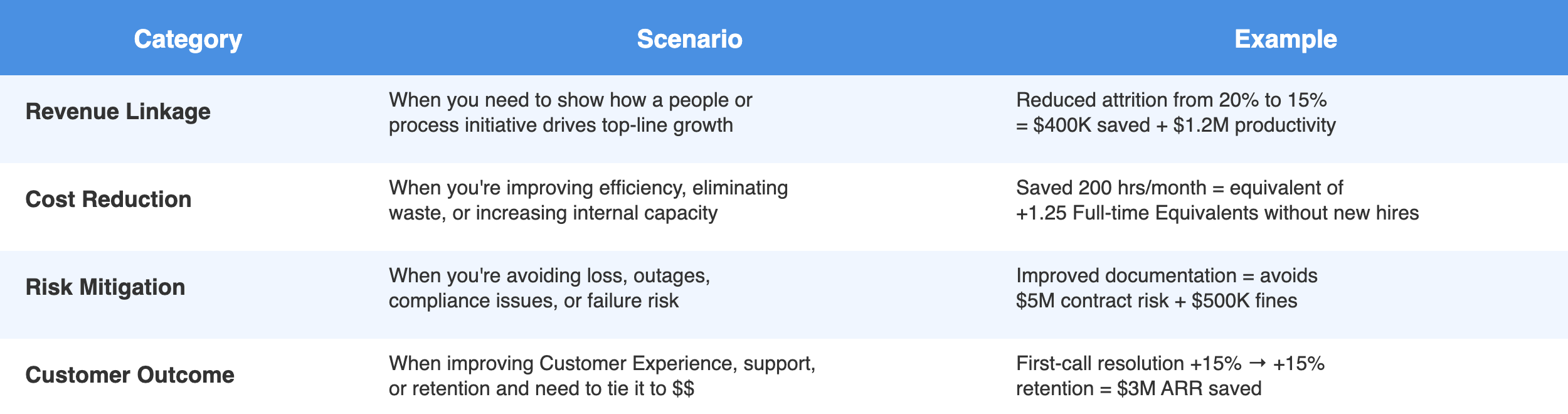
Revenue linkage often proves most compelling but requires thinking beyond direct sales impact.
Cost reduction extends beyond simple budget cuts to include efficiency gains and opportunity costs.
Risk mitigation value often gets overlooked because prevented problems do not create visible wins, yet this represents enormous value for organizations.
Customer outcome linkages require understanding both immediate satisfaction drivers and lifetime value impacts.
The chart below provides scenarios and examples of when you would employ these focus areas:
 Creating these value translations requires investigation and partnership with other functions. Schedule brief conversations with finance to understand how they calculate customer lifetime value, with sales to learn which features drive deal closure, and with customer success to identify retention drivers. A particularly effective approach involves asking: "If this project succeeds completely, what numbers would change on your dashboard?" This question helps stakeholders articulate value in their own terms, which you can then adopt in your communications.
Furthermore, remember that different stakeholders prioritize different value dimensions. While the CFO might care most about cost reduction, the Chief Customer Officer focuses on satisfaction scores, and the Chief Risk Officer worries about compliance. Prepare multiple value translations for the same priority, deploying the most relevant framing for each audience. Your system integration project might be a cost play for finance, a customer experience win for marketing, and a risk reduction initiative for legal—all simultaneously true and strategically communicated based on your audience.
Defending Trade-offs and Stop-Doing Choices
The true test of your prioritization skills comes when stakeholders push back on your trade-offs, especially your decisions about what to stop doing. Every strategic choice to focus on high-value work requires equally strategic choices about what to abandon, defer, or deliberately deliver at a lower quality level. Your ability to defend these stop-doing choices determines whether your carefully designed focus survives contact with organizational reality.
Defending trade-offs begins with proactive transparency about what you are not doing and why. Rather than hoping nobody notices dropped activities, explicitly communicate your stop-doing list with clear rationale. For example, to deliver a high-priority project faster, you might stop or automate lower-value activities and clearly state the time or resources this frees up. This transparency transforms potential surprises into strategic discussions about organizational priorities.
The key to successful trade-off defense is to frame stop-doing choices as investments in higher-value outcomes, not as abandonments. When challenged, explain the opportunity cost: every hour or resource spent on a lower-priority activity is one not spent on a higher-impact initiative. Offer stakeholders a clear choice between continuing the lower-value work or accelerating the more valuable outcome, making the trade-off explicit.
Prepare for common pushback by redirecting the conversation toward value-based decision-making. If someone says a request will "only take an hour," point out the cumulative impact of many such requests and explain your process for batching or deferring them. If urgency is raised, clarify that accommodating the new request will require delaying or deprioritizing another commitment, and ask which should be adjusted.
When discontinuing activities with vocal supporters but limited value, consider a gradual approach: reduce frequency, shift to written updates, or move to exception-only reporting. This phased reduction often meets less resistance and frees up time for higher-value work.
Document your trade-off decisions in a simple decision log, noting the date, decision, rationale, stakeholder agreement, and review date. This record helps prevent repeated debates and provides clarity when questions arise in the future.
As you prepare to practice these concepts through roleplay exercises, you will have opportunities to present focus memos that clearly link work to value, respond to stakeholder challenges about your trade-offs, and defend your stop-doing choices without damaging relationships. These simulated conversations will build your confidence to have these crucial discussions in real organizational settings where the stakes and emotions run high.
