Defining the "Right" Work
Welcome to the Course
Welcome to "Choosing the Right Work". based on key information from the HBR Guide to Getting the Right Work Done, this course will help guide you in making strategic decisions about where to invest your time and energy in the workplace. In today's workplace, you're bombarded with endless requests, urgent emails, and competing priorities that pull you in every direction. The harsh truth is that you simply can't get it all done, and trying to do everything means nothing gets done well. This course will fundamentally transform how you approach your workload.
Throughout this course, you'll develop the judgment and language needed to identify high-leverage work that truly moves the needle for your team and organization. More importantly, you'll learn practical frameworks for declining or deferring less critical work without damaging relationships. You'll also master the art of creating concrete, if-then plans that turn good intentions into consistent execution. These aren't just theories – they're battle-tested approaches that successful managers use every day.
Defining the Right Work and Distinguishing from "Noise"
Not all work is created equal, and understanding this distinction is crucial for your success. High-leverage "right work" is the work that creates disproportionate value – it's the 20% of activities that drive 80% of your results. Think of it as the difference between responding to countless emails about a process problem versus fixing the root cause of that process problem. The first keeps you busy; the second makes you effective.
High-leverage work reveals itself through three distinctive characteristics that set it apart from routine tasks. First and foremost, it affects multiple people or systems rather than solving isolated, one-off issues. When you're coaching a team member on delegation skills, for instance, you're not just helping them with today's task – you're building capability that compounds over months and even years. Second, high-leverage work creates lasting change rather than temporary fixes. Building a team norm around how urgent requests are hanfled eliminates hundreds of future interruptions, freeing everyone to focus on what matters. Third, and perhaps most importantly, it aligns directly with your team's core objectives and your organization's strategic priorities, ensuring your efforts ladder up to meaningful outcomes.
In contrast, the noise that clutters your day feels urgent but lacks real importance. It manifests as the endless stream of "Can you quickly review this?" requests that multiply like rabbits, consuming hours with minimal value creation. It includes those meetings where you're informed but not needed for decisions, where your presence adds little beyond warming a seat. Furthermore, it encompasses the fire drills that wouldn't exist if proper planning had occurred. Distinguishing between high-leverage work and noise requires you to constantly ask yourself three critical questions:
- Will this matter in three months?
- Does this require my unique skills and position?
- What happens if I don't do this?
The answers to these questions often reveal an uncomfortable truth – much of what feels urgent is actually just loud, demanding attention without deserving it.
Let's look at how this distinction plays out in a real conversation between two managers:
- Jessica: Hey Chris, I need you to personally review all these vendor contracts by tomorrow. It's super urgent.
- Chris: I understand it feels urgent. Can you help me understand what specifically requires my review versus our procurement team's standard process?
- Jessica: Well, leadership wants to make sure everything's perfect. You know how detail-oriented you are.
- Chris: I appreciate that, but here's my concern – I'm currently redesigning our vendor onboarding process that will save us three weeks per vendor going forward. That affects all 50 vendors we onboard annually.
- Jessica: But these contracts need to be done tomorrow!
- Chris: What if we do this instead? I'll spend 30 minutes with Jake from procurement to highlight the key risk areas to watch for. He can do the detailed review, and I'll do a final spot-check on the high-risk sections only. That way, the contracts get done, but I can still finish the process redesign that will prevent these fire drills in the future.
- Jessica: I hadn't thought about it that way. You're right – fixing the process would actually prevent this panic next quarter.
Notice how Chris distinguished between the urgent noise (personally reviewing every contract) and the high-leverage work (redesigning the process). By asking clarifying questions and proposing an alternative that addresses the immediate need while protecting the important work, Chris maintains both relationships and priorities.
Map Priorities to Value
Once you've identified potential high-leverage work, the next crucial step is mapping it to concrete value drivers that your organization actually cares about. This isn't about creating elaborate business cases or lengthy justification documents, it's about developing a clear mental model of how your focus areas connect to measurable outcomes. Every organization, regardless of industry or size, typically focuses on five universal value drivers: revenue generation, cost reduction, risk mitigation, customer satisfaction, and mission advancement. Understanding how your work connects to these drivers transforms vague priorities into defensible decisions.
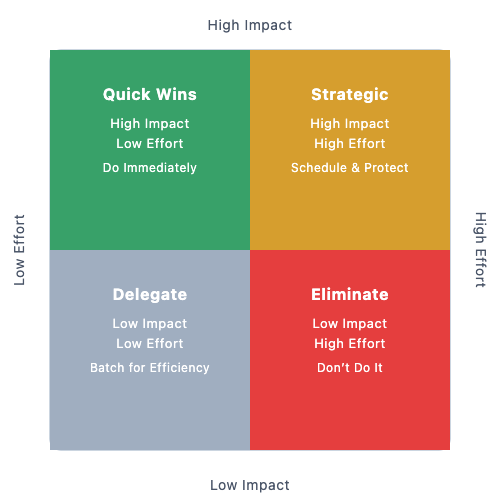
The key to effective value mapping lies in being ruthlessly honest about these connections. If you're struggling to map an activity to value, it might be work you enjoy or work you're comfortable with, but not necessarily the right work for this moment. A helpful framework for this evaluation involves rating each potential priority on a simple but powerful scale, as shown in the diagram below:
Plan in "To-Go" Terms with Explicit Stop-Doing Items
Traditional to-do lists tell you what to start, but they rarely tell you what to stop or when you're actually done, leaving you in a perpetual state of partial completion. Planning in "to-go" terms fundamentally flips this model to focus on outcomes rather than activities. Instead of writing "Work on performance reviews," you define "Complete draft reviews for 3 team members by Friday 5pm, with specific examples for each rating." This subtle shift forces you to define what "done" looks like and when you'll reassess progress, creating clarity that traditional task lists never provide.
However, here's the crucial element that most productivity systems completely miss – for every new priority you add to your plate, you must explicitly name what you're stopping or deferring. This isn't optional; it's physics. You have finite hours in your day, and pretending otherwise leads directly to burnout and broken commitments that damage your credibility. Your stop-doing list becomes as important as your to-do list.
Creating if-then rules transforms these prioritization decisions from emotional struggles into automatic responses. For instance, you might establish: "If someone requests a 'quick review,' then I'll point them to my office hours on Thursday afternoons." Another powerful rule might be: "If a meeting invite doesn't include an agenda and my specific role, then I'll decline and ask for a summary instead." These rules become your operating system, removing the emotional labor of deciding each time while maintaining consistency. When you communicate these boundaries clearly to your team and stakeholders, you gain respect for your clarity and intentionality. People appreciate knowing where they stand and how to work with you effectively.
In the upcoming roleplay and writing exercises, you'll practice these concepts in realistic scenarios that mirror the challenges you face daily. You'll learn to protect your focus while maintaining strong stakeholder relationships, turning these frameworks into practical skills. Get ready to transform how you choose and commit to the work that truly matters, leaving behind the overwhelming feeling of never quite catching up.
